
 Afrika
 Azia
Azia Evropa
 Amerika e Jugut
 Australia dhe Oqeania
 Antarktida
 Oqeani Paqësor
 Oqeani Atlantik
 Oqeani Indian
 Oqeani Arktik
 Deti Mesdhe
 Deti i Kuq
 Deti i Karaibeve
 Deti Koral
 Deti i Kinës Jugore
 Deti i Filipineve
 Deti Andaman
 Deti i Veriut
 Deti i Timorit dhe Deti Arafura
 Gjiri i Bengalit
 Gjiri i Kalifornisë
Katipo
 Kafshimet
The katipō is a cobweb spider found only in New Zealand, where it lives in coastal sand dunes. It is closely related to the Australian redback spider. Its bite is venomous to people, but bites are rare.1
 Si ta njohësh
- Adult females have a body length of 8–10 mm (about 0.3–0.4 in).1
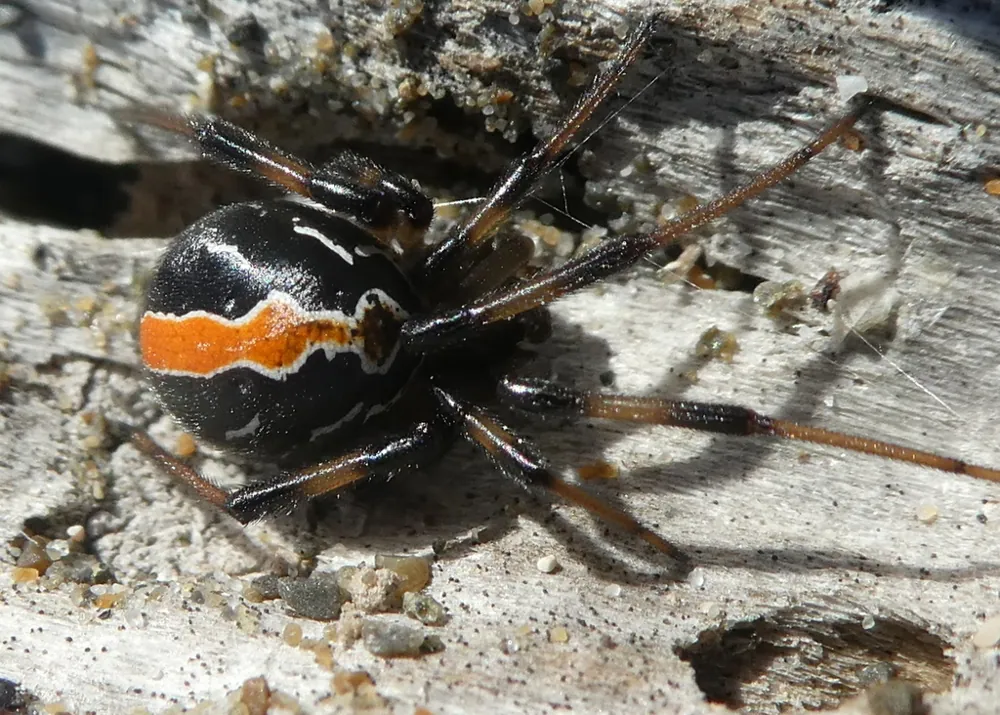
- The red katipō, found in the South Island and lower North Island, has a large black, shiny abdomen with a white-bordered orange or red stripe on top, and a red hourglass-shaped marking underneath.1
- The black katipō, found in the upper North Island, has no upper red or orange stripe and is somewhat lighter in colour.1
- Males are 4–5 mm long, white with black stripes and red hourglass-shaped markings.1
Shpesh ngatërrohet me: Steatoda species, which share the same habitat, are very similar and are called "false katipō" in New Zealand. The katipō has a less shiny, more tapered abdomen, and its side eyes are further apart. It is also similar to the redback, but the katipō has only short hair-like spines on its abdomen, while the redback has a mix of long and short ones.1
Fuqia e helmit
Helmi del përmes dhëmbëve helmues ose dhëmbëve kur kafshon.
Çfarë bën helmi i saj?
The bite can cause latrodectism, a toxic syndrome that affects the nerves and body. Symptoms include extreme pain and, potentially, high blood pressure (hypertension) or seizures.1
Sa e rrezikshme është për njerëzit?
Rreziku për njerëzit: SeriozNjë kafshim ka nevojë për mjek. Vdekjet janë shumë të rralla.Katipō are venomous to humans, but bites are described as rare. Serious symptoms are possible, including extreme pain, high blood pressure and seizures.1
 Lajm i mirë: mjekët kanë një ilaç (serum kundër helmit) ose një trajtim për këtë.1
 Nëse kafshon
- Laje kafshimin dhe vendos një qese akulli mbi të për dhimbjen. Kërko ndihmë mjekësore nëse dhimbja është e fortë, përhapet ose personi ndihet keq.
Gjithmonë telefono së pari numrin e emergjencës (112, 000, 911). Ky është udhëzim i përgjithshëm për ndihmën e parë, jo këshillë mjekësore. Bazat e ndihmës së parë
 Rri i sigurt
- Mos prek, mos kap dhe mos ngacmo kurrë një kafshë të egër, edhe të vogël, edhe nëse duket në gjumë ose e ngordhur.
- Lëri hapësirë. Nëse takon një të tillë, qëndro i qetë, tërhiqu ngadalë dhe lëre të shkojë në rrugën e vet.
- Nëse të kafshon një e tillë: qëndro i qetë, mos lëviz, telefono numrin e emergjencës (112, 000, 911) ose shko shpejt në spital. Mbaj mend si dukej, një foto ndihmon.
Nuk ka qëllim të të sulmojë. E përdor helmin për të kapur ushqim ose për t'u mbrojtur, dhe preferon shumë më tepër të fshihet. Më shumë për sigurinë
Sa i madh është?
Sa i gjatë është?
 aq i vogël sa mund të rrijë mbi thoin tënd
Sa i madh është Katipo krahasuar me TY?
Vetëm matematikë në shfletuesin tënd. Asgjë nuk ruhet dhe nuk dërgohet askund.
Sa i shpejtë është?


Fakte
In one 24-hour study of young spiders, 28% left the web by ballooning, carried by air currents.1
Katipō is one of the few Māori words that refers to a specific species of spider.1
The female does not usually eat the male after mating, unlike some other widow spiders.1
Females cover their egg sacs with silk and sand, which partly hides them in the web.1
The katipō is found only in New Zealand.1
Rrëzuesi i miteve
Miti: The katipō is just a form of the redback spider.
E vërteta: The katipō is genetically and physically distinct from the redback, even though the two are closely related. It was once thought to be a subspecies of the redback.1
Për ekspertët e helmeve
- Emri shkencor
- Latrodectus katipo
- Grupi
- Merimangat
- Familja
- Theridiidae2
- Renditja
- Araneae
- Kontinentet
- Australia dhe Oqeania
- Foshnjat
- The female lays five or six egg sacs in November or December, with about 70 to 90 eggs in each. The young hatch after 20–25 days and leave the egg sac in January and February.1
- Si po ia del në natyrë
- In serious decline (New Zealand Threat Classification System)1
- Rreziku për njerëzit
- 3 / 5: Serioz3
Nga vijnë faktet
- Katipō (Wikipedia (CC BY-SA 4.0))
- Latrodectus katipo (iNaturalist): emrat dhe klasifikimi.
- Venom Wiki: niveli i rrezikut, madhësia tipike dhe shpejtësia e hamendësuar janë tonat. Shiko si i llogarisim: Si e vlerësojmë rrezikun.
Çdo fakt në këtë faqe ka një numër që të çon te burimi i tij. Nëse kemi gabuar diçka, na fal, ne jemi adhurues kafshësh, jo revistë shkencore. Na shkruaj në [email protected] dhe do ta rregullojmë.
 Akrepi është i uritur! Venom Wiki është projekt i një njeriu të vetëm: falas, pa reklama dhe pa gjurmues. Një bakshish i vogël ndihmon ta mbajë online.Ushqe akrepin
Më shumë nga i njëjti grup: Merimangat
 Redback spider
 White-tailed spider
 Peacock spider
 Badge huntsman spider
 Black house spider
 Eastern white-tailed spider
Jeton edhe në: Australia dhe Oqeania
 Coastal taipanGjarpërinjtë e AustralisëVdekjeprurës
 Common death adderGjarpërinjtë e AustralisëVdekjeprurës
 Eastern brown snakeGjarpërinjtë e AustralisëVdekjeprurës
 Inland taipanGjarpërinjtë e AustralisëVdekjeprurës
 Sydney funnel-web spiderTarantulat dhe merimangat me rrjetë hinkëVdekjeprurës
 Tiger snakeGjarpërinjtë e AustralisëVdekjeprurës