
 Afrika
 Azia
Azia Evropa
 Amerika e Jugut
 Australia dhe Oqeania
 Antarktida
 Oqeani Paqësor
 Oqeani Atlantik
 Oqeani Indian
 Oqeani Arktik
 Deti Mesdhe
 Deti i Kuq
 Deti i Karaibeve
 Deti Koral
 Deti i Kinës Jugore
 Deti i Filipineve
 Deti Andaman
 Deti i Veriut
 Deti i Timorit dhe Deti Arafura
 Gjiri i Bengalit
 Gjiri i Kalifornisë
Mediterranean box jellyfish
 Tentakula që thumbojnë
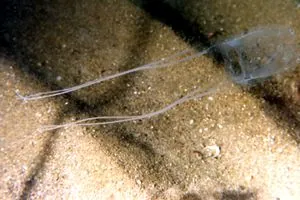
The Mediterranean box jellyfish is a small, see-through jellyfish with a box-shaped body about 3 cm across. It lives only in the Mediterranean Sea, where it is the only box jellyfish, and its sting can hurt people who swim in shallow water.1


 Si ta njohësh
- Transparent, box-shaped bell about 3 cm across1
- Four long tentacles at the lower corners of the bell, up to 30 cm long1
- Red banding on the tentacles1
- Small white or yellowish warts on the bell that carry stinging cells1
- Often found in small groups1
Shpesh ngatërrohet me: Other box jellyfish of the genus Carybdea look similar, but they live in warm oceans elsewhere. The red banding on the tentacles is the feature that separates this species from them.1
Fuqia e helmit
Mijëra qeliza të vogla thumbuese shkrepin kur diçka i prek.
Çfarë bën helmi i saj?
Its sting is venomous to humans, but some swimmers feel no painful sensation at all. In severe cases the symptoms spread through the body, with pain at the sting site and elsewhere, paresthesia (abnormal prickling or tingling sensations), hyperesthesia (over-sensitive skin) and skin lesions. These symptoms can take a few months to fully disappear.1
Sa e rrezikshme është për njerëzit?
Rreziku për njerëzit: E dhimbshmeMund të dhembë shumë, por pothuajse kurrë nuk është serioze.It is far less dangerous than some box jellyfish species from other parts of the world. It is still considered the second-most significant stinging jellyfish in the Mediterranean, after Pelagia noctiluca.1
 Nëse thumbon
- Dil nga uji dhe hiq çdo tentakul (me doreza ose me një leckë).
- Për kandilët e detit kuti tropikalë: hidh uthull mbi thumbimet për të paktën 30 sekonda, thirr ndihmë dhe ji gati të bësh RKP (ringjallje kardiopulmonare). Për flluskat blu dhe shumicën e të tjerëve: shpëlaje me ujë deti, pastaj me ujë të nxehtë për dhimbjen.
Gjithmonë telefono së pari numrin e emergjencës (112, 000, 911). Ky është udhëzim i përgjithshëm për ndihmën e parë, jo këshillë mjekësore. Bazat e ndihmës së parë
 Rri i sigurt
- Mos prek, mos kap dhe mos ngacmo kurrë një kafshë të egër, edhe të vogël, edhe nëse duket në gjumë ose e ngordhur.
- Lëri hapësirë. Nëse takon një të tillë, qëndro i qetë, tërhiqu ngadalë dhe lëre të shkojë në rrugën e vet.
- Nëse të thumbon një e tillë: qëndro i qetë, mos lëviz, telefono numrin e emergjencës (112, 000, 911) ose shko shpejt në spital. Mbaj mend si dukej, një foto ndihmon.
Nuk ka qëllim të të sulmojë. E përdor helmin për të kapur ushqim ose për t'u mbrojtur, dhe preferon shumë më tepër të fshihet. Më shumë për sigurinë
Ku në botë?
Sa i madh është?
Sa i gjatë është?
 rreth aq i gjatë sa një kapëse letrash
 mund të notonte gjatësinë e një pishine të madhe (50 m) për 36 sekonda
Sa i madh është Mediterranean box jellyfish krahasuar me TY?
Vetëm matematikë në shfletuesin tënd. Asgjë nuk ruhet dhe nuk dërgohet askund.
Sa i shpejtë është?
Fakte
It has comparatively sophisticated eyes with lenses, which help it detect and avoid obstacles such as posts or a ship's rudder.1
After a free-swimming larva forms, it develops into a polyp that can reproduce by budding, and it can regenerate missing parts within 72 hours.1
It swims by making rapid contractions of its bell, moving between 3 and 6 metres per minute.1
Its tentacles can grow up to 30 cm long, many times the width of its box-shaped bell.1
It is the only box jellyfish found in the Mediterranean Sea.1
Për ekspertët e helmeve
- Emri shkencor
- Carybdea marsupialis
- Grupi
- Kandilët e detit dhe thumbuesit e detit
- Familja
- Carybdeidae2
- Renditja
- Carybdeida
- Kontinentet
- Oqeani Atlantik, Deti Mesdhe, Oqeanet
- Foshnjat
- The sexes are separate, and eggs and sperm (gametes) are released into the open water to fuse; the young develop into a free-swimming larva and then a small polyp stage before becoming jellyfish.1
- Rreziku për njerëzit
- 2 / 5: E dhimbshme3
Nga vijnë faktet
- Carybdea marsupialis (Wikipedia (CC BY-SA 4.0))
- Carybdea marsupialis (iNaturalist): emrat dhe klasifikimi.
- Venom Wiki: niveli i rrezikut, madhësia tipike dhe shpejtësia e hamendësuar janë tonat. Shiko si i llogarisim: Si e vlerësojmë rrezikun.
Çdo fakt në këtë faqe ka një numër që të çon te burimi i tij. Nëse kemi gabuar diçka, na fal, ne jemi adhurues kafshësh, jo revistë shkencore. Na shkruaj në [email protected] dhe do ta rregullojmë.
 Akrepi është i uritur! Venom Wiki është projekt i një njeriu të vetëm: falas, pa reklama dhe pa gjurmues. Një bakshish i vogël ndihmon ta mbajë online.Ushqe akrepin
Më shumë nga i njëjti grup: Kandilët e detit dhe thumbuesit e detit
 Australian box jellyfishKandilët e detit dhe thumbuesit e detitVdekjeprurësMos e prek
 Irukandji jellyfishKandilët e detit dhe thumbuesit e detitMund të vrasëMos e prek
 Portuguese man o' warKandilët e detit dhe thumbuesit e detitKa nevojë për mjekMos e prek
 Lion's mane jellyfishKandilët e detit dhe thumbuesit e detitVetëm dhembMos e prek
 Moon jellyfishKandilët e detit dhe thumbuesit e detitI padëmshëm
 Common kingslayerKandilët e detit dhe thumbuesit e detitMund të vrasëMos e prek
Jeton edhe në: Oqeani Atlantik
 Hawksbill sea turtleKafshë të tjera toksikeMund të vrasë
 Blue sea dragonKërmijtë kon dhe oktapodëtVetëm dhemb
 Greenland sharkKafshë të tjera toksikeVetëm dhemb
 Common octopusKërmijtë kon dhe oktapodëtI padëmshëm
 Common stingrayPeshq helmuesKa nevojë për mjek
 Greater weeverPeshq helmuesKa nevojë për mjekMos e prek