
 Afrika
 Asien
Asien Europa
 Sydamerika
 Australien och Oceanien
 Antarktis
 Stilla havet
 Atlanten
 Indiska oceanen
 Norra ishavet
 Medelhavet
 Röda havet
 Karibiska havet
 Korallhavet
 Sydkinesiska havet
 Filippinska havet
 Andamansjön
 Nordsjön
 Timorhavet och Arafurasjön
 Bengaliska viken
 Kaliforniska viken
Bat ray
 Stick
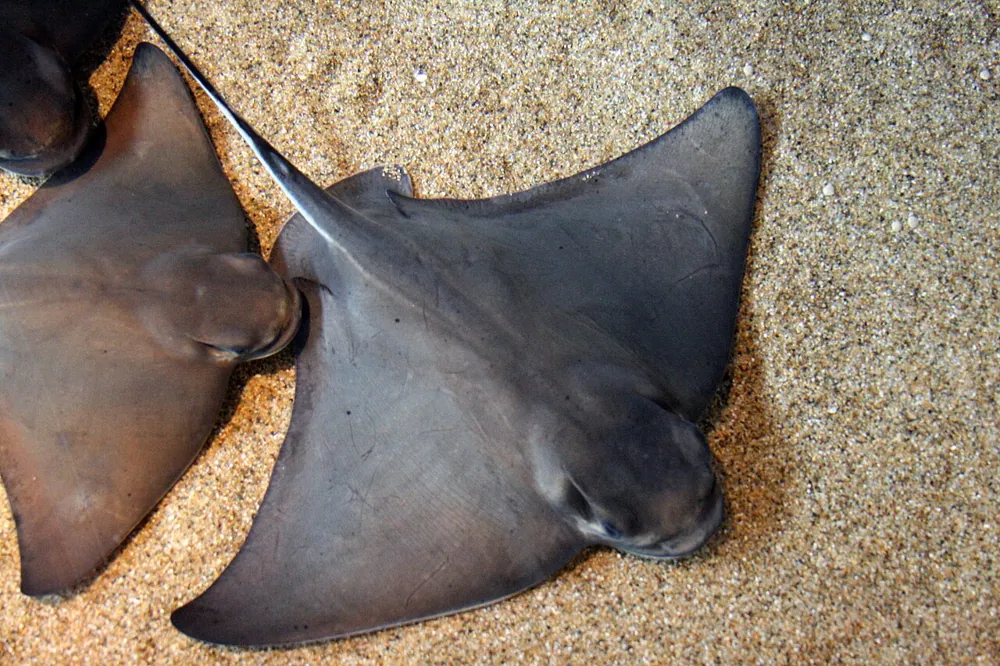
StickThe bat ray is a flat, diamond-shaped fish related to sharks, with wing-like fins that it flaps to swim. It lives in shallow coastal waters from central Oregon in the USA down to the Gulf of California in Mexico, and around the Galápagos Islands. It has a venomous spine near the base of its tail, but it uses it only when it feels threatened.1



 Så känner du igen den
- Diamond-shaped body, with wing-like pectoral fins that end in blunt points1
- Broad head raised higher than the fins, with eyes set on the sides of the head1
- Dark back, black or dark brown, with a white underside1
- Whip-like tail with at least one venomous spine at its base1
- Usually two small cephalic horns (projections from the front of the head) used for pushing food into the mouth1
Giftkraft
Giftet kommer ut genom en gadd.
Hur farlig är den för människor?
Fara för människor: SmärtsamDet kan göra riktigt ont, men det är nästan aldrig allvarligt.The bat ray is not considered dangerous to people. It uses its venomous tail spine only when it is attacked or frightened.1
Vad gör den när den är rädd?
The bat ray camouflages itself in the sand and uses its tail spine only when attacked or frightened.1
 Om den sticker
- Lägg såret i varmt vatten, så varmt som personen tål utan att bränna sig (känn efter med din egen hand), i 30 till 90 minuter. Sök vård, särskilt vid stenfisk och stingrocka.
Ring alltid ditt larmnummer först (112, 000, 911). Det här är allmänna råd om första hjälpen, inte medicinsk rådgivning. Första hjälpen, grunderna
 Håll dig säker
- Rör aldrig, fånga aldrig och reta aldrig ett vilt djur, inte ens ett litet, och inte ens om det ser ut att sova eller vara dött.
- Håll avstånd. Om du möter en, var lugn, backa långsamt och låt den gå sin väg.
- Om en sticker dig: var lugn, håll dig stilla, ring ditt larmnummer (112, 000, 911) eller ta dig snabbt till ett sjukhus. Kom ihåg hur den såg ut, ett foto hjälper.
Den är inte ute efter dig. Den använder sitt gift för att fånga mat eller skydda sig, och den gömmer sig mycket hellre. Mer om hur du håller dig säker
Var i världen?
Hur stor är den?
Hur lång är den?
Hur tung är den?

 lika lång som 4 huskatter från nos till svans
 lika lång som 10 bananer på rad
 skulle kunna simma längden av en stor simbassäng (50 m) på 8,2 sekunder
Hur stor är Bat ray jämfört med DIG?
Bara matematik i din webbläsare. Inget sparas eller skickas någonstans.
Hur snabb är den?

Fakta
Bat rays dig pits in the seabed that can be up to 4 m long, and small fish gather to eat the creatures the rays expose.1
The bat ray's young are born with the spine's sheath, which falls off within hours of birth.1
Bat rays can grow to a wingspan of 1.8 m, and the largest individuals weigh about 91 kg.1
Some bat rays live alone, while others form schools of thousands.1
Bat rays have teeth that are replaced continuously, as is the case with all elasmobranchs (sharks, rays and their relatives).1
Myt eller sanning
Myt: Bat rays are dangerous to people because of their venomous spine.
Sanning: Bat rays are not considered dangerous. They use the spine only when attacked or frightened, and people can avoid it by shuffling their feet when walking through shallow sand.1
För giftexperter
- Vetenskapligt namn
- Myliobatis californica
- Grupp
- Giftiga fiskar
- Familj
- Myliobatidae2
- Ordning
- Myliobatiformes
- Kontinenter
- Stilla havet, Kaliforniska viken, Haven
- Bebisar
- Bat rays are ovoviviparous, so the eggs hatch inside the mother and the young are born live. A litter has two to ten pups, which are born tail first with their fins wrapped around their bodies.1
- Livslängd
- ungefär 23 år1
- Hur det går för den i naturen
- Least Concern1
- Fara för människor
- 2 / 5: Smärtsam3
Var fakta kommer ifrån
- Bat ray (Wikipedia (CC BY-SA 4.0))
- Myliobatis californica (iNaturalist): namn och klassificering.
- Venom Wiki: farlighetsnivån, den typiska storleken och den gissade hastigheten är våra egna. Se hur vi räknar fram dem: Så bedömer vi faran.
Alla fakta på den här sidan har en siffra som visar var de kommer ifrån. Om vi har fått något fel, förlåt, vi är djurfans, inte en vetenskaplig tidskrift. Berätta för oss på [email protected] så rättar vi det.
 Skorpionen är hungrig! Venom Wiki är ett enmansprojekt: gratis, utan reklam och utan spårning. En liten dricks hjälper till att hålla den online.Mata skorpionen
Mer från samma grupp: Giftiga fiskar
 Reef stonefish
 Red lionfish
 Estuarine stonefish
 Short-tail stingray
 Striped eel catfish
 Bluespotted ribbontail ray
Lever också i: Stilla havet
 Australian box jellyfishManeter och andra brännande havsdjurDödligRör inte
 Geography coneKägelsnäckor och bläckfiskarDödlig
 Greater blue-ringed octopusKägelsnäckor och bläckfiskarDödlig
 Japanese pufferfishAndra passivt giftiga djurDödlig
 Southern blue-ringed octopusKägelsnäckor och bläckfiskarDödlig
 Hawksbill sea turtleAndra passivt giftiga djurKan döda