
 Aprika
 Asya
Asya Europa
 Timog Amerika
 Australia at Oceania
 Antarctica
 Karagatang Pasipiko
 Karagatang Atlantiko
 Karagatang Indiyano
 Karagatang Artiko
 Dagat Mediteraneo
 Dagat Pula
 Dagat Caribe
 Dagat Coral
 Dagat Timog Tsina
 Dagat Pilipinas
 Dagat Andaman
 Dagat Hilaga
 Dagat Timor at Arafura
 Look ng Bengal
 Golpo ng California
African crested rat
 May lason sa balat nitoKinakain: Mga halamanNakalalason, hindi makamandag
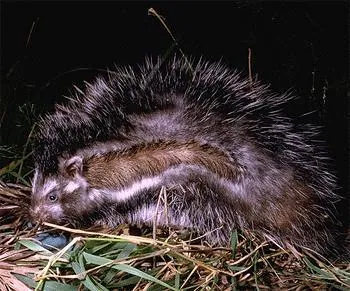
The African crested rat is a large, nocturnal rodent with long hair and a bushy tail. It looks a little like a porcupine. It lives in East Africa, where it is the world's only known poisonous rodent, coating itself in plant toxins to keep predators away.1



 Paano ito makikilala
- Large, nocturnal rodent with long, silver and black-tipped guard hairs over a woolly grey and white undercoat1
- A mane of longer black-and-white banded hairs runs from the top of the head to just beyond the base of the tail1
- A broad, white-bordered strip of glandular skin sits beside the mane, and it becomes visible when the animal is threatened1
- Bushy tail and short black fur on the face and limbs1
- Superficially resembles a porcupine1
Lakas ng lason
Nakalalason ang balat nito. Delikado itong hawakan, dilaan o kainin.
Ano ang epekto ng lason nito?
This animal is poisonous rather than venomous, so it does not bite or sting to inject poison. It smears poison from the bark of the poison arrow tree onto the hairs of its glandular skin patch. A predator that bites it can be sickened or even killed by this poison.1
Gaano ito kapanganib sa tao?
Panganib sa tao: MalalaKung may humawak o kumain nito, magpatingin sa doktor. Napakabihira ng namamatay.Its poison is a risk to predators that try to bite it. The rat itself is not harmed by the toxins it stores.1
Ano ang ginagawa nito kapag natatakot?
When threatened or excited, the mane stands up and the glandular strip parts, exposing the skin that carries the poison.1
 Kung may humawak o kumain nito
- Kung may kumain nito o may sintomas pagkatapos itong kainin: tawagan agad ang numero pang-emergency o ang poison control center.
Laging tawagan muna ang numero pang-emergency (112, 000, 911). Ito ay pangkalahatang gabay sa pangunang lunas, hindi payong medikal. Mga batayan ng pangunang lunas
 Mag-ingat
- Huwag kailanman hawakan, hulihin o asarin ang ligaw na hayop, kahit maliit, at kahit mukha itong tulog o patay.
- Bigyan ito ng espasyo. Kung makasalubong ka ng isa, manatiling kalmado, dahan-dahang umatras at hayaan itong umalis.
- Kung nahawakan o nakain mo ito: huwag kuskusin ang mata o bibig mo, hugasan ang mga kamay mo at kumuha ng tulong medikal.
Hindi ka nito hinahabol. Ang lason nito ay para lang walang kumain dito. Higit pa tungkol sa pag-iingat
Gaano ito kalaki?
Gaano ito kahaba?
Gaano ito kabigat?

 kasinghaba ng 10 laruang building brick na magkakasunod
 kayang tapusin ang 100 metro sa loob ng 72 segundo (9.6 ang kailangan ng pinakamabilis na tao)
Gaano kalaki si African crested rat kumpara sa IYO?
Math lang sa browser mo. Walang sine-save o ipinapadala kahit saan.
Gaano ito kabilis?


Mga fact
It is the world's only known poisonous rodent.1
It is the only rodent known to use and store toxins from a different species in nature to protect itself, and it suffers no known harm from them.1
Its stomach has five anatomically distinct sections, a feature found in very few rodents.1
The skull is covered with small bony projections that give it a pebbled look.1
Its large size may allow microbes in its foregut to break down cellulose from plants by fermentation.1
Myth buster
Mito: The maned rat was believed to be solitary.
Totoo: It is now known to be somewhat sociable. Several animals are found in the same territory, and they purr and groom one another, so they may form family groups of a male, a female and their young.1
Para sa mga eksperto sa kamandag
- Pangalang siyentipiko
- Lophiomys imhausi
- Grupo
- Iba pang nakalalasong hayop
- Pamilya
- Muridae2
- Ayos
- Rodentia
- Mga kontinente
- Aprika
- Mga sanggol
- Litters have 1 to 3 young. The young are slightly haired at birth, their eyes open by day 13, and they are weaned by day 40.1
- Kalagayan nito sa ligaw
- Least Concern1
- Panganib sa tao
- 3 / 5: Malala3
Saan galing ang mga fact
- Maned rat (Wikipedia (CC BY-SA 4.0))
- Lophiomys imhausi (iNaturalist): mga pangalan at klasipikasyon.
- Venom Wiki: sarili naming tantiya ang antas ng panganib, karaniwang laki at hula sa bilis. Tingnan kung paano namin ito kinukuwenta: Paano namin sinusukat ang panganib.
Bawat fact sa pahinang ito ay may numerong tumuturo sa pinagmulan nito. Kung may mali kami, pasensya na, mahilig lang kami sa hayop, hindi kami science journal. Sabihin sa amin sa [email protected] at aayusin namin.
 Gutom ang alakdan! Ang Venom Wiki ay proyekto ng iisang tao: libre, walang ads at walang trackers. Nakatutulong ang maliit na tip para manatili itong online.Pakainin ang alakdan
Higit pa mula sa parehong grupo: Iba pang nakalalasong hayop
 Common quailIba pang nakalalasong hayopMasakit lang
 Spur-winged gooseIba pang nakalalasong hayopMasakit lang
 Fahaka pufferfishIba pang nakalalasong hayopPuwedeng pumatay
 Red-striped oil beetleIba pang nakalalasong hayopMasakit langHuwag hawakan
 Butete ng HaponIba pang nakalalasong hayopNakamamatay
 Hawksbill sea turtleIba pang nakalalasong hayopPuwedeng pumatay
 Itim na mamba
 Alakdang deathstalker
 Kobrang Ehipsiyo
 Puff adder
 Boomslang
 Fat-tailed scorpion