
 Aprika
 Asya
Asya Europa
 Timog Amerika
 Australia at Oceania
 Antarctica
 Karagatang Pasipiko
 Karagatang Atlantiko
 Karagatang Indiyano
 Karagatang Artiko
 Dagat Mediteraneo
 Dagat Pula
 Dagat Caribe
 Dagat Coral
 Dagat Timog Tsina
 Dagat Pilipinas
 Dagat Andaman
 Dagat Hilaga
 Dagat Timor at Arafura
 Look ng Bengal
 Golpo ng California
False water cobra
 Mga kagat
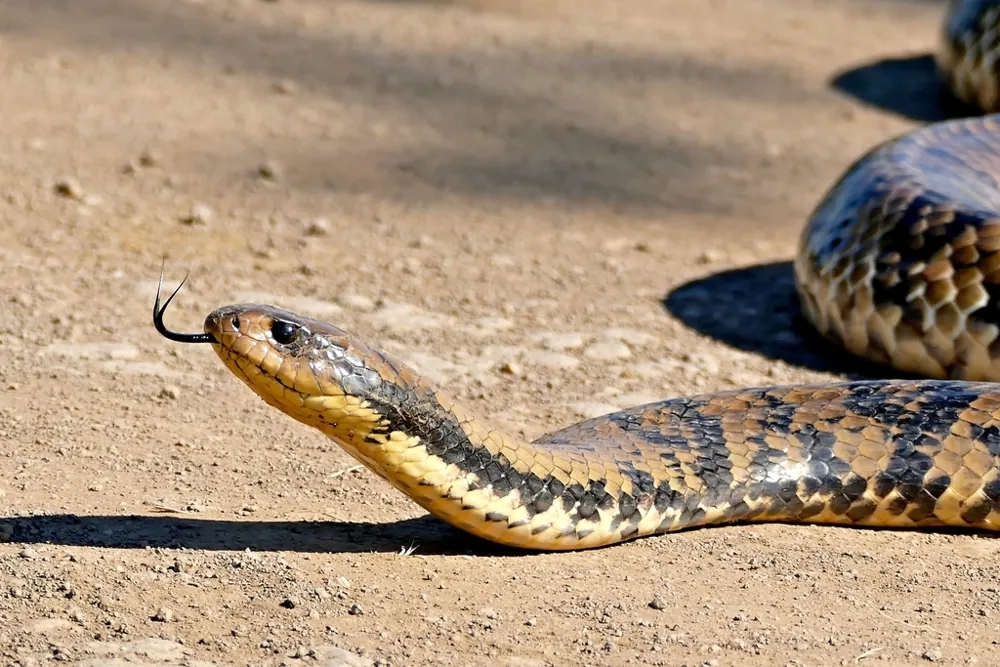
The false water cobra is a large snake that lives in South America. It is named after true cobras because it flattens its neck to look bigger when threatened, but it is not a true cobra. It is mildly venomous, and its bites rarely cause serious harm to people.1



 Paano ito makikilala
- Background colour is olive green or brown, with dark spots and bands over much of the body.1
- Bands and colour grow darker towards the tail.1
- Large eyes with round pupils. The tongue is black.1
- Belly is yellow or brown with dark flecks, which form three dotted lines. Males tend to be yellow underneath and females brown.1
- Hatchlings and juveniles are much darker and lack the dark eyes of adults.1
Madalas mapagkamalang: Its pattern and colouring look somewhat like those of true water cobras (Boulengerina). The easiest difference to see is the hood: when threatened, the false water cobra stays horizontal, while a true cobra rears up.1
Lakas ng kamandag
Lumalabas ang kamandag sa pangil o ngipin nito kapag nangangagat ito.
Ano ang epekto ng kamandag nito?
This snake has enlarged rear teeth that are not grooved, and they are linked to a gland that produces oral secretions with proteolytic activity, meaning they break down proteins. In the few serious cases, symptoms included severe swelling, bruising, numbness, itching and dizziness. Most bites cause only mild pain and minor swelling.1
Gaano ito kapanganib sa tao?
Panganib sa tao: MasakitTalagang masakit, pero halos hindi kailanman malala.Many bites have been recorded, but only four cases of significant reaction in humans are reported for this species. It is considered mildly venomous.1
Ano ang ginagawa nito kapag natatakot?
When threatened, it flattens its neck like a cobra, and can flatten lower parts of its body too, to look larger and more intimidating.1
 Kung kumagat ito
- Hugasan ang kagat, panatilihing kalmado ang tao at kumuha ng tulong medikal. May mga species (gaya ng boomslang) na puwedeng nakamamatay makalipas ang ilang oras.
Laging tawagan muna ang numero pang-emergency (112, 000, 911). Ito ay pangkalahatang gabay sa pangunang lunas, hindi payong medikal. Mga batayan ng pangunang lunas
 Mag-ingat
- Huwag kailanman hawakan, hulihin o asarin ang ligaw na hayop, kahit maliit, at kahit mukha itong tulog o patay.
- Bigyan ito ng espasyo. Kung makasalubong ka ng isa, manatiling kalmado, dahan-dahang umatras at hayaan itong umalis.
- Kung kagatin ka ng isa: manatiling kalmado, huwag gumalaw, tawagan ang numero pang-emergency (112, 000, 911) o pumunta agad sa ospital. Tandaan ang itsura nito, makakatulong ang litrato.
Hindi ka nito hinahabol. Ginagamit nito ang kamandag para manghuli ng pagkain o ipagtanggol ang sarili, at mas gusto pa nitong magtago. Higit pa tungkol sa pag-iingat
Gaano ito kalaki?
Gaano ito kahaba?
Gaano ito kabigat?
 kasinghaba ng 3 aso mula ilong hanggang buntot
 kasinghaba ng 17 saging na magkakadugtong
 halos kasimbigat ng pusang bahay
 kayang tapusin ang 100 metro sa loob ng 54 segundo (9.6 ang kailangan ng pinakamabilis na tao)
Gaano kalaki si False water cobra kumpara sa IYO?
Math lang sa browser mo. Walang sine-save o ipinapadala kahit saan.
Gaano ito kabilis?


Mga fact
Captive-bred individuals can become quite tame and trusting, and many show a high level of intelligence.1
Temperaments vary a lot: some individuals are docile, while others are defensive or even aggressive.1
Males are much smaller than females, a difference called sexual dimorphism.1
It is mainly active during the day, which gives it good daytime vision thanks to its large eyes.1
Myth buster
Mito: It is a true cobra.
Totoo: It is not a true cobra. It hoods in a similar way, but stays horizontal instead of rearing up.1
Saan galing ang mga fact
- Hydrodynastes gigas (Wikipedia (CC BY-SA 4.0))
- Hydrodynastes gigas (iNaturalist): mga pangalan at klasipikasyon.
- Venom Wiki: sarili naming tantiya ang antas ng panganib, karaniwang laki at hula sa bilis. Tingnan kung paano namin ito kinukuwenta: Paano namin sinusukat ang panganib.
Bawat fact sa pahinang ito ay may numerong tumuturo sa pinagmulan nito. Kung may mali kami, pasensya na, mahilig lang kami sa hayop, hindi kami science journal. Sabihin sa amin sa [email protected] at aayusin namin.
 Gutom ang alakdan! Ang Venom Wiki ay proyekto ng iisang tao: libre, walang ads at walang trackers. Nakatutulong ang maliit na tip para manatili itong online.Pakainin ang alakdan
Higit pa mula sa parehong grupo: Mga ahas na nasa likod ang pangil
 Baron's green racerMga ahas na nasa likod ang pangilMasakit lang
 Brown vine snakeMga ahas na nasa likod ang pangilHindi nakapipinsala
 Green vine snakeMga ahas na nasa likod ang pangilHindi nakapipinsala
 Lichtenstein's green racerMga ahas na nasa likod ang pangilKailangan ng doktor
 Peruvian slender snakeMga ahas na nasa likod ang pangilKailangan ng doktor
 Chilean green racerMga ahas na nasa likod ang pangilMasakit lang
Nakatira rin sa: Timog Amerika
 Gintong poison frogMga poison frog, palaka at newtNakamamatayHuwag hawakan
 TerciopeloMga pit viperNakamamatay
 Brazilian wandering spiderMga gagambaPuwedeng pumatay
 Eyelash viperMga pit viperPuwedeng pumatay
 Golden lanceheadMga pit viperPuwedeng pumatay
 South American bushmasterMga pit viperPuwedeng pumatay