
 Aprika
 Asya
Asya Europa
 Timog Amerika
 Australia at Oceania
 Antarctica
 Karagatang Pasipiko
 Karagatang Atlantiko
 Karagatang Indiyano
 Karagatang Artiko
 Dagat Mediteraneo
 Dagat Pula
 Dagat Caribe
 Dagat Coral
 Dagat Timog Tsina
 Dagat Pilipinas
 Dagat Andaman
 Dagat Hilaga
 Dagat Timor at Arafura
 Look ng Bengal
 Golpo ng California
Giant vinegaroon
 Nagsisirit o dumudura
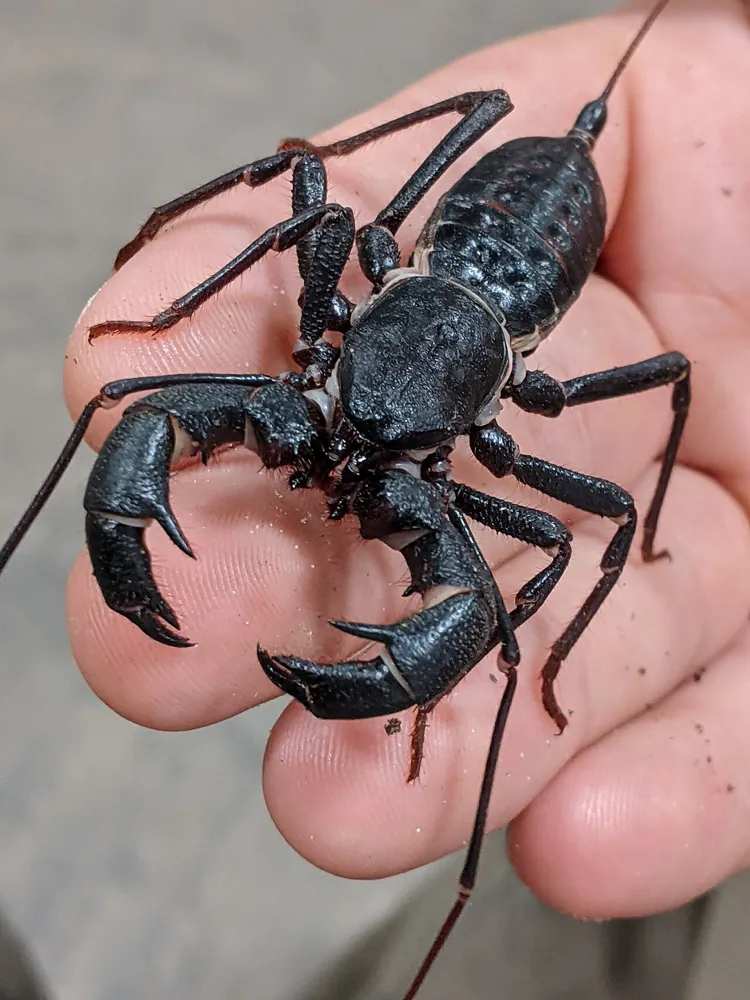
The giant vinegaroon is a large, harmless-to-people relative of the scorpion, known for the vinegar smell it gives off when threatened. It lives in the southern United States and Mexico, where it hunts insects and other small creatures at night. It is useful to people because it eats scorpions and other pests.1



 Paano ito makikilala
- Body length is 40 to 60 millimetres, not counting the tail.1
- Has a long, thin, whip-like tail at the back.1
- Has two long front legs that it uses to feel around and sense vibrations.1
- Has two large pedipalps (front limbs) modified into claws for crushing prey.1
- When sprayed, it smells strongly of vinegar.1
Lakas ng kamandag
Nagsisirit o dumudura ito ng mahapding likido sa mga umaatake.
Ano ang epekto ng kamandag nito?
It is not venomous. From the base of its tail it sprays a liquid made of 85% acetic acid, the main component of vinegar. If the spray gets into mucous membranes or cuts, it can sting, and it can irritate the eyes.1
Gaano ito kapanganib sa tao?
Panganib sa tao: BanayadParang kagat ng bubuyog o mas mahina. Halos hindi nakapipinsala sa tao.It seldom bites or pinches people. Its main risk is the acid spray, which can sting and cause eye irritation.1
Ano ang ginagawa nito kapag natatakot?
When threatened, it sprays acetic acid from the base of its tail.1
 Kung siritan ka nito
- Para sa nanunusok na balahibo ng higad: alisin ang mga ito gamit ang sticky tape, pagkatapos ay hugasan ang balat. Huwag kuskusin.
- Para sa kagat: hugasan at palamigin. Kumuha ng tulong medikal kung masama ang pakiramdam ng tao o madali siyang dumugo.
Laging tawagan muna ang numero pang-emergency (112, 000, 911). Ito ay pangkalahatang gabay sa pangunang lunas, hindi payong medikal. Mga batayan ng pangunang lunas
 Mag-ingat
- Huwag kailanman hawakan, hulihin o asarin ang ligaw na hayop, kahit maliit, at kahit mukha itong tulog o patay.
- Bigyan ito ng espasyo. Kung makasalubong ka ng isa, manatiling kalmado, dahan-dahang umatras at hayaan itong umalis.
- Kung siritan ka ng isa: manatiling kalmado, huwag gumalaw, tawagan ang numero pang-emergency (112, 000, 911) o pumunta agad sa ospital. Tandaan ang itsura nito, makakatulong ang litrato.
Hindi ka nito hinahabol. Ginagamit nito ang kamandag para manghuli ng pagkain o ipagtanggol ang sarili, at mas gusto pa nitong magtago. Higit pa tungkol sa pag-iingat
Gaano ito kalaki?
Gaano ito kahaba?
 kasinghaba ng 2 laruang building brick na magkakasunod
Gaano kalaki si Giant vinegaroon kumpara sa IYO?
Math lang sa browser mo. Walang sine-save o ipinapadala kahit saan.
Gaano ito kabilis?


Mga fact
Its common name 'vinegaroon' comes from the vinegar smell of the acid it sprays.1
It is an efficient predator of scorpions, and it is sometimes bought for that purpose.1
Males fight each other at night in fierce battles for the chance to mate with a female.1
It has eight eyes, but they are very weak, so it finds its way mostly by feeling with its front legs, tail and pedipalps.1
Raccoons, coatis, armadillos, skunks, bears, roadrunners, lizards and tarantulas may all eat it.1
It is sold in the exotic animal trade as a pet.1
Myth buster
Mito: Giant vinegaroons are dangerous and venomous to people.
Totoo: They are non-venomous and seldom bite or pinch people. The main risk is the acid spray, which can irritate the eyes or sting if it reaches cuts or mucous membranes.1
Para sa mga eksperto sa kamandag
- Pangalang siyentipiko
- Mastigoproctus giganteus
- Grupo
- Mga higad at insekto
- Pamilya
- Thelyphonidae2
- Ayos
- Uropygi
- Mga kontinente
- Hilagang Amerika
- Mga sanggol
- The female produces about 40 offspring, which she protects and feeds during their early lives. She reproduces only once.1
- Haba ng buhay
- mga 7 taon1
- Panganib sa tao
- 1 / 5: Banayad3
Saan galing ang mga fact
- Mastigoproctus giganteus (Wikipedia (CC BY-SA 4.0))
- Mastigoproctus giganteus (iNaturalist): mga pangalan at klasipikasyon.
- Venom Wiki: sarili naming tantiya ang antas ng panganib, karaniwang laki at hula sa bilis. Tingnan kung paano namin ito kinukuwenta: Paano namin sinusukat ang panganib.
Bawat fact sa pahinang ito ay may numerong tumuturo sa pinagmulan nito. Kung may mali kami, pasensya na, mahilig lang kami sa hayop, hindi kami science journal. Sabihin sa amin sa [email protected] at aayusin namin.
 Gutom ang alakdan! Ang Venom Wiki ay proyekto ng iisang tao: libre, walang ads at walang trackers. Nakatutulong ang maliit na tip para manatili itong online.Pakainin ang alakdan
Higit pa mula sa parehong grupo: Mga higad at insekto
 Giant water bugMga higad at insektoMasakit lang
 Puss caterpillarMga higad at insektoMasakit langHuwag hawakan
 Saddleback caterpillarMga higad at insektoMasakit langHuwag hawakan
 Wheel bugMga higad at insektoMasakit lang
 Rhodnius kissing bugMga higad at insektoKailangan ng doktor
 Black-waved flannel mothMga higad at insektoMasakit langHuwag hawakan
 Terciopelo
 Eastern coral snake
 Eastern diamondback rattlesnake
 Eyelash viper
 Timber rattlesnake
 Western diamondback rattlesnake
_face.jpg)