
 Aprika
 Asya
Asya Europa
 Timog Amerika
 Australia at Oceania
 Antarctica
 Karagatang Pasipiko
 Karagatang Atlantiko
 Karagatang Indiyano
 Karagatang Artiko
 Dagat Mediteraneo
 Dagat Pula
 Dagat Caribe
 Dagat Coral
 Dagat Timog Tsina
 Dagat Pilipinas
 Dagat Andaman
 Dagat Hilaga
 Dagat Timor at Arafura
 Look ng Bengal
 Golpo ng California
Golden tree snake
 Mga kagat
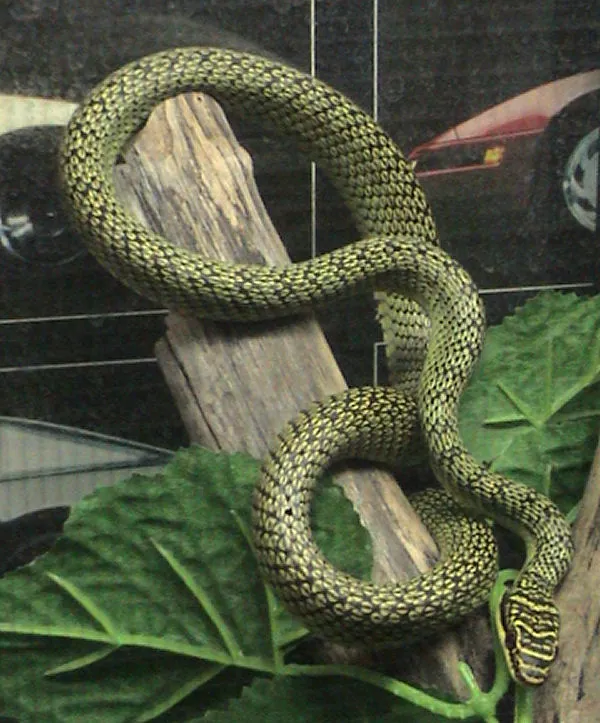
The golden tree snake is a slim, green snake with gold and black markings that lives in trees across South and Southeast Asia. It is famous for its ability to glide from tree to tree, which it does by launching itself into the air and steering with its body. It is mildly venomous, but it is not considered dangerous to people.1



 Paano ito makikilala
- Usually green, with black cross-hatching and yellow or gold accents1
- Slender body with a flattened head, a blunt nose and large eyes with round pupils1
- In Sri Lanka and southern India it is mainly greenish yellow or pale green, often with reddish or orange flower-shaped spots on its back1
- In Southeast Asia it lacks the reddish spots and has less prominent black crossbars1
- Nervous and fast-moving, it climbs trees and vertical rock faces in graceful curves1
Madalas mapagkamalang: The paradise flying snake (C. paradisi) is a close relative that also glides. Its gliding is more impressive than that of the golden tree snake, which is still able to move easily from tree to tree.1
Lakas ng kamandag
Lumalabas ang kamandag sa pangil o ngipin nito kapag nangangagat ito.
Ano ang epekto ng kamandag nito?
It is mildly venomous. Its two small fangs are at the back of the upper jaw, so it must chew to get venom into prey. The venom is meant to subdue fast-moving tree-living animals and is not considered dangerous to humans.1
Gaano ito kapanganib sa tao?
Panganib sa tao: BanayadParang kagat ng bubuyog o mas mahina. Halos hindi nakapipinsala sa tao.It is not considered dangerous to humans and is not of medical importance. It generally does not hesitate to bite if handled.1
Ano ang ginagawa nito kapag natatakot?
When disturbed it tries to flee, and it can glide away from predators such as birds or other reptiles.1
 Kung kumagat ito
- Hugasan ang kagat, panatilihing kalmado ang tao at kumuha ng tulong medikal. May mga species (gaya ng boomslang) na puwedeng nakamamatay makalipas ang ilang oras.
Laging tawagan muna ang numero pang-emergency (112, 000, 911). Ito ay pangkalahatang gabay sa pangunang lunas, hindi payong medikal. Mga batayan ng pangunang lunas
 Mag-ingat
- Huwag kailanman hawakan, hulihin o asarin ang ligaw na hayop, kahit maliit, at kahit mukha itong tulog o patay.
- Bigyan ito ng espasyo. Kung makasalubong ka ng isa, manatiling kalmado, dahan-dahang umatras at hayaan itong umalis.
- Kung kagatin ka ng isa: manatiling kalmado, huwag gumalaw, tawagan ang numero pang-emergency (112, 000, 911) o pumunta agad sa ospital. Tandaan ang itsura nito, makakatulong ang litrato.
Hindi ka nito hinahabol. Ginagamit nito ang kamandag para manghuli ng pagkain o ipagtanggol ang sarili, at mas gusto pa nitong magtago. Higit pa tungkol sa pag-iingat
Gaano ito kalaki?
Gaano ito kahaba?
 kasinghaba ng 2.5 pusang bahay mula ilong hanggang buntot
 kasinghaba ng 7 saging na magkakadugtong
 kayang tapusin ang 100 metro sa loob ng 64 segundo (9.6 ang kailangan ng pinakamabilis na tao)
Gaano kalaki si Golden tree snake kumpara sa IYO?
Math lang sa browser mo. Walang sine-save o ipinapadala kahit saan.
Gaano ito kabilis?


Mga fact
It can glide, or parachute, across distances of as much as 100 m from tree to tree.1
To glide, it curves its belly into a U-shape that acts like a parachute, then undulates through the air like it is swimming.1
It balances in the air by twisting its tail from side to side, with the tail held rigidly upwards.1
Its striking looks and gliding have made it a sought-after choice for captivity, though it often struggles in captivity.1
It is sometimes cooked for food.1
Myth buster
Mito: Many locals assume that all snakes are venomous and kill them on sight.
Totoo: The golden tree snake is only mildly venomous and is not considered dangerous to humans.1
Para sa mga eksperto sa kamandag
- Pangalang siyentipiko
- Chrysopelea ornata
- Grupo
- Mga ahas na nasa likod ang pangil
- Pamilya
- Colubridae2
- Ayos
- Squamata
- Mga kontinente
- Asya
- Mga sanggol
- It lays eggs. Six to 12 elongated eggs are laid, and hatchlings measure 114–152 mm long.1
- Kalagayan nito sa ligaw
- Not known to be endangered1
- Panganib sa tao
- 1 / 5: Banayad3
Saan galing ang mga fact
- Chrysopelea ornata (Wikipedia (CC BY-SA 4.0))
- Chrysopelea ornata (iNaturalist): mga pangalan at klasipikasyon.
- Venom Wiki: sarili naming tantiya ang antas ng panganib, karaniwang laki at hula sa bilis. Tingnan kung paano namin ito kinukuwenta: Paano namin sinusukat ang panganib.
Bawat fact sa pahinang ito ay may numerong tumuturo sa pinagmulan nito. Kung may mali kami, pasensya na, mahilig lang kami sa hayop, hindi kami science journal. Sabihin sa amin sa [email protected] at aayusin namin.
 Gutom ang alakdan! Ang Venom Wiki ay proyekto ng iisang tao: libre, walang ads at walang trackers. Nakatutulong ang maliit na tip para manatili itong online.Pakainin ang alakdan
Higit pa mula sa parehong grupo: Mga ahas na nasa likod ang pangil
 Brown tree snakeMga ahas na nasa likod ang pangilMasakit lang
 Tiger keelbackMga ahas na nasa likod ang pangilPuwedeng pumatay
 Red-necked keelbackMga ahas na nasa likod ang pangilKailangan ng doktor
 Green cat snakeMga ahas na nasa likod ang pangilMasakit lang
 Mangrove snakeMga ahas na nasa likod ang pangilMasakit lang
 Asian vine snakeMga ahas na nasa likod ang pangilHindi nakapipinsala
 Alakdang deathstalker
 Kobrang Indiyano
 Indian saw-scaled viper
 King cobra
 Puff adder
 Ulupong ni Russell