
 Aprika
 Asya
Asya Europa
 Timog Amerika
 Australia at Oceania
 Antarctica
 Karagatang Pasipiko
 Karagatang Atlantiko
 Karagatang Indiyano
 Karagatang Artiko
 Dagat Mediteraneo
 Dagat Pula
 Dagat Caribe
 Dagat Coral
 Dagat Timog Tsina
 Dagat Pilipinas
 Dagat Andaman
 Dagat Hilaga
 Dagat Timor at Arafura
 Look ng Bengal
 Golpo ng California
Lace monitor
 Mga kagat
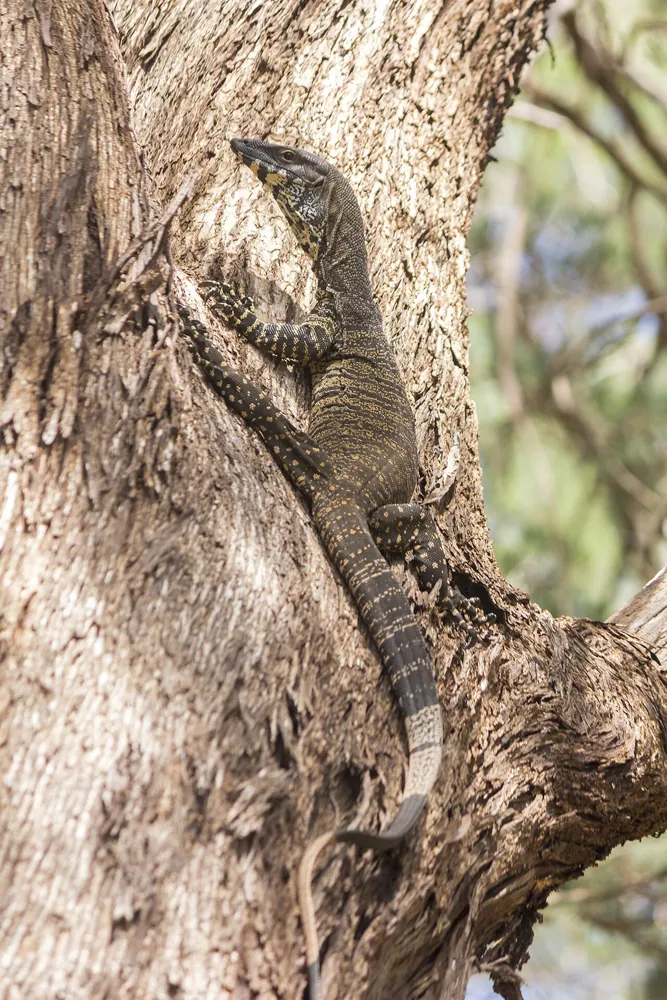
The lace monitor is a large lizard that lives in eastern Australia, and it can grow up to 2 metres long. It is a skilled climber that often lives in trees, and it is one of the country's biggest monitor lizards. It is also known as the tree goanna.1



 Paano ito makikilala
- The main form is dark grey to dull bluish-black with scattered cream-coloured spots.1
- The head is black, and the snout has prominent black and yellow bands that extend under the chin and neck.1
- The tail has narrow black and cream bands that get wider towards the tip.1
- Bell's form has a yellow-brown or yellow base colour with fine black mottling and broad black or dark brown bands from the shoulders to the tail.1
- Juveniles have more defined banding, with five narrow black bands on the neck and eight on the body.1
Lakas ng kamandag
Lumalabas ang kamandag sa pangil o ngipin nito kapag nangangagat ito.
Ano ang epekto ng kamandag nito?
Lace monitors have venom glands, and their venom is similar to snake venom, but it is not strong enough to cause serious harm. A bite on the hand can cause swelling within minutes, localised disruption of blood clotting (the blood clots less well in that area), and shooting pain up to the elbow. This pain can often last for several hours.1
Gaano ito kapanganib sa tao?
Panganib sa tao: MasakitTalagang masakit, pero halos hindi kailanman malala.Its venom is not enough to cause serious harm. Scientists have cautioned that calling these lizards venomous overestimates the medical risk to bite victims.1
Ano ang ginagawa nito kapag natatakot?
When disturbed, lace monitors retreat to a nearby tree.1
 Kung kumagat ito
- Hugasan ang sugat, panatilihing kalmado ang tao at kumuha ng tulong medikal.
Laging tawagan muna ang numero pang-emergency (112, 000, 911). Ito ay pangkalahatang gabay sa pangunang lunas, hindi payong medikal. Mga batayan ng pangunang lunas
 Mag-ingat
- Huwag kailanman hawakan, hulihin o asarin ang ligaw na hayop, kahit maliit, at kahit mukha itong tulog o patay.
- Bigyan ito ng espasyo. Kung makasalubong ka ng isa, manatiling kalmado, dahan-dahang umatras at hayaan itong umalis.
- Kung kagatin ka ng isa: manatiling kalmado, huwag gumalaw, tawagan ang numero pang-emergency (112, 000, 911) o pumunta agad sa ospital. Tandaan ang itsura nito, makakatulong ang litrato.
Hindi ka nito hinahabol. Ginagamit nito ang kamandag para manghuli ng pagkain o ipagtanggol ang sarili, at mas gusto pa nitong magtago. Higit pa tungkol sa pag-iingat
Gaano ito kalaki?
Gaano ito kahaba?
Gaano ito kabigat?
 kasinghaba ng 4 pusang bahay mula ilong hanggang buntot
 kasinghaba ng 11 saging na magkakadugtong
 kayang tapusin ang 100 metro sa loob ng 22 segundo (9.6 ang kailangan ng pinakamabilis na tao)
Gaano kalaki si Lace monitor kumpara sa IYO?
Math lang sa browser mo. Walang sine-save o ipinapadala kahit saan.
Gaano ito kabilis?

,_photographed_in_the_Kindra_State_Forest.jpg)
Mga fact
Populations near rubbish tips were thirty five times greater than in natural forest, and individuals were around twice as heavy.1
Lace monitors quickly learned to avoid cane toads after they had been poisoned by them.1
One lace monitor was recorded climbing a brick wall to find shelter during a thunderstorm.1
Its closest living relative is the Komodo dragon.1
Myth buster
Mito: Bites from monitors were thought to be dangerous mainly because of infection from bacteria in their mouths.
Totoo: Researchers found in 2005 that the immediate effects of bites were more likely caused by venom.1
Para sa mga eksperto sa kamandag
- Pangalang siyentipiko
- Varanus varius
- Grupo
- Mga makamandag na butiki
- Pamilya
- Varanidae2
- Ayos
- Squamata
- Mga kontinente
- Australia at Oceania
- Mga sanggol
- Females lay an average of eight eggs, and up to 12, in active termite nests on the ground or in trees. The eggs hatch 6 to 7 months later.1
- Haba ng buhay
- mga 20 taon1
- Kalagayan nito sa ligaw
- Least Concern1
- Panganib sa tao
- 2 / 5: Masakit3
Saan galing ang mga fact
- Lace monitor (Wikipedia (CC BY-SA 4.0))
- Varanus varius (iNaturalist): mga pangalan at klasipikasyon.
- Venom Wiki: sarili naming tantiya ang antas ng panganib, karaniwang laki at hula sa bilis. Tingnan kung paano namin ito kinukuwenta: Paano namin sinusukat ang panganib.
Bawat fact sa pahinang ito ay may numerong tumuturo sa pinagmulan nito. Kung may mali kami, pasensya na, mahilig lang kami sa hayop, hindi kami science journal. Sabihin sa amin sa [email protected] at aayusin namin.
 Gutom ang alakdan! Ang Venom Wiki ay proyekto ng iisang tao: libre, walang ads at walang trackers. Nakatutulong ang maliit na tip para manatili itong online.Pakainin ang alakdan
Higit pa mula sa parehong grupo: Mga makamandag na butiki
 PerentieMga makamandag na butikiMasakit lang
 Spiny-tailed monitorMga makamandag na butikiHindi nakapipinsala
 Yellow-spotted monitorMga makamandag na butikiMasakit lang
 Mitchell's water monitorMga makamandag na butikiHindi nakapipinsala
 Komodo dragonMga makamandag na butikiPuwedeng pumatay
 Gila monsterMga makamandag na butikiKailangan ng doktor
Nakatira rin sa: Australia at Oceania
 Taipan sa baybayinMga ahas ng AustraliaNakamamatay
 Karaniwang death adderMga ahas ng AustraliaNakamamatay
 Silangang kayumangging ahasMga ahas ng AustraliaNakamamatay
 Inland taipanMga ahas ng AustraliaNakamamatay
 Sydney funnel-web spiderMga tarantula at funnel-webNakamamatay
 Ahas-tigreMga ahas ng AustraliaNakamamatay