
 Aprika
 Asya
Asya Europa
 Timog Amerika
 Australia at Oceania
 Antarctica
 Karagatang Pasipiko
 Karagatang Atlantiko
 Karagatang Indiyano
 Karagatang Artiko
 Dagat Mediteraneo
 Dagat Pula
 Dagat Caribe
 Dagat Coral
 Dagat Timog Tsina
 Dagat Pilipinas
 Dagat Andaman
 Dagat Hilaga
 Dagat Timor at Arafura
 Look ng Bengal
 Golpo ng California
Red-bellied black snake
 Mga kagat
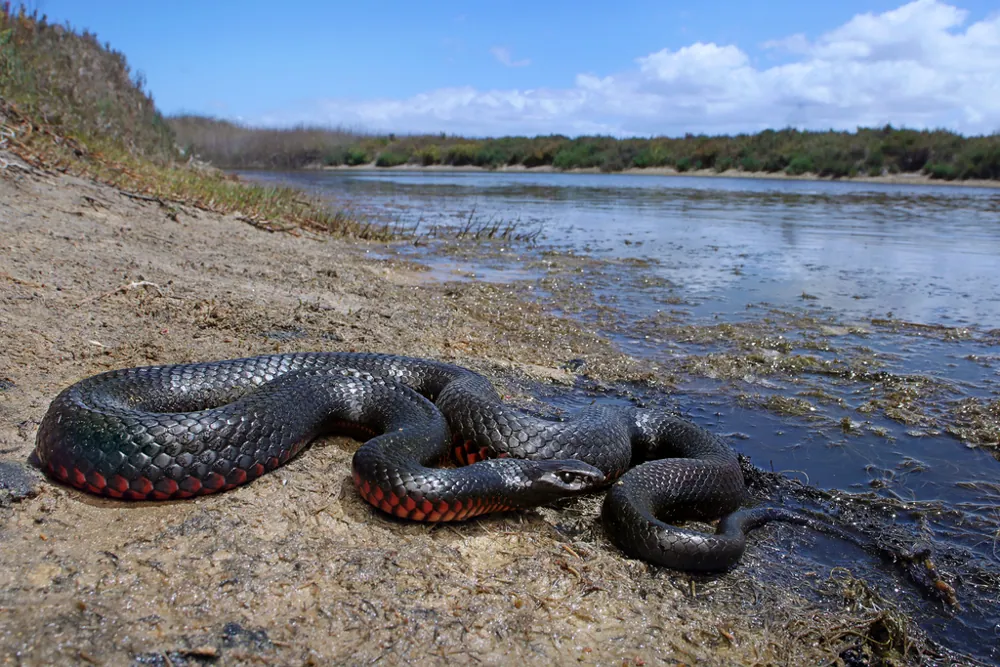
The red-bellied black snake is a venomous snake found along the east coast of Australia, where it is one of the most commonly met snakes. It is glossy black on top, with bright red or orange sides. It often lives near water, and it sometimes turns up in backyards in towns and cities.1



 Paano ito makikilala
- Glossy black upperparts with a light-grey snout and a completely black tail1
- Bright red or orange flanks that fade to a pink or dull red belly1
- No well-defined neck, so the head merges into the body1
- Adults average about 1.25 m in total length, including the tail1
Madalas mapagkamalang: Juveniles look similar to the eastern small-eyed snake, but that species lacks red flanks. Other similar snakes include the blue-bellied black snake and copperheads of the genus Austrelaps.1
Lakas ng kamandag
Lumalabas ang kamandag sa pangil o ngipin nito kapag nangangagat ito.
Ano ang epekto ng kamandag nito?
Its venom contains neurotoxins, which attack the nerves, myotoxins, which damage muscle, and coagulants, which affect blood clotting. It also has haemolytic properties, meaning it can break down red blood cells. Bites can cause severe pain, local swelling, prolonged bleeding and local tissue death, especially on a finger. Victims can also lose their sense of smell, and nausea, vomiting, headache, abdominal pain, diarrhoea or heavy sweating can follow.1
Gaano ito kapanganib sa tao?
Panganib sa tao: MalalaKailangang magpatingin sa doktor kapag nakagat. Napakabihira ng namamatay.No deaths have been recorded from its bite. It is less venomous than many other Australian elapid snakes, but it can still cause significant illness. It accounted for 16% of identified snakebite victims in Australia between 2005 and 2015. Severe local reactions may need surgery or, rarely, amputation.1
Ano ang ginagawa nito kapag natatakot?
It is not aggressive and usually withdraws. If provoked, it raises its head and front body into a striking stance, widens and flattens its neck, and may bite as a last resort.1
 Kung kumagat ito
- Pressure immobilisation: balutin nang mahigpit ng elastic bandage ang kagat at pataas sa buong braso o binti, lagyan ng splint, at panatilihing ganap na hindi gumagalaw ang tao hanggang dumating ang tulong.
- Huwag hugasan ang kagat: masusuri ng ospital ang kamandag na naiwan sa balat para mapili ang tamang antivenom.
Laging tawagan muna ang numero pang-emergency (112, 000, 911). Ito ay pangkalahatang gabay sa pangunang lunas, hindi payong medikal. Mga batayan ng pangunang lunas
 Mag-ingat
- Huwag kailanman hawakan, hulihin o asarin ang ligaw na hayop, kahit maliit, at kahit mukha itong tulog o patay.
- Bigyan ito ng espasyo. Kung makasalubong ka ng isa, manatiling kalmado, dahan-dahang umatras at hayaan itong umalis.
- Kung kagatin ka ng isa: manatiling kalmado, huwag gumalaw, tawagan ang numero pang-emergency (112, 000, 911) o pumunta agad sa ospital. Tandaan ang itsura nito, makakatulong ang litrato.
Hindi ka nito hinahabol. Ginagamit nito ang kamandag para manghuli ng pagkain o ipagtanggol ang sarili, at mas gusto pa nitong magtago. Higit pa tungkol sa pag-iingat
Gaano ito kalaki?
Gaano ito kahaba?
Gaano ito kabigat?

 kasinghaba ng 2.5 aso mula ilong hanggang buntot
 kasinghaba ng 14 saging na magkakadugtong
 kayang tapusin ang 100 metro sa loob ng 46 segundo (9.6 ang kailangan ng pinakamabilis na tao)
Gaano kalaki si Red-bellied black snake kumpara sa IYO?
Math lang sa browser mo. Walang sine-save o ipinapadala kahit saan.
Gaano ito kabilis?


Mga fact
It can stay underwater for as long as 23 minutes after fleeing into water.1
Some populations have evolved increased resistance to cane toad toxin in less than 75 years.1
Males of the species may wrestle in ritualised combat in spring, and rarely bite while doing so.1
A male was reported to travel 1,220 m in a single day while roaming for mates in spring.1
In winter it becomes relatively inactive rather than truly hibernating, and groups of up to six have been found under concrete slabs.1
Myth buster
Mito: The red-bellied black snake is harmless and not venomous, because it has no visible fangs.
Totoo: It is venomous and front-fanged, like all elapid snakes. It is less dangerous than many other Australian species, and no deaths have been recorded from its bite.1
Para sa mga eksperto sa kamandag
- Pangalang siyentipiko
- Pseudechis porphyriacus
- Grupo
- Mga ahas ng Australia
- Pamilya
- Elapidae2
- Ayos
- Squamata
- Mga kontinente
- Australia at Oceania
- Mga sanggol
- It gives birth to live young, usually in February or March, with between eight and 40 young per litter.1
- Haba ng buhay
- mga 25 taon1
- Kalagayan nito sa ligaw
- Least concern (IUCN), although its numbers are thought to be declining1
- Panganib sa tao
- 3 / 5: Malala3
Saan galing ang mga fact
- Red-bellied black snake (Wikipedia (CC BY-SA 4.0))
- Pseudechis porphyriacus (iNaturalist): mga pangalan at klasipikasyon.
- Venom Wiki: sarili naming tantiya ang antas ng panganib, karaniwang laki at hula sa bilis. Tingnan kung paano namin ito kinukuwenta: Paano namin sinusukat ang panganib.
Bawat fact sa pahinang ito ay may numerong tumuturo sa pinagmulan nito. Kung may mali kami, pasensya na, mahilig lang kami sa hayop, hindi kami science journal. Sabihin sa amin sa [email protected] at aayusin namin.
 Gutom ang alakdan! Ang Venom Wiki ay proyekto ng iisang tao: libre, walang ads at walang trackers. Nakatutulong ang maliit na tip para manatili itong online.Pakainin ang alakdan
Higit pa mula sa parehong grupo: Mga ahas ng Australia
 Taipan sa baybayinMga ahas ng AustraliaNakamamatay
 Karaniwang death adderMga ahas ng AustraliaNakamamatay
 Silangang kayumangging ahasMga ahas ng AustraliaNakamamatay
 Inland taipanMga ahas ng AustraliaNakamamatay
 Ahas-tigreMga ahas ng AustraliaNakamamatay
 Collett's snakeMga ahas ng AustraliaPuwedeng pumatay
Nakatira rin sa: Australia at Oceania
 Sydney funnel-web spiderMga tarantula at funnel-webNakamamatay
 Redback spiderMga gagambaKailangan ng doktor
 Brown tree snakeMga ahas na nasa likod ang pangilMasakit lang
 Hooded pitohuiIba pang nakalalasong hayopMasakit langHuwag hawakan
 PlatypusMga makamandag na mammalMasakit lang
 Northern tree-dwelling funnel-web spiderMga tarantula at funnel-webNakamamatay