
 Aprika
 Asya
Asya Europa
 Timog Amerika
 Australia at Oceania
 Antarctica
 Karagatang Pasipiko
 Karagatang Atlantiko
 Karagatang Indiyano
 Karagatang Artiko
 Dagat Mediteraneo
 Dagat Pula
 Dagat Caribe
 Dagat Coral
 Dagat Timog Tsina
 Dagat Pilipinas
 Dagat Andaman
 Dagat Hilaga
 Dagat Timor at Arafura
 Look ng Bengal
 Golpo ng California
Red harvester ant
 Mga tusok
The red harvester ant is a large ant that lives in the dry, scrubby land of the southwestern United States. Its nests are dug underground, and the bare patches around them are easy to spot in open grassland. It matters because these ants gather seeds and help spread plants across the land.1


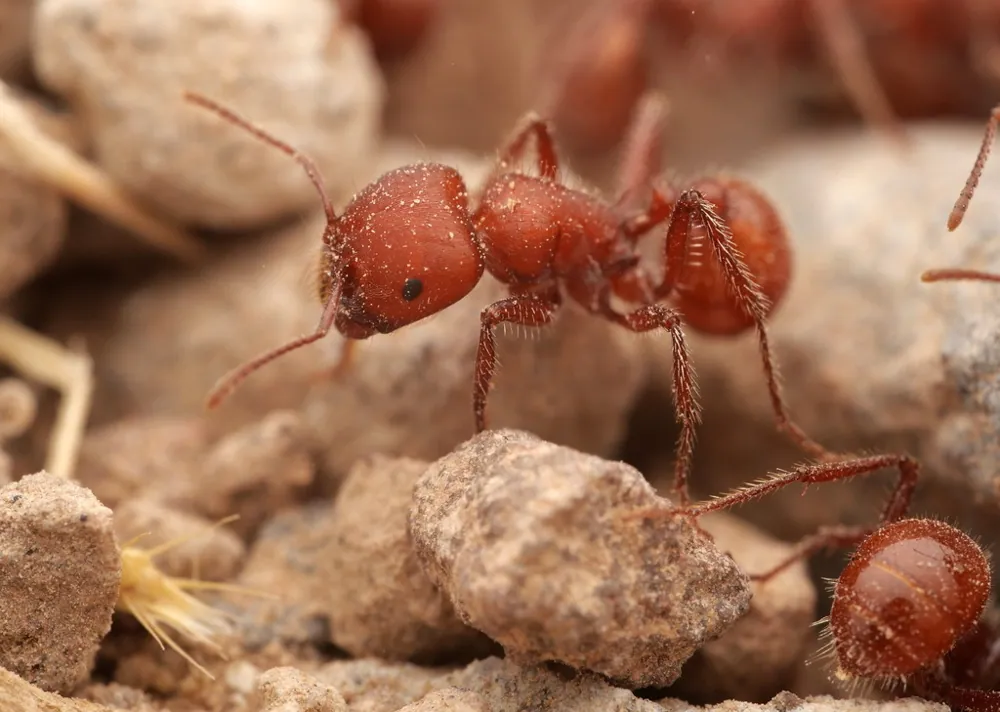
 Paano ito makikilala
- Large ant, about 5 to 7 mm long1
- Mound is flat and broad, up to 100 mm high and 300 to 1,200 mm across1
- Bare ground with no plants, and small pebbles around the tunnel entrance1
- Three to eight trails lead out from the mound, like arms1
- Seed hulls are often scattered around the nest1
Madalas mapagkamalang: Red harvester ants are often mistaken for fire ants. They are not closely related to any fire ant species, native or introduced.1
Lakas ng kamandag
Lumalabas ang kamandag sa pamamagitan ng pantusok.
Gaano ito kapanganib sa tao?
Panganib sa tao: MasakitTalagang masakit, pero halos hindi kailanman malala. Kung tumusok ito
- Hugasan at palamigin ang mga tusok.
- Kung nahihirapang huminga ang tao, namamaga ang mukha o lalamunan, o parang hihimatayin, ito ay emergency sa allergy: tawagan ang numero pang-emergency.
Laging tawagan muna ang numero pang-emergency (112, 000, 911). Ito ay pangkalahatang gabay sa pangunang lunas, hindi payong medikal. Mga batayan ng pangunang lunas
 Mag-ingat
- Huwag kailanman hawakan, hulihin o asarin ang ligaw na hayop, kahit maliit, at kahit mukha itong tulog o patay.
- Bigyan ito ng espasyo. Kung makasalubong ka ng isa, manatiling kalmado, dahan-dahang umatras at hayaan itong umalis.
- Kung tusukin ka ng isa: manatiling kalmado, huwag gumalaw, tawagan ang numero pang-emergency (112, 000, 911) o pumunta agad sa ospital. Tandaan ang itsura nito, makakatulong ang litrato.
Hindi ka nito hinahabol. Ginagamit nito ang kamandag para manghuli ng pagkain o ipagtanggol ang sarili, at mas gusto pa nitong magtago. Higit pa tungkol sa pag-iingat
Gaano ito kalaki?
Gaano ito kahaba?
 sapat na maliit para umupo sa kuko mo
Gaano kalaki si Red harvester ant kumpara sa IYO?
Math lang sa browser mo. Walang sine-save o ipinapadala kahit saan.
Gaano ito kabilis?


Mga fact
Some queens have been known to live up to 30 years in the wild.1
Colonies have no central control. They adjust how much they forage using feedback from returning ants, which can take only seconds.1
Rival Novomessor cockerelli ants block nest entrances with sand and small rocks, delaying the red harvester ants' activity by one to three hours.1
Seeds are stored in the nest for months, and sometimes several years, so the colony has food during lean times.1
The plants benefit too. Ants carry seeds while foraging, which spreads the plants over a wider area.1
Ant foraging is guided by chemical signals, and foragers can travel up to 50 to 60 m from the nest.1
Myth buster
Mito: Red harvester ants are fire ants.
Totoo: They are often mistaken for fire ants but are not closely related to any fire ant species.1
Para sa mga eksperto sa kamandag
- Pangalang siyentipiko
- Pogonomyrmex barbatus
- Grupo
- Mga langgam
- Pamilya
- Formicidae2
- Ayos
- Hymenoptera
- Mga kontinente
- Hilagang Amerika
- Mga sanggol
- A single queen starts each new colony by sealing herself in a soil nest and laying eggs. The first workers emerge over six to eight weeks.1
- Haba ng buhay
- mga 30 taon1
- Panganib sa tao
- 2 / 5: Masakit3
Saan galing ang mga fact
- Red harvester ant (Wikipedia (CC BY-SA 4.0))
- Pogonomyrmex barbatus (iNaturalist): mga pangalan at klasipikasyon.
- Venom Wiki: sarili naming tantiya ang antas ng panganib, karaniwang laki at hula sa bilis. Tingnan kung paano namin ito kinukuwenta: Paano namin sinusukat ang panganib.
Bawat fact sa pahinang ito ay may numerong tumuturo sa pinagmulan nito. Kung may mali kami, pasensya na, mahilig lang kami sa hayop, hindi kami science journal. Sabihin sa amin sa [email protected] at aayusin namin.
 Gutom ang alakdan! Ang Venom Wiki ay proyekto ng iisang tao: libre, walang ads at walang trackers. Nakatutulong ang maliit na tip para manatili itong online.Pakainin ang alakdan
 Bullet ant
 Army ant
 Maricopa harvester ant
 Trap-jaw ant
 Acacia ant
 California harvester ant
 Terciopelo
 Eastern coral snake
 Eastern diamondback rattlesnake
 Eyelash viper
 Timber rattlesnake
 Western diamondback rattlesnake