
 Aprika
 Asya
Asya Europa
 Timog Amerika
 Australia at Oceania
 Antarctica
 Karagatang Pasipiko
 Karagatang Atlantiko
 Karagatang Indiyano
 Karagatang Artiko
 Dagat Mediteraneo
 Dagat Pula
 Dagat Caribe
 Dagat Coral
 Dagat Timog Tsina
 Dagat Pilipinas
 Dagat Andaman
 Dagat Hilaga
 Dagat Timor at Arafura
 Look ng Bengal
 Golpo ng California
Rhombic night adder
 Mga kagat
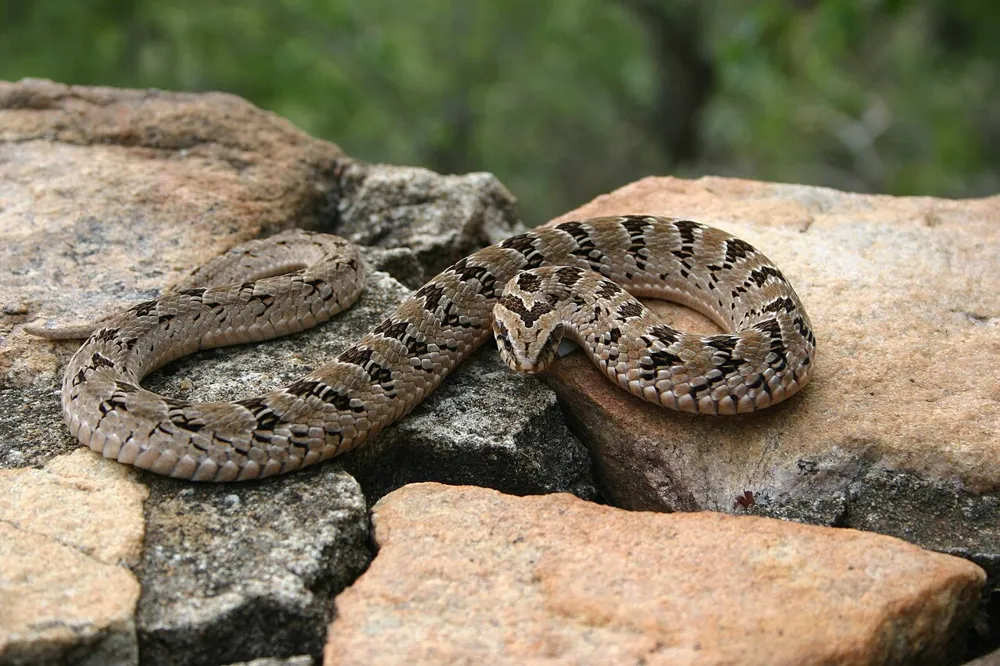
The rhombic night adder is a venomous snake found across much of Sub-Saharan Africa. It is the largest snake in its genus, Causus, and it has a striking threat display that makes it look more dangerous than its venom usually makes it.1


 Paano ito makikilala
- The main colour is usually a shade of brown, sometimes pinkish or greyish, and occasionally olive green.1
- It has 20 to 30 rhombic (diamond-shaped) blotches with pale edges running along its back.1
- Oblique black bars on its sides are each topped by one or two black spots with pale centres, which look like eyes.1
- The head has a V-shaped mark that may be solid black, or brown with a black outline.1
- Northern populations may have no pattern at all, which makes them harder to identify.1
Madalas mapagkamalang: The common egg-eater (Dasypeltis scabra) is compared with this snake. Its colour pattern and behaviour may be a form of defensive mimicry, meaning it may resemble another animal to stay safe.1
Lakas ng kamandag
Lumalabas ang kamandag sa pangil o ngipin nito kapag nangangagat ito.
Ano ang epekto ng kamandag nito?
The venom is low in toxicity. Bites usually cause pain and minor swelling, with little tissue death (necrosis), and these symptoms usually fade within 2 to 3 days. Bites can still be serious, as in at least one case where a child needed a fasciotomy, a surgical operation to relieve pressure in a limb.1
Gaano ito kapanganib sa tao?
Panganib sa tao: MasakitTalagang masakit, pero halos hindi kailanman malala.Most individuals are docile and seldom bite unless severely provoked. Bites can be serious, but there are no modern, well-documented cases of deaths from this species.1
Ano ang ginagawa nito kapag natatakot?
When seriously disturbed, it coils up, inflates its body so the dark markings stand out, hisses and puffs loudly, flattens the front of its body and neck, and strikes frantically.1
 Kung kumagat ito
- Panatilihing hindi gumagalaw at kalmado ang tao, panatilihin ang nakagat na braso o binti sa antas ng puso, tanggalin ang mga singsing at masisikip na bagay, at pumunta agad sa ospital.
Laging tawagan muna ang numero pang-emergency (112, 000, 911). Ito ay pangkalahatang gabay sa pangunang lunas, hindi payong medikal. Mga batayan ng pangunang lunas
 Mag-ingat
- Huwag kailanman hawakan, hulihin o asarin ang ligaw na hayop, kahit maliit, at kahit mukha itong tulog o patay.
- Bigyan ito ng espasyo. Kung makasalubong ka ng isa, manatiling kalmado, dahan-dahang umatras at hayaan itong umalis.
- Kung kagatin ka ng isa: manatiling kalmado, huwag gumalaw, tawagan ang numero pang-emergency (112, 000, 911) o pumunta agad sa ospital. Tandaan ang itsura nito, makakatulong ang litrato.
Hindi ka nito hinahabol. Ginagamit nito ang kamandag para manghuli ng pagkain o ipagtanggol ang sarili, at mas gusto pa nitong magtago. Higit pa tungkol sa pag-iingat
Gaano ito kalaki?
Gaano ito kahaba?
 kasinghaba ng 2 pusang bahay mula ilong hanggang buntot
 kasinghaba ng 5 saging na magkakadugtong
 kayang tapusin ang 100 metro sa loob ng 110 segundo (9.6 ang kailangan ng pinakamabilis na tao)
Gaano kalaki si Rhombic night adder kumpara sa IYO?
Math lang sa browser mo. Walang sine-save o ipinapadala kahit saan.
Gaano ito kabilis?


Mga fact
Myth buster
Mito: Its bite is deadly.
Totoo: There are no modern, well-documented cases of deaths from this species. Bites usually cause pain and minor swelling that fade within 2 to 3 days, although bites can still be serious.1
Para sa mga eksperto sa kamandag
- Pangalang siyentipiko
- Causus rhombeatus
- Grupo
- Mga viper at adder
- Pamilya
- Viperidae2
- Ayos
- Squamata
- Mga kontinente
- Aprika
- Mga sanggol
- Females lay an average clutch of 24 eggs, which take about four months to hatch. The hatchlings are 10 to 12.5 cm long and feed on tiny frogs and toads.1
- Panganib sa tao
- 2 / 5: Masakit3
Saan galing ang mga fact
- Causus rhombeatus (Wikipedia (CC BY-SA 4.0))
- Causus rhombeatus (iNaturalist): mga pangalan at klasipikasyon.
- Venom Wiki: sarili naming tantiya ang antas ng panganib, karaniwang laki at hula sa bilis. Tingnan kung paano namin ito kinukuwenta: Paano namin sinusukat ang panganib.
Bawat fact sa pahinang ito ay may numerong tumuturo sa pinagmulan nito. Kung may mali kami, pasensya na, mahilig lang kami sa hayop, hindi kami science journal. Sabihin sa amin sa [email protected] at aayusin namin.
 Gutom ang alakdan! Ang Venom Wiki ay proyekto ng iisang tao: libre, walang ads at walang trackers. Nakatutulong ang maliit na tip para manatili itong online.Pakainin ang alakdan
Higit pa mula sa parehong grupo: Mga viper at adder
 Puff adderMga viper at adderNakamamatay
 Gaboon viperMga viper at adderPuwedeng pumatay
 Northeast African carpet viperMga viper at adderNakamamatay
 West African carpet viperMga viper at adderNakamamatay
 Rhinoceros viperMga viper at adderPuwedeng pumatay
 West African Gaboon viperMga viper at adderPuwedeng pumatay
 Black mamba
 Deathstalker
 Egyptian cobra
 Boomslang
 Fat-tailed scorpion
 Western honey bee