
 Aforika
 Asia
Asia Yuropa
 Amerika Borwa
 Australia le Oceania
 Antarctica
 Lewatle la Pacific
 Lewatle la Atlantic
 Lewatle la India
 Lewatle la Arctic
 Lewatle la Mediterranean
 Lewatle le Lehibidu
 Lewatle la Caribbean
 Lewatle la Coral
 Lewatle la China Borwa
 Lewatle la Philippines
 Lewatle la Andaman
 Lewatle la Bokone
 Lewatle la Timor le la Arafura
 Kou ya Bengal
 Gulf ya California
Blue-legged mantella
 Botlhole mo letlalong la yoneE botlhole go e ama kgotsa go e ja, ga e tsenye botlhole
The blue-legged mantella is a small frog, only 2 to 3 cm long, that lives in Madagascar. Its bright yellow, blue and black colours warn predators that its skin contains toxins. It is endangered, so it is important to protect it.1
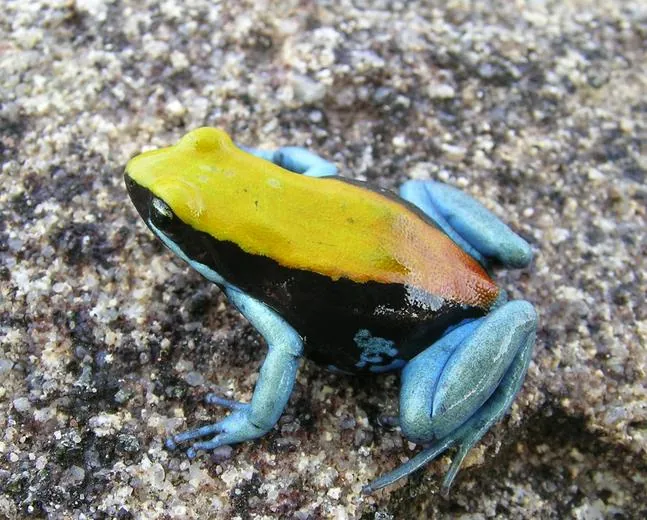
 Tsela ya go e lemoga
- Yellow back and top of the head1
- Blue legs1
- Black flanks and sides of the head1
- Black underside with blue spots1
- In males, a horseshoe-shaped blue spot on the lower jaw1
Gantsi e tlhakanngwa le: In the south of its range, some individuals have brown on their legs and look like the brown mantella (M. betsileo). Some are genetically in between the two species. Individuals in the far north can have a reddish lower back and grey legs.1
Maatla a botlhole
Letlalo la yone le botlhole. Go kotsi go e ama, go e latswa kgotsa go e ja.
E kotsi go le kae go batho?
Kotsi go batho: Kotsi e nnyeJaaka go tlhabiwa ke notshe kgotsa go le kwa tlase. Ga e na kotsi go batho.Its main threats are habitat loss and collection for the pet trade. Both are locally common but endangered because of these pressures.1
E dira eng fa e tshogile?
Its bright aposematic colours warn predators of the alkaloid toxins in its skin.1
 Fa mongwe a e amile kgotsa a e jele
- Fa mongwe a amile e nngwe: tlhatswa diatla sentle mme o se ka wa ama matlho kgotsa molomo. Fa ngwana kgotsa phologolo ya gae e latswitse kgotsa e jele e nngwe: leletsa senthara ya botlhole kgotsa nomoro ya tshoganyetso.
Ka gale leletsa nomoro ya gago ya tshoganyetso pele (112, 000, 911). Se ke kaelo e e akaretsang ya thuso ya ntlha, ga se kgakololo ya bongaka. Motheo wa thuso ya ntlha
 Nna o babalesegile
- O se ka wa ama, wa tshwara kgotsa wa tshwenya phologolo ya naga, le fa e le e nnye, le fa e lebega e robetse kgotsa e sule.
- E fe sebaka. Fa o kopana le yone, ritibala, boela morago ka bonya mme o e tlogele e tsamaye ka tsela ya yone.
- Fa o e amile kgotsa o e jele: o se ka wa gotlha matlho kgotsa molomo wa gago, tlhatswa diatla mme o batle thuso ya bongaka.
Ga e go batle. Botlhole jwa yone bo teng fela gore sepe se se ka se e je. Go le gontsi ka go nna o babalesegile
Kae mo lefatsheng?
E kgolo go le kae?
E telele go le kae?
 e ka nna boleele jo bo lekanang le jwa kelipi ya pampiri
 e ka taboga dimetara di le 100 ka metsotswana e le 100 (motho yo o bonako go gaisa o tlhoka 9,6)
Blue-legged mantella e kgolo go le kae fa e bapisiwa le WENA?
Ke dipalo fela mo sefetleng sa gago (browser). Ga go sepe se se bolokwang kgotsa se se romelwang gope.
E bonako go le kae?


Dintlha
Ya baitseanape ba botlhole
- Leina la saense
- Mantella expectata
- Setlhopha
- Digwagwa tsa botlhole, digwagwa tse dingwe le dinewt
- Lelapa
- Mantellidae2
- Lekoko
- Anura
- Dikontinente
- Aforika
- Masea
- Eggs are hung on canyon walls or laid under rocks, then flooded so they develop in temporary pools.1
- Dingwaga tsa botshelo
- e ka nna dingwaga di le 31
- Seemo sa yone kwa nageng
- Endangered1
- Kotsi go batho
- 1 / 5: Kotsi e nnye3
Kwa dintlha di tswang teng
- Blue-legged mantella (Wikipedia (CC BY-SA 4.0))
- Mantella expectata (iNaturalist): maina le thulaganyo ya mefuta.
- Venom Wiki: seelo sa kotsi, bogolo jo bo tlwaelegileng le kakanyo ya lebelo ke tsa rona. Bona kafa re di balang ka teng: Kafa re lekanyang kotsi ka teng.
Ntlha nngwe le nngwe mo tsebeng e e na le nomoro e e supang motswedi wa yone. Fa re dirile phoso, maitshwarelo, re barati ba diphologolo, e seng kgatiso ya saense. Re bolelele kwa [email protected] mme re tla e baakanya.
 Phepheng e tshwerwe ke tlala! Venom Wiki ke porojeke ya motho a le mongwe: ke mahala, ga e na dipapatso le ditraka. Mpho e nnye e thusa go e tshegetsa mo inthaneteng.Fepa phepheng
Tse dingwe tsa setlhopha se se tshwanang: Digwagwa tsa botlhole, digwagwa tse dingwe le dinewt
 Golden mantellaDigwagwa tsa botlhole, digwagwa tse dingwe le dinewtGa e na kotsi
 Iberian ribbed newtDigwagwa tsa botlhole, digwagwa tse dingwe le dinewtGa e na kotsi
 Tomato frogDigwagwa tsa botlhole, digwagwa tse dingwe le dinewtGa e na kotsi
 African common toadDigwagwa tsa botlhole, digwagwa tse dingwe le dinewtE utlwisa botlhoko felaO se ka wa ama
 Baron's mantellaDigwagwa tsa botlhole, digwagwa tse dingwe le dinewtGa e na kotsi
 Climbing mantellaDigwagwa tsa botlhole, digwagwa tse dingwe le dinewtGa e na kotsi
 Black mamba
 Deathstalker
 Egyptian cobra
 Puff adder
 Boomslang
 Fat-tailed scorpion