
 Afrika
 Osiyo
Osiyo Yevropa
 Janubiy Amerika
 Avstraliya va Okeaniya
 Antarktida
 Tinch okeani
 Atlantika okeani
 Hind okeani
 Shimoliy Muz okeani
 Oʻrta yer dengizi
 Qizil dengiz
 Karib dengizi
 Marjon dengizi
 Janubiy Xitoy dengizi
 Filippin dengizi
 Andaman dengizi
 Shimoliy dengiz
 Timor va Arafura dengizi
 Bengal koʻrfazi
 Kaliforniya koʻrfazi
Katipo
 Chaqadi
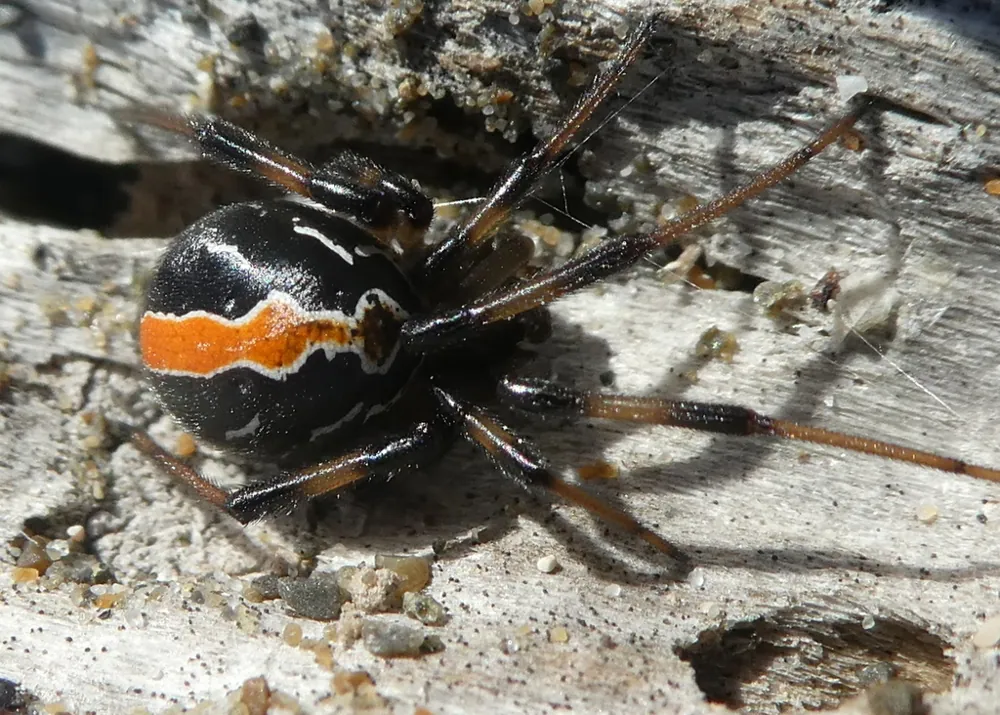
The katipō is a cobweb spider found only in New Zealand, where it lives in coastal sand dunes. It is closely related to the Australian redback spider. Its bite is venomous to people, but bites are rare.1


 Uni qanday tanish mumkin
- Adult females have a body length of 8–10 mm (about 0.3–0.4 in).1
- The red katipō, found in the South Island and lower North Island, has a large black, shiny abdomen with a white-bordered orange or red stripe on top, and a red hourglass-shaped marking underneath.1
- The black katipō, found in the upper North Island, has no upper red or orange stripe and is somewhat lighter in colour.1
- Males are 4–5 mm long, white with black stripes and red hourglass-shaped markings.1
Koʻpincha adashtiriladi: Steatoda species, which share the same habitat, are very similar and are called "false katipō" in New Zealand. The katipō has a less shiny, more tapered abdomen, and its side eyes are further apart. It is also similar to the redback, but the katipō has only short hair-like spines on its abdomen, while the redback has a mix of long and short ones.1
Zahar quvvati
Chaqqanda zahar zaharli tishlari yoki tishlari orqali chiqadi.
Uning zahari (chaqsa yoki nish ursa) nima qiladi?
The bite can cause latrodectism, a toxic syndrome that affects the nerves and body. Symptoms include extreme pain and, potentially, high blood pressure (hypertension) or seizures.1
Odamlar uchun qanchalik xavfli?
Odamlar uchun xavf: JiddiyChaqqanda shifokor kerak. Oʻlim holatlari juda kam.Katipō are venomous to humans, but bites are described as rare. Serious symptoms are possible, including extreme pain, high blood pressure and seizures.1
 Yaxshi xabar: shifokorlarda buning uchun dori (zaharga qarshi zardob) yoki davolash usuli bor.1
 Agar chaqsa
- Chaqilgan joyni yuv va ogʻriq uchun ustiga muz xaltasi qoʻy. Agar ogʻriq kuchli boʻlsa, tarqalsa yoki odam oʻzini yomon his qilsa, tibbiy yordam ol.
Har doim avval favqulodda yordam raqamiga qoʻngʻiroq qil (112, 000, 911). Bu birinchi yordam boʻyicha umumiy maslahat, tibbiy maslahat emas. Birinchi yordam asoslari
 Xavfsiz boʻl
- Hech qachon yovvoyi hayvonga tegma, uni tutma yoki jigʻiga tegma, hatto kichkina boʻlsa ham va hatto uxlayotgan yoki oʻlik koʻrinsa ham.
- Unga joy ber. Agar duch kelsang, xotirjam boʻl, sekin orqaga chekin va uni oʻz yoʻliga ketishiga qoʻy.
- Agar biri seni chaqsa: xotirjam boʻl, qimirlamay tur, favqulodda yordam raqamiga qoʻngʻiroq qil (112, 000, 911) yoki tezda kasalxonaga yet. U qanday koʻrinishda ekanini eslab qol, surat yordam beradi.
U seni ovlamoqchi emas. Zaharini ovqat tutish yoki oʻzini himoya qilish uchun ishlatadi va yashirinishni ancha afzal koʻradi. Xavfsiz qolish haqida batafsil
Dunyoning qayerida?
U qanchalik katta?
U qanchalik uzun?
 tirnogʻing ustiga sigʻadigan darajada kichik
Katipo SEN bilan solishtirganda qanchalik katta?
Faqat brauzeringdagi hisob-kitob. Hech narsa saqlanmaydi va hech qayerga yuborilmaydi.
U qanchalik tez?


Faktlar
In one 24-hour study of young spiders, 28% left the web by ballooning, carried by air currents.1
Katipō is one of the few Māori words that refers to a specific species of spider.1
The female does not usually eat the male after mating, unlike some other widow spiders.1
Females cover their egg sacs with silk and sand, which partly hides them in the web.1
The katipō is found only in New Zealand.1
Afsonalarni fosh qiluvchi
Afsona: The katipō is just a form of the redback spider.
Haqiqat: The katipō is genetically and physically distinct from the redback, even though the two are closely related. It was once thought to be a subspecies of the redback.1
Zahar mutaxassislari uchun
- Ilmiy nomi
- Latrodectus katipo
- Guruh
- Oʻrgimchaklar
- Oila
- Theridiidae2
- Tartib
- Araneae
- Qitʼalar
- Avstraliya va Okeaniya
- Chaqaloqlar
- The female lays five or six egg sacs in November or December, with about 70 to 90 eggs in each. The young hatch after 20–25 days and leave the egg sac in January and February.1
- Tabiatda ahvoli qanday
- In serious decline (New Zealand Threat Classification System)1
- Odamlar uchun xavf
- 3 / 5: Jiddiy3
Faktlar qayerdan olingan
- Katipō (Wikipedia (CC BY-SA 4.0))
- Latrodectus katipo (iNaturalist): nomlar va tasnif.
- Venom Wiki: xavf darajasi, odatiy oʻlcham va taxminiy tezlik bizning oʻz baholarimiz. Ularni qanday hisoblashimizni koʻr: Xavfni qanday baholaymiz.
Bu sahifadagi har bir faktning manbasiga ishora qiluvchi raqami bor. Agar biror narsani xato yozgan boʻlsak, kechir, biz hayvon ixlosmandlarimiz, ilmiy jurnal emas. [email protected] manziliga yoz, tuzatamiz.
 Chayon och! Venom Wiki bir kishining loyihasi: bepul, reklamasiz va kuzatuvchilarsiz. Kichik xayriya uni internetda saqlab qolishga yordam beradi.Chayonni boq
 Redback spider
 White-tailed spider
 Peacock spider
 Badge huntsman spider
 Black house spider
 Eastern white-tailed spider
 Coastal taipan
 Common death adder
 Eastern brown snake
 Ichki taypan
 Sydney funnel-web spider
 Yo'lbars ilon