
 Châu Phi
 Châu Á
 Châu Âu
 Nam Mỹ
 Úc và châu Đại Dương
 Châu Nam Cực
 Thái Bình Dương
 Đại Tây Dương
 Ấn Độ Dương
 Bắc Băng Dương
 Địa Trung Hải
 Biển Đỏ
 Biển Caribe
 Biển San Hô
 Biển Đông
 Biển Philippines
 Biển Andaman
 Biển Bắc
 Biển Timor và Arafura
 Vịnh Bengal
 Vịnh California
Rhinoceros viper
 Vết cắn
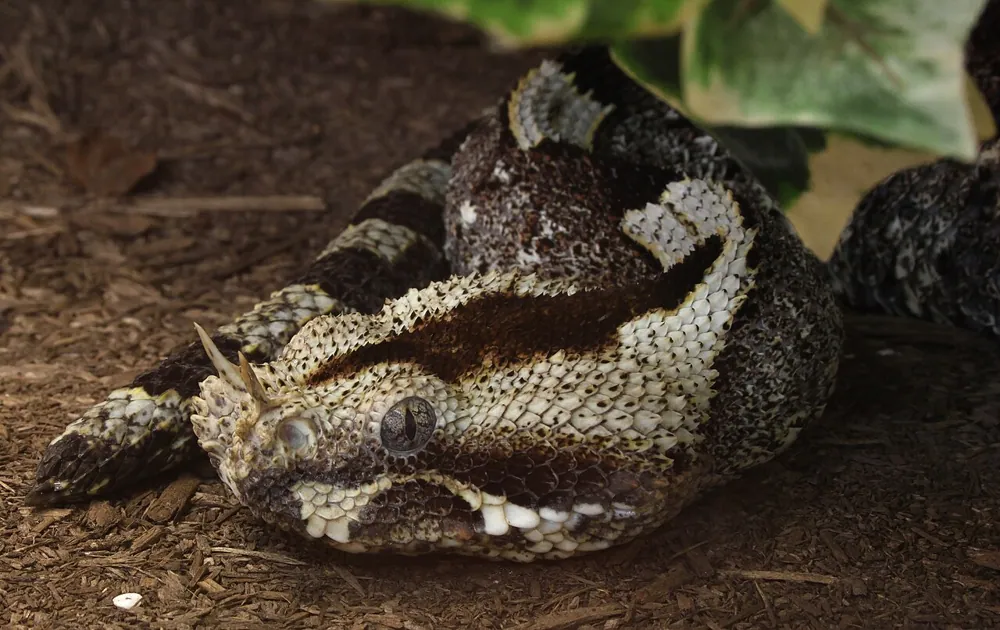
The rhinoceros viper is a large, stout snake with bright colours and two or three horn-like scales on its nose. It lives in forests across West and Central Africa. It is venomous, and its venom is mainly hemotoxic, meaning it attacks the blood and circulation.1



 Cách nhận biết
- Large and stout, with rough, heavily keeled scales1
- Two or three horn-like scales on the end of the nose, the front pair often long1
- Series of blue or blue-green oblong markings, each with a lemon-yellow line down the centre, set within black blotches1
- Dark crimson triangles down the flanks, bordered with green or blue1
- Top of the head blue or green, with a black arrow mark1
Hay bị nhầm với: The name horned puff adder is also used for Bitis caudalis (horned adder), which is a different species. Because of this, names can cause confusion, so the name butterfly viper is preferred.1
Sức mạnh nọc độc
Nọc độc thoát ra qua răng nanh hoặc răng khi nó cắn.
Nọc độc của nó gây ra gì?
Its venom is mainly hemotoxic, which attacks the circulatory system, destroying tissue and blood vessels and causing internal bleeding. It also has a neurotoxic component, which attacks the nerves. Small doses of the venom can be deadly. In the few detailed reports of human bites, massive swelling was described, which may lead to necrosis (death of tissue).1
Nó nguy hiểm thế nào với con người?
Nguy hiểm với con người: Rất nguy hiểmCó thể giết một người không được điều trị.Because its range is restricted, few bites have been reported and no statistics are available. In 2003 a man in Dayton, Ohio, who kept one as a pet, was bitten and died.1
 Tin tốt: bác sĩ có thuốc (huyết thanh kháng nọc) hoặc cách điều trị cho trường hợp này.1
Nó làm gì khi sợ?
When approached it often reveals its presence with a very loud hiss, almost a shriek, and it can strike quickly forwards or sideways without coiling first or giving a warning.1
 Nếu nó cắn
- Giữ người bị nạn nằm yên và bình tĩnh, để chi bị cắn ngang tầm tim, tháo nhẫn và đồ bó chặt, và đến bệnh viện thật nhanh.
Luôn gọi số khẩn cấp trước tiên (112, 000, 911). Đây là hướng dẫn sơ cứu chung, không phải lời khuyên y tế. Sơ cứu cơ bản
 Giữ an toàn
- Đừng bao giờ chạm, bắt hay trêu chọc động vật hoang dã, dù nó nhỏ, và dù trông như đang ngủ hay đã chết.
- Chừa khoảng cách cho nó. Nếu gặp, hãy bình tĩnh, lùi lại từ từ và để nó đi.
- Nếu nó cắn bạn: bình tĩnh, nằm yên, gọi số khẩn cấp (112, 000, 911) hoặc đến bệnh viện thật nhanh. Hãy nhớ hình dạng nó, có ảnh càng tốt.
Nó không nhắm vào bạn. Nó dùng nọc để bắt mồi hoặc tự vệ, và nó thích trốn hơn nhiều. Thêm về cách giữ an toàn
Nó to cỡ nào?
Nó dài bao nhiêu?
 dài bằng 2 con mèo nhà nối từ mũi đến đuôi
 dài bằng 6 quả chuối nối đuôi nhau
 có thể chạy 100 mét trong 100 giây (người nhanh nhất cần 9,6)
Rhinoceros viper to cỡ nào so với BẠN?
Chỉ là phép tính trong trình duyệt của bạn. Không có gì được lưu hay gửi đi đâu cả.
Nó nhanh cỡ nào?


Thông tin
Its scales are so rough that they can cut people who handle a snake that is struggling.1
Its vivid colours break up its outline in the dappled light of the forest floor, so it is very hard to see.1
Its fangs are not large, rarely more than 1.5 cm long, and when not in use they fold up into the roof of its mouth.1
Its bright colours fade quickly after it sheds its skin, as silt from its moist habitat builds up on its rough scales.1
At least one antivenom, called India Antiserum Africa Polyvalent, protects specifically against bites from this species.1
Phá tan lời đồn
Lời đồn: Its bright colours make it easy to spot in the forest.
Sự thật: Its colours give it excellent camouflage in the dappled light of the forest floor, which can make it almost invisible.1
Thông tin lấy từ đâu
- Bitis nasicornis (Wikipedia (CC BY-SA 4.0))
- Bitis nasicornis (iNaturalist): tên gọi và phân loại.
- Venom Wiki: mức nguy hiểm, kích thước điển hình và tốc độ ước đoán là của chúng tôi. Xem cách chúng tôi tính: Cách chúng tôi đánh giá nguy hiểm.
Mỗi thông tin trên trang này có một con số dẫn đến nguồn của nó. Nếu chúng tôi sai điều gì, xin lỗi nhé, chúng tôi là người mê động vật, không phải tạp chí khoa học. Hãy báo cho chúng tôi qua [email protected] và chúng tôi sẽ sửa.
 Bọ cạp đói rồi! Venom Wiki là dự án của một người: miễn phí, không quảng cáo, không theo dõi. Một chút tiền tip giúp trang tiếp tục hoạt động.Cho bọ cạp ăn
Cùng nhóm: Rắn lục
 Rắn hổ lục Gaboon phì
 Gaboon viper
 Northeast African carpet viper
 West African carpet viper
 West African Gaboon viper
 Horned adder
.jpg)
Cũng sống ở: Châu Phi
 Rắn mamba đenRắn hổ mang, rắn mamba và rắn cạp niaChết người
 Bọ cạp tử thầnBọ cạpChết người
 Rắn hổ mang Ai CậpRắn hổ mang, rắn mamba và rắn cạp niaChết người
 BoomslangRắn nanh sauCó thể gây chết người
 Fat-tailed scorpionBọ cạpCó thể gây chết người
 Western honey beeOng, ong bắp cày và ong vò vẽChỉ đau thôi