
 Afrika
 Asië
Asië Europa
 Suid-Amerika
 Australië & Oseanië
 Antarktika
 Stille Oseaan
 Atlantiese Oseaan
 Indiese Oseaan
 Arktiese Oseaan
 Middellandse See
 Rooi See
 Karibiese See
 Koraalsee
 Suid-Chinese See
 Filippynse See
 Andamansee
 Noordsee
 Timorsee & Arafurasee
 Baai van Bengale
 Golf van Kalifornië
Arizona blond tarantula
 Byte
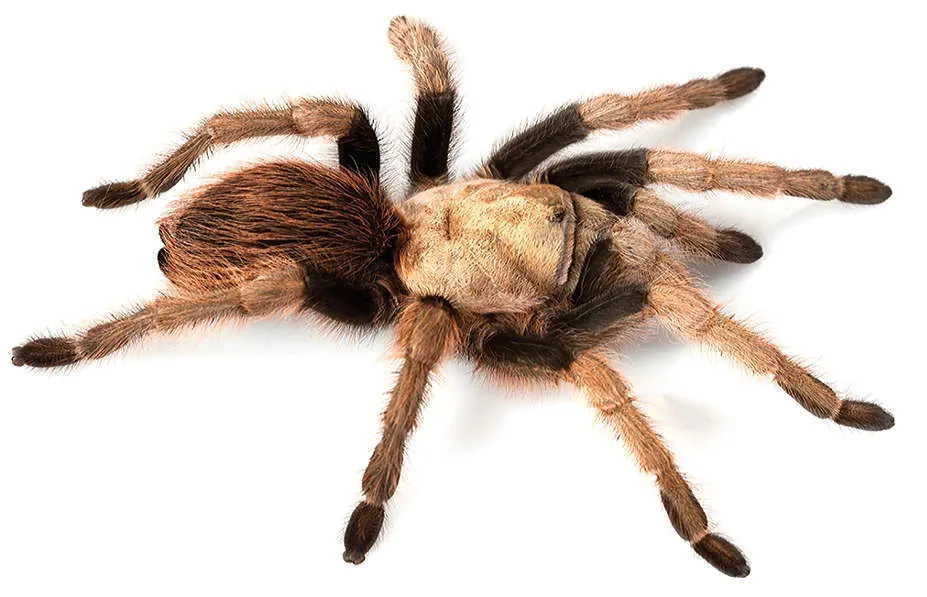
ByteThe Arizona blond tarantula is a large, burrowing spider with pale, golden-looking hairs on its front body. It lives in the deserts of Arizona and New Mexico and nearby parts of Mexico. Its venom is considered low in toxicity, so it is not highly dangerous to people.1

 Hoe om dit te herken
- Front body (carapace) covered in dense pale hairs, which gives it the blonde name.1
- Females are usually a uniform tan colour.1
- Males have black legs, a copper-coloured front body and a reddish abdomen.1
- Burrows can be 2.5 to 5.1 cm across, with some strands of silk over the opening.1
- Body length is up to 5.6 cm in females and up to 4.4 cm in males.1
Gifkrag
Gif kom deur sy giftande of tande uit wanneer dit byt.
Wat doen sy gif as dit byt of steek?
The venom contains neurotoxins, which attack the nerves. The two named compounds are Apc600 and Apc728. These toxins have not been studied in depth, and the venom is considered low in toxicity for humans.1
Hoe gevaarlik is dit vir mense?
Gevaar vir mense: LigSoos 'n bysteek of minder. Basies onskadelik vir mense.The venom is not highly dangerous to humans. Compared with a bee sting, its venom level is not significantly higher. It is one of the least dangerous spiders in its family, Theraphosidae.1
 As dit byt
- Was die byt en koel dit af. Kry mediese hulp as die pyn erg is of die persoon sleg voel.
Bel altyd eers jou noodnommer (112, 000, 911). Dit is algemene noodhulpraad, nie mediese advies nie. Noodhulp-basiese beginsels
 Bly veilig
- Moet nooit aan 'n wilde dier raak, dit vang of terg nie, selfs nie 'n kleintjie nie, en selfs nie as dit lyk of dit slaap of dood is nie.
- Gee dit spasie. As jy een raakloop, bly kalm, stap stadig terug en laat dit sy eie pad gaan.
- As een jou byt: bly kalm, bly stil, bel jou noodnommer (112, 000, 911) of kom vinnig by 'n hospitaal uit. Onthou hoe dit gelyk het, 'n foto help.
Dit is nie uit om jou te kry nie. Dit gebruik sy gif om kos te vang of om homself te beskerm, en kruip baie eerder weg. Meer oor veilig bly
Waar in die wêreld?
Hoe groot is dit?
Hoe lank is dit?
 korter as jou pinkie
 kan 100 meter in 220 sekondes aflê (die vinnigste mens het 9,6 nodig)
Hoe groot is Arizona blond tarantula in vergelyking met JOU?
Net wiskunde in jou blaaier. Niks word gestoor of enige plek heen gestuur nie.
Hoe vinnig is dit?


Feite
Females can live about 24 to 30 years, while males live about 5 to 10 years.1
Each spider molts about 25 times over two years, going through ten main stages.1
Newborns look like females, and males only show male features after several years of development.1
Its popularity among beginner tarantula keepers is linked to its long lifespan and calm nature.1
Molting is seasonal, and is especially common in March and April, even though tarantulas can molt at any time of day.1
Waar die feite vandaan kom
- Aphonopelma chalcodes (Wikipedia (CC BY-SA 4.0))
- Aphonopelma chalcodes (iNaturalist): name en klassifikasie.
- Venom Wiki: die gevaarvlak, die tipiese grootte en die spoedskatting is ons eie. Kyk hoe ons dit uitwerk: Hoe ons gevaar gradeer.
Elke feit op hierdie bladsy het 'n nommer wat na sy bron wys. As ons iets verkeerd het, jammer, ons is dierfanatici, nie 'n wetenskaplike joernaal nie. Laat weet ons by [email protected] en ons maak dit reg.
 Die skerpioen is honger! Venom Wiki is 'n eenmanprojek: gratis, sonder advertensies en sonder spoorsnyers. 'n Klein fooitjie help om dit aanlyn te hou.Voer die skerpioen
Meer uit dieselfde groep: Tarantulas & tregterwebspinnekoppe
 Mexican redknee tarantulaTarantulas & tregterwebspinnekoppeOnskadelik
 Ravine trapdoor spiderTarantulas & tregterwebspinnekoppeOnskadelik
 Trinidad chevron tarantulaTarantulas & tregterwebspinnekoppeMaak net seer
 Antilles pinktoe tarantulaTarantulas & tregterwebspinnekoppeOnskadelik
 California trapdoor spiderTarantulas & tregterwebspinnekoppeOnskadelik
 Costa Rican zebra tarantulaTarantulas & tregterwebspinnekoppeOnskadelik
 Terciopelo
 Eastern coral snake
 Eastern diamondback rattlesnake
 Eyelash viper
 Timber rattlesnake
 Western diamondback rattlesnake