
 Afrika
 Asië
Asië Europa
 Suid-Amerika
 Australië & Oseanië
 Antarktika
 Stille Oseaan
 Atlantiese Oseaan
 Indiese Oseaan
 Arktiese Oseaan
 Middellandse See
 Rooi See
 Karibiese See
 Koraalsee
 Suid-Chinese See
 Filippynse See
 Andamansee
 Noordsee
 Timorsee & Arafurasee
 Baai van Bengale
 Golf van Kalifornië
Mexican redknee tarantula
 Byte
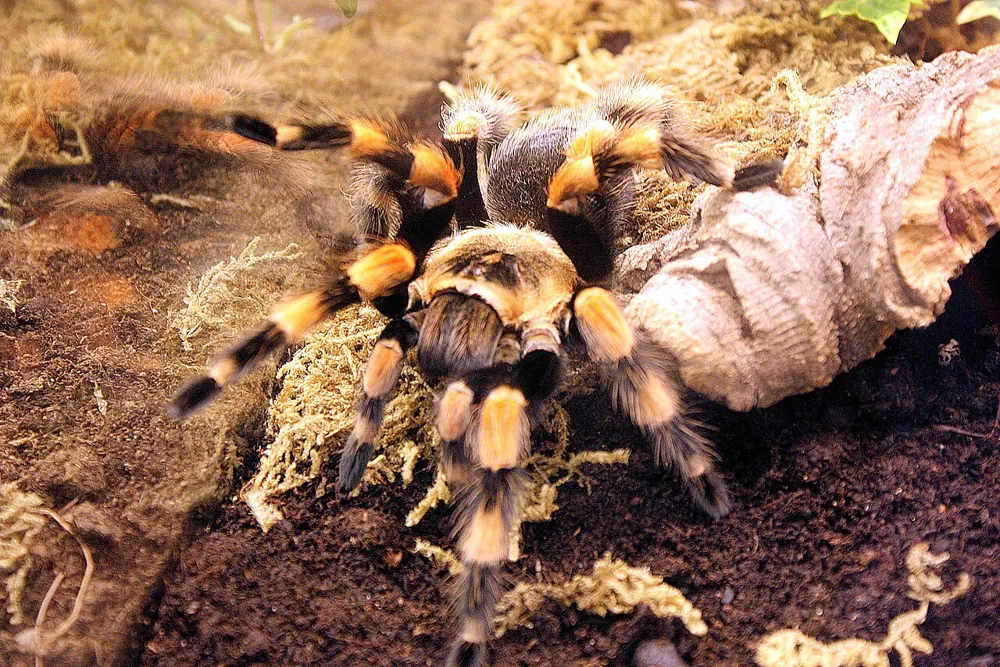
ByteThe Mexican redknee tarantula is a large, hairy spider from the Pacific coast of Mexico. It lives in burrows under rocks and tree roots, and it is a popular pet among tarantula keepers. Its name has caused confusion, because for many years it was mixed up with a very similar species.1



 Hoe om dit te herken
- Males and females are large, with bodies about 4 to 6 cm long, not counting the fangs and spinnerets.1
- Legs and palps (the short leg-like parts near the mouth) are bluish black with reddish orange and pale pink rings.1
- Adult males have a yellowish brown carapace (the hard top of the front body) and a black upper abdomen.1
- Adult females vary more. The carapace may be mostly bluish black with a light brown border, or have a dark starburst pattern.1
Word dikwels verwar met: It is often confused with Brachypelma hamorii, which has very similar colours. The two can be told apart by two brownish pink bands on the chelicerae (the fang-bearing parts), which are present in B. hamorii but absent in B. smithi. Mature males can also be told apart by the shape of the palpal bulb, which is straighter and spoon-shaped in B. smithi.1
Gifkrag
Gif kom deur sy giftande of tande uit wanneer dit byt.
Hoe gevaarlik is dit vir mense?
Gevaar vir mense: LigSoos 'n bysteek of minder. Basies onskadelik vir mense. As dit byt
- Was die byt en koel dit af. Kry mediese hulp as die pyn erg is of die persoon sleg voel.
Bel altyd eers jou noodnommer (112, 000, 911). Dit is algemene noodhulpraad, nie mediese advies nie. Noodhulp-basiese beginsels
 Bly veilig
- Moet nooit aan 'n wilde dier raak, dit vang of terg nie, selfs nie 'n kleintjie nie, en selfs nie as dit lyk of dit slaap of dood is nie.
- Gee dit spasie. As jy een raakloop, bly kalm, stap stadig terug en laat dit sy eie pad gaan.
- As een jou byt: bly kalm, bly stil, bel jou noodnommer (112, 000, 911) of kom vinnig by 'n hospitaal uit. Onthou hoe dit gelyk het, 'n foto help.
Dit is nie uit om jou te kry nie. Dit gebruik sy gif om kos te vang of om homself te beskerm, en kruip baie eerder weg. Meer oor veilig bly
Waar in die wêreld?
Hoe groot is dit?
Hoe lank is dit?
 korter as jou pinkie
 kan 100 meter in 200 sekondes aflê (die vinnigste mens het 9,6 nodig)
Hoe groot is Mexican redknee tarantula in vergelyking met JOU?
Net wiskunde in jou blaaier. Niks word gestoor of enige plek heen gestuur nie.
Hoe vinnig is dit?


Feite
Large numbers of wild-caught Mexican redknee tarantulas are still smuggled out of Mexico. At least 3,000 Mexican tarantulas were sent to the United States or Europe a few years before 2017, most of them this species.1
Its burrow has a single entrance, a tunnel about three times the spider's leg span long, and one or two chambers, one for moulting and one for resting and eating.1
Males have shorter bodies than females but longer legs.1
Mite-breker
Mite: The name Mexican redknee tarantula always refers to one single species.
Waarheid: The name has been used for two very similar species, B. smithi and B. hamorii. Many older sources mixed them up, so earlier records may be about either species.1
Waar die feite vandaan kom
- Brachypelma smithi (Wikipedia (CC BY-SA 4.0))
- Brachypelma smithi (iNaturalist): name en klassifikasie.
- Venom Wiki: die gevaarvlak, die tipiese grootte en die spoedskatting is ons eie. Kyk hoe ons dit uitwerk: Hoe ons gevaar gradeer.
Elke feit op hierdie bladsy het 'n nommer wat na sy bron wys. As ons iets verkeerd het, jammer, ons is dierfanatici, nie 'n wetenskaplike joernaal nie. Laat weet ons by [email protected] en ons maak dit reg.
 Die skerpioen is honger! Venom Wiki is 'n eenmanprojek: gratis, sonder advertensies en sonder spoorsnyers. 'n Klein fooitjie help om dit aanlyn te hou.Voer die skerpioen
Meer uit dieselfde groep: Tarantulas & tregterwebspinnekoppe
 Arizona blond tarantulaTarantulas & tregterwebspinnekoppeOnskadelik
 Ravine trapdoor spiderTarantulas & tregterwebspinnekoppeOnskadelik
 Trinidad chevron tarantulaTarantulas & tregterwebspinnekoppeMaak net seer
 Antilles pinktoe tarantulaTarantulas & tregterwebspinnekoppeOnskadelik
 California trapdoor spiderTarantulas & tregterwebspinnekoppeOnskadelik
 Costa Rican zebra tarantulaTarantulas & tregterwebspinnekoppeOnskadelik
 Terciopelo
 Eastern coral snake
 Eastern diamondback rattlesnake
 Eyelash viper
 Timber rattlesnake
 Western diamondback rattlesnake