
 Afrika
 Asië
Asië Europa
 Suid-Amerika
 Australië & Oseanië
 Antarktika
 Stille Oseaan
 Atlantiese Oseaan
 Indiese Oseaan
 Arktiese Oseaan
 Middellandse See
 Rooi See
 Karibiese See
 Koraalsee
 Suid-Chinese See
 Filippynse See
 Andamansee
 Noordsee
 Timorsee & Arafurasee
 Baai van Bengale
 Golf van Kalifornië
Atlantic banded box jellyfish
 Steektentakels
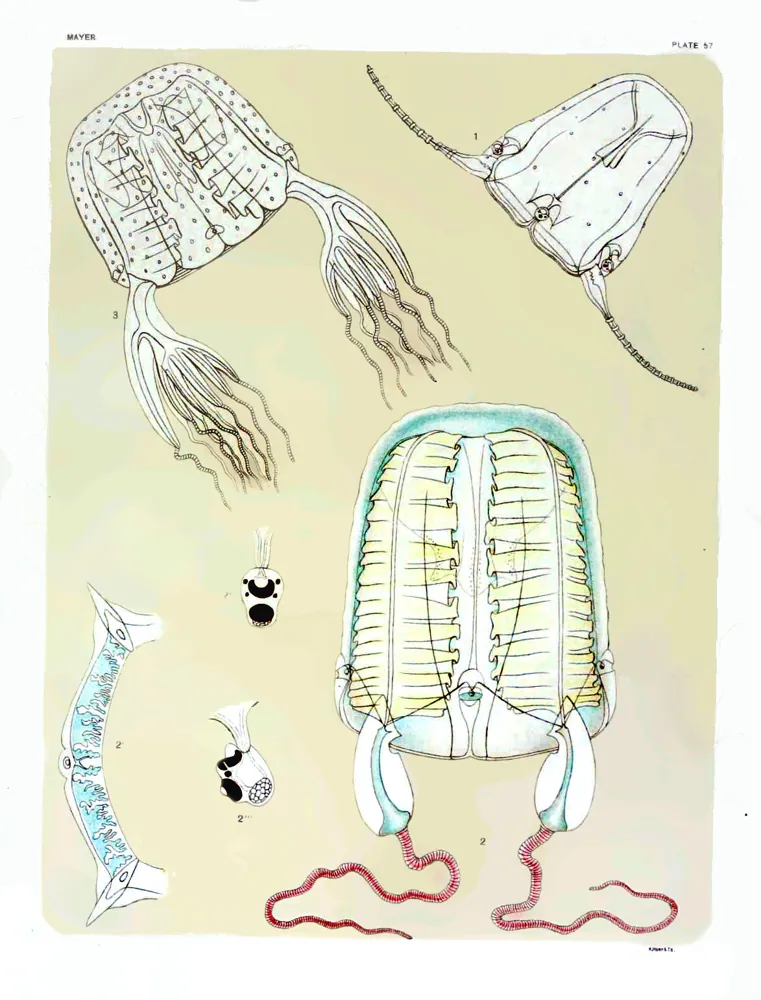
The Atlantic banded box jellyfish is a sea creature with a box-shaped bell and four long tentacles. It lives in the western Atlantic Ocean, and it is highly venomous, so it can sting people. It is the type species of its genus, which means it is the example species used to define the group.1


 Hoe om dit te herken
- Has four tentacles, one on each inter-radial pedal (a fleshy stalk between the bell's sides).1
- Has four rhopalia, which are sense organs on the bell edge, each with a statolith (a balance structure).1
- Each rhopalium has four simple eyes and two camera eyes.1
- Fish may swim in among the tentacles without being eaten.1
Gifkrag
Duisende piepklein steekselle skiet af wanneer iets aan hulle raak.
Wat doen sy gif as dit byt of steek?
It is highly venomous, like other box jellyfish. Its stings are harmful to humans.1
Hoe gevaarlik is dit vir mense?
Gevaar vir mense: Ernstig'n Steek moet deur 'n dokter gesien word. Sterftes is baie skaars.It is highly venomous and has been known to sting humans.1
 As dit steek
- Vinegar should be applied to the skin to deactivate the nematocysts (stinging cells). A cold seawater compress should also be applied.1
- Klim uit die water en pluk enige tentakels af (met handskoene of 'n lap).
- Vir tropiese kubuskwalle: gooi vir minstens 30 sekondes asyn oor die steke, roep hulp en wees gereed om KPR te doen. Vir bloublasies en die meeste ander: spoel af met seewater, dan warm water vir die pyn.
Bel altyd eers jou noodnommer (112, 000, 911). Dit is algemene noodhulpraad, nie mediese advies nie. Noodhulp-basiese beginsels
 Bly veilig
- Moet nooit aan 'n wilde dier raak, dit vang of terg nie, selfs nie 'n kleintjie nie, en selfs nie as dit lyk of dit slaap of dood is nie.
- Gee dit spasie. As jy een raakloop, bly kalm, stap stadig terug en laat dit sy eie pad gaan.
- As een jou steek: bly kalm, bly stil, bel jou noodnommer (112, 000, 911) of kom vinnig by 'n hospitaal uit. Onthou hoe dit gelyk het, 'n foto help.
Dit is nie uit om jou te kry nie. Dit gebruik sy gif om kos te vang of om homself te beskerm, en kruip baie eerder weg. Meer oor veilig bly
Waar in die wêreld?
Hoe groot is dit?
Hoe lank is dit?
 so lank soos 3 speelgoed-boublokke in 'n ry
 kan die lengte van 'n groot swembad (50 m) in 36 sekondes swem
Hoe groot is Atlantic banded box jellyfish in vergelyking met JOU?
Net wiskunde in jou blaaier. Niks word gestoor of enige plek heen gestuur nie.
Hoe vinnig is dit?
Feite
Mite-breker
Mite: It lives off the coast of Africa.
Waarheid: Sightings off Africa were later attributed to a different species, Tamoya ancamori. This species is native to the western Atlantic.1
Waar die feite vandaan kom
- Tamoya haplonema (Wikipedia (CC BY-SA 4.0))
- Tamoya haplonema (iNaturalist): name en klassifikasie.
- Venom Wiki: die gevaarvlak, die tipiese grootte en die spoedskatting is ons eie. Kyk hoe ons dit uitwerk: Hoe ons gevaar gradeer.
Elke feit op hierdie bladsy het 'n nommer wat na sy bron wys. As ons iets verkeerd het, jammer, ons is dierfanatici, nie 'n wetenskaplike joernaal nie. Laat weet ons by [email protected] en ons maak dit reg.
 Die skerpioen is honger! Venom Wiki is 'n eenmanprojek: gratis, sonder advertensies en sonder spoorsnyers. 'n Klein fooitjie help om dit aanlyn te hou.Voer die skerpioen
Meer uit dieselfde groep: Jellievisse & see-steekdiere
 Australian box jellyfishJellievisse & see-steekdiereDodelikMoenie aanraak nie
 Irukandji jellyfishJellievisse & see-steekdiereKan doodmaakMoenie aanraak nie
 Portuguese man o' warJellievisse & see-steekdiereMoet 'n dokter sienMoenie aanraak nie
 Lion's mane jellyfishJellievisse & see-steekdiereMaak net seerMoenie aanraak nie
 Moon jellyfishJellievisse & see-steekdiereOnskadelik
 Common kingslayerJellievisse & see-steekdiereKan doodmaakMoenie aanraak nie
Leef ook in: Atlantiese Oseaan
 Hawksbill sea turtleAnder diere wat giftig is om aan te raak of te eetKan doodmaak
 Blue sea dragonKeëlslakke & seekatteMaak net seer
 Greenland sharkAnder diere wat giftig is om aan te raak of te eetMaak net seer
 Common octopusKeëlslakke & seekatteOnskadelik
 Common stingrayGiftige visseMoet 'n dokter sien
 Greater weeverGiftige visseMoet 'n dokter sienMoenie aanraak nie