
 Afrika
 Asië
Asië Europa
 Suid-Amerika
 Australië & Oseanië
 Antarktika
 Stille Oseaan
 Atlantiese Oseaan
 Indiese Oseaan
 Arktiese Oseaan
 Middellandse See
 Rooi See
 Karibiese See
 Koraalsee
 Suid-Chinese See
 Filippynse See
 Andamansee
 Noordsee
 Timorsee & Arafurasee
 Baai van Bengale
 Golf van Kalifornië
Common stingray
 Steke
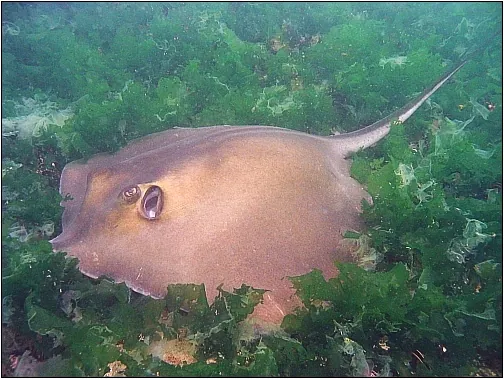
StekeThe common stingray is a flat, diamond-shaped ray that lives on sandy or muddy seabeds in shallow coastal waters. It is found in the northeastern Atlantic, the Mediterranean and the Black Sea. It has a venomous spine on its tail, which can give a very painful sting.1
 Hoe om dit te herken
- Diamond-shaped pectoral fin disc that is slightly wider than it is long1
- Plain colour: solid grey, brown, reddish or olive-green above, and whitish below with dark fin edges1
- Mostly smooth skin; the largest individuals have a row of bony knobs along the middle of the back1
- Slender, whip-like tail with a serrated venomous spine about a third of the way along it1
Word dikwels verwar met: The blue stingray of southern Africa was once thought to be a variant of this species, but it is a separate species. The common stingray lacks the blue markings of the blue stingray. Tortonese's stingray of the Mediterranean is similar, and the difference between the two is poorly understood.1
Gifkrag
Gif kom deur 'n angel uit.
Wat doen sy gif as dit byt of steek?
The venom comes from a gland at the base of a serrated tail spine. A sting causes an excruciatingly painful wound. It is rarely life-threatening.1
Hoe gevaarlik is dit vir mense?
Gevaar vir mense: Ernstig'n Steek moet deur 'n dokter gesien word. Sterftes is baie skaars.The common stingray is not aggressive, but it can inflict a very painful wound with its tail spine. The wound is rarely life-threatening.1
 As dit steek
- Sit die wond in warm water, so warm as wat die persoon kan verdra sonder om te brand (toets dit met jou eie hand), vir 30 tot 90 minute. Kry mediese hulp, veral vir klipvisse en pylsterte.
Bel altyd eers jou noodnommer (112, 000, 911). Dit is algemene noodhulpraad, nie mediese advies nie. Noodhulp-basiese beginsels
 Bly veilig
- Moet nooit aan 'n wilde dier raak, dit vang of terg nie, selfs nie 'n kleintjie nie, en selfs nie as dit lyk of dit slaap of dood is nie.
- Gee dit spasie. As jy een raakloop, bly kalm, stap stadig terug en laat dit sy eie pad gaan.
- As een jou steek: bly kalm, bly stil, bel jou noodnommer (112, 000, 911) of kom vinnig by 'n hospitaal uit. Onthou hoe dit gelyk het, 'n foto help.
Dit is nie uit om jou te kry nie. Dit gebruik sy gif om kos te vang of om homself te beskerm, en kruip baie eerder weg. Meer oor veilig bly
Waar in die wêreld?
Hoe groot is dit?
Hoe lank is dit?
 so lank soos 2,5 honde neus tot stert
 so lank soos 14 piesangs punt aan punt
 kan die lengte van 'n groot swembad (50 m) in 9,5 sekondes swem
Hoe groot is Common stingray in vergelyking met JOU?
Net wiskunde in jou blaaier. Niks word gestoor of enige plek heen gestuur nie.
Hoe vinnig is dit?


Feite
The tail spine is replaced regularly, and a second or even third spine may be growing in behind the first.1
The largest recorded specimen was found in 2016 in İzmir Province, Turkey, with fins measuring 2.21 m across.1
Welsh fishermen once used its liver oil to treat burns and other injuries, and its liver is a delicacy in French cuisine.1
The oldest known wild individual was ten years old, but the species has lived up to 21 years in captivity.1
Mite-breker
Mite: The stingray's spine could kill trees, pierce armour like an arrow, corrode iron and even dissolve stone, as some ancient writers claimed.
Waarheid: The common stingray's wound is painful but rarely life-threatening. These ancient claims about its spine were legends.1
Vir gifkenners
- Wetenskaplike naam
- Dasyatis pastinaca
- Groep
- Giftige visse
- Familie
- Dasyatidae2
- Orde
- Myliobatiformes
- Kontinente
- Atlantiese Oseaan, Middellandse See, Noordsee, Die oseane
- Babas
- It is aplacental viviparous, meaning it gives birth to live young. Females bear 4–9 young twice a year in shallow inshore water, after a gestation period of four months.1
- Lewensduur
- omtrent 21 jaar1
- Hoe dit in die natuur gaan
- Vulnerable1
- Gevaar vir mense
- 3 / 5: Ernstig3
Waar die feite vandaan kom
- Common stingray (Wikipedia (CC BY-SA 4.0))
- Dasyatis pastinaca (iNaturalist): name en klassifikasie.
- Venom Wiki: die gevaarvlak, die tipiese grootte en die spoedskatting is ons eie. Kyk hoe ons dit uitwerk: Hoe ons gevaar gradeer.
Elke feit op hierdie bladsy het 'n nommer wat na sy bron wys. As ons iets verkeerd het, jammer, ons is dierfanatici, nie 'n wetenskaplike joernaal nie. Laat weet ons by [email protected] en ons maak dit reg.
 Die skerpioen is honger! Venom Wiki is 'n eenmanprojek: gratis, sonder advertensies en sonder spoorsnyers. 'n Klein fooitjie help om dit aanlyn te hou.Voer die skerpioen
Meer uit dieselfde groep: Giftige visse
 Reef stonefishGiftige visseKan doodmaakMoenie aanraak nie
 Red lionfishGiftige visseMoet 'n dokter sienMoenie aanraak nie
 Estuarine stonefishGiftige visseKan doodmaakMoenie aanraak nie
 Short-tail stingrayGiftige visseKan doodmaak
 Striped eel catfishGiftige visseKan doodmaakMoenie aanraak nie
 Bluespotted ribbontail rayGiftige visseMoet 'n dokter sien
Leef ook in: Atlantiese Oseaan
 Hawksbill sea turtleAnder diere wat giftig is om aan te raak of te eetKan doodmaak
 Portuguese man o' warJellievisse & see-steekdiereMoet 'n dokter sienMoenie aanraak nie
 Blue sea dragonKeëlslakke & seekatteMaak net seer
 Greenland sharkAnder diere wat giftig is om aan te raak of te eetMaak net seer
 Lion's mane jellyfishJellievisse & see-steekdiereMaak net seerMoenie aanraak nie
 Common octopusKeëlslakke & seekatteOnskadelik