
 Afrika
 Asië
Asië Europa
 Suid-Amerika
 Australië & Oseanië
 Antarktika
 Stille Oseaan
 Atlantiese Oseaan
 Indiese Oseaan
 Arktiese Oseaan
 Middellandse See
 Rooi See
 Karibiese See
 Koraalsee
 Suid-Chinese See
 Filippynse See
 Andamansee
 Noordsee
 Timorsee & Arafurasee
 Baai van Bengale
 Golf van Kalifornië
Black long-spined urchin
 Giftige stekels
The black long-spined urchin is a sea urchin with very long, hollow spines. It lives on coral reefs, sand flats and seagrass beds across the Indo-Pacific, and it is one of the most widespread sea urchins in that region. Its spines can deliver a mild venom, so it is best to watch where you put your feet.1


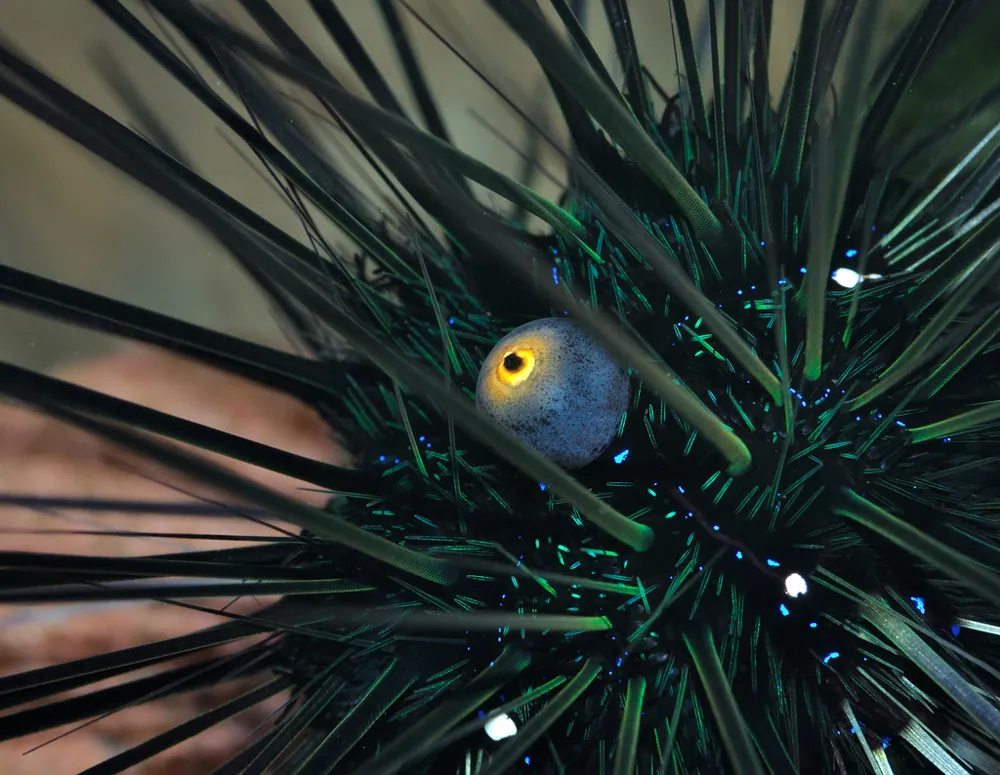
 Hoe om dit te herken
- Black, near-spherical body (test) with extremely long, narrow, hollow spines, often black but sometimes brown-banded1
- Five white spots on the body, which separate it from other Diadema species1
- A bright orange ring around the periproctal cone (the 'anal cone'), which is often mistaken for an eye1
- Bluish spots on the genital plates and a line of blue spots along the body1
- Adults are no more than 70 mm across the body and about 40 mm high1
Word dikwels verwar met: Other Diadema species are similar in shape and spines, but they lack the five white spots that mark this species. Its orange ring and blue spots also help to tell it apart.1
Gifkrag
Skerp stekels dra die gif. Dit maak seer as jy daarop trap of dit gryp.
Wat doen sy gif as dit byt of steek?
The spines are hollow and contain a mild venom. The toxin mostly causes swelling and pain, which spreads gradually over several hours. The venom is not fatal to humans. The spines themselves are a bigger problem, because they are brittle and needle-like, break off in flesh and are difficult to remove.1
Hoe gevaarlik is dit vir mense?
Gevaar vir mense: PynlikDit kan regtig seermaak, maar dit is amper nooit ernstig nie.The venom is only mild, and the species is not considered a serious threat to humans. Stepping on it can cause painful stings.1
Wat doen dit as dit bang is?
When threatened by a sudden impact or by spines snapping, it rapidly flips its body over and 'runs' on the tips of its longest spines.1
 As sy stekels jou steek
- Sit die wond in warm water, so warm as wat die persoon kan verdra sonder om te brand, en kry mediese hulp om die stekels te verwyder. Moenie self daarna grawe nie.
Bel altyd eers jou noodnommer (112, 000, 911). Dit is algemene noodhulpraad, nie mediese advies nie. Noodhulp-basiese beginsels
 Bly veilig
- Moet nooit aan 'n wilde dier raak, dit vang of terg nie, selfs nie 'n kleintjie nie, en selfs nie as dit lyk of dit slaap of dood is nie.
- Gee dit spasie. As jy een raakloop, bly kalm, stap stadig terug en laat dit sy eie pad gaan.
- As sy stekels jou steek: bly kalm, bly stil, bel jou noodnommer (112, 000, 911) of kom vinnig by 'n hospitaal uit. Onthou hoe dit gelyk het, 'n foto help.
Dit is nie uit om jou te kry nie. Dit gebruik sy gif om kos te vang of om homself te beskerm, en kruip baie eerder weg. Meer oor veilig bly
Waar in die wêreld?
Hoe groot is dit?
Hoe lank is dit?
Hoe swaar is dit?

 so lank soos 2 speelgoed-boublokke in 'n ry
 stadiger as 'n tuinslak
Hoe groot is Black long-spined urchin in vergelyking met JOU?
Net wiskunde in jou blaaier. Niks word gestoor of enige plek heen gestuur nie.
Hoe vinnig is dit?

Feite
It can move 760 mm in just 7 seconds by rolling and walking on the tips of its spines.1
It has no eye, but it has a diffuse light-sensing system that lets it detect light levels and the size and colour of objects.1
In 2006, living specimens were found off Turkey, making it the first invasive Erythrean sea urchin recorded in the Mediterranean.1
Goose barnacles of the genus Microlepas are known to live on it as parasites.1
It is considered one of the oldest living species in its genus, Diadema.1
Mite-breker
Mite: Black long-spined urchins are deadly and their stings can kill people.
Waarheid: Their venom is mild and is not fatal to humans. The main problems are pain, swelling and spines that break off in the skin.1
Vir gifkenners
- Wetenskaplike naam
- Diadema setosum
- Groep
- See-egels, seesterre & wurms
- Familie
- Diadematidae2
- Orde
- Diadematoida
- Kontinente
- Indiese Oseaan, Stille Oseaan, Rooi See, Koraalsee, Filippynse See, Arabiese See & Persiese Golf, Timorsee & Arafurasee, Baai van Bengale, Die oseane
- Babas
- It is a broadcast spawner, releasing eggs and sperm into the water. Spawning happens seasonally or year-round depending on the location, and in some places it follows the full moon.1
- Gevaar vir mense
- 2 / 5: Pynlik3
Waar die feite vandaan kom
- Diadema setosum (Wikipedia (CC BY-SA 4.0))
- Diadema setosum (iNaturalist): name en klassifikasie.
- Venom Wiki: die gevaarvlak, die tipiese grootte en die spoedskatting is ons eie. Kyk hoe ons dit uitwerk: Hoe ons gevaar gradeer.
Elke feit op hierdie bladsy het 'n nommer wat na sy bron wys. As ons iets verkeerd het, jammer, ons is dierfanatici, nie 'n wetenskaplike joernaal nie. Laat weet ons by [email protected] en ons maak dit reg.
 Die skerpioen is honger! Venom Wiki is 'n eenmanprojek: gratis, sonder advertensies en sonder spoorsnyers. 'n Klein fooitjie help om dit aanlyn te hou.Voer die skerpioen
Meer uit dieselfde groep: See-egels, seesterre & wurms
 Crown-of-thorns starfishSee-egels, seesterre & wurmsMoet 'n dokter sienMoenie aanraak nie
 Flower urchinSee-egels, seesterre & wurmsKan doodmaak
 Fire urchinSee-egels, seesterre & wurmsMoet 'n dokter sienMoenie aanraak nie
 Bearded firewormSee-egels, seesterre & wurmsMaak net seerMoenie aanraak nie
 BloodwormSee-egels, seesterre & wurmsMaak net seer
 Bobbit wormSee-egels, seesterre & wurmsMaak net seer
Leef ook in: Indiese Oseaan
 Australian box jellyfishJellievisse & see-steekdiereDodelikMoenie aanraak nie
 Geography coneKeëlslakke & seekatteDodelik
 Greater blue-ringed octopusKeëlslakke & seekatteDodelik
 Southern blue-ringed octopusKeëlslakke & seekatteDodelik
 Hawksbill sea turtleAnder diere wat giftig is om aan te raak of te eetKan doodmaak
 Irukandji jellyfishJellievisse & see-steekdiereKan doodmaakMoenie aanraak nie