
 Afrika
 Asië
Asië Europa
 Suid-Amerika
 Australië & Oseanië
 Antarktika
 Stille Oseaan
 Atlantiese Oseaan
 Indiese Oseaan
 Arktiese Oseaan
 Middellandse See
 Rooi See
 Karibiese See
 Koraalsee
 Suid-Chinese See
 Filippynse See
 Andamansee
 Noordsee
 Timorsee & Arafurasee
 Baai van Bengale
 Golf van Kalifornië
Estuarine stonefish
 Giftige stekels
The estuarine stonefish is a fish that looks like a stone lying on the seabed. It lives in shallow reefs and estuaries across the Indo-Pacific, including northern Australia. It is considered one of the most dangerous venomous fish in the world, so it is important to know what it looks like.1



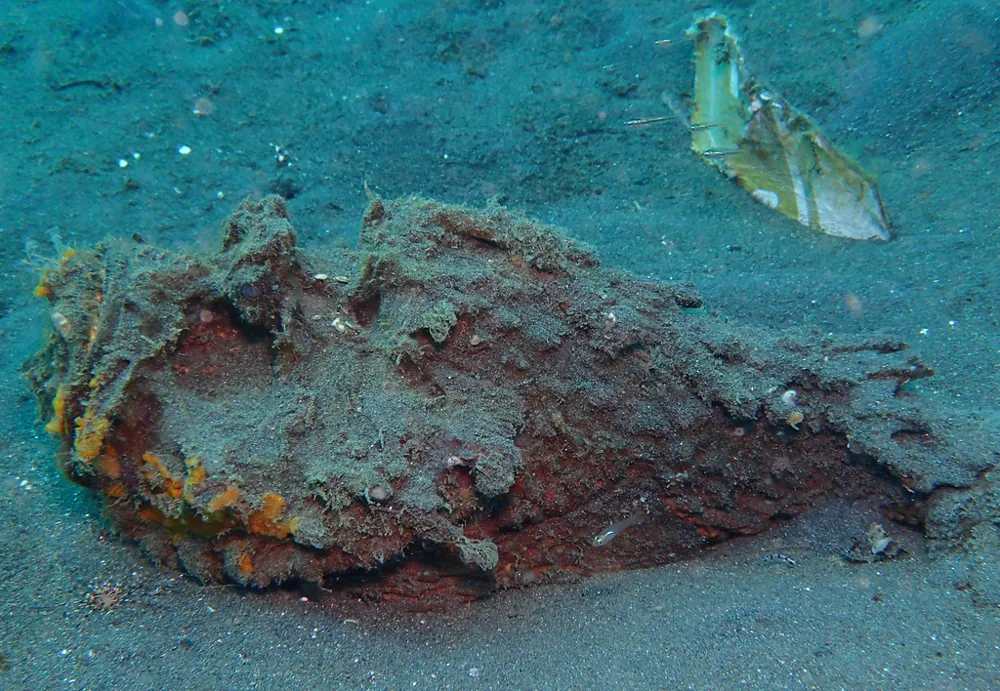
 Hoe om dit te herken
- Drab brownish-grey, reddish or greenish-brown colour1
- Skin has no scales and is covered in warts, often with filamentous algae growing on it1
- Head is flattened, with small eyes set high and pointing upwards, and a deep pit behind and under each eye1
- Large, almost vertical mouth with fringing cirri on the lips1
- Camouflaged to look like a stone resting on the bottom; it has no bright warning colours1
- Grows to a maximum of 60 cm1
Gifkrag
Skerp stekels dra die gif. Dit maak seer as jy daarop trap of dit gryp.
Wat doen sy gif as dit byt of steek?
Each fin spine has two venom-producing glands. The venom affects the cardiovascular and neuromuscular systems. The sting is extremely painful and has been known to be lethal.1
Hoe gevaarlik is dit vir mense?
Gevaar vir mense: Baie gevaarlikDit kan 'n mens doodmaak wat geen behandeling kry nie.It is considered one of the most dangerous venomous fishes. Stings are extremely painful and have been known to be fatal. Since European settlement, there have been no recorded deaths in Australia from stonefish venom, but deaths have been recorded elsewhere in its range.1
 Goeie nuus: dokters het 'n medisyne (teengif) of 'n behandeling hiervoor.1
Wat doen dit as dit bang is?
When disturbed, it erects its venomous spines, which inject venom if the fish is stepped on.1
 As sy stekels jou steek
- Antivenom can be given after envenomation. Immersing the sting wound in hot water can be used to denature the venom.1
- Sit die wond in warm water, so warm as wat die persoon kan verdra sonder om te brand (toets dit met jou eie hand), vir 30 tot 90 minute. Kry mediese hulp, veral vir klipvisse en pylsterte.
Bel altyd eers jou noodnommer (112, 000, 911). Dit is algemene noodhulpraad, nie mediese advies nie. Noodhulp-basiese beginsels
 Bly veilig
- Moet nooit aan 'n wilde dier raak, dit vang of terg nie, selfs nie 'n kleintjie nie, en selfs nie as dit lyk of dit slaap of dood is nie.
- Gee dit spasie. As jy een raakloop, bly kalm, stap stadig terug en laat dit sy eie pad gaan.
- As sy stekels jou steek: bly kalm, bly stil, bel jou noodnommer (112, 000, 911) of kom vinnig by 'n hospitaal uit. Onthou hoe dit gelyk het, 'n foto help.
Dit is nie uit om jou te kry nie. Dit gebruik sy gif om kos te vang of om homself te beskerm, en kruip baie eerder weg. Meer oor veilig bly
Waar in die wêreld?
Hoe groot is dit?
Hoe lank is dit?
 so lank soos 3 piesangs punt aan punt
 kan die lengte van 'n groot swembad (50 m) in 90 sekondes swem
Hoe groot is Estuarine stonefish in vergelyking met JOU?
Net wiskunde in jou blaaier. Niks word gestoor of enige plek heen gestuur nie.
Hoe vinnig is dit?


Feite
It can tolerate being out of the water for up to 24 hours.1
It scoops out a shallow hollow in the seabed with its large pectoral fins and curls its tail around its body to hide.1
It is camouflaged to look like a stone, unlike many venomous animals that use bright warning colours.1
Females are larger than males.1
Mite-breker
Mite: The species name horrida refers to its dangerous spines.
Waarheid: The name means "dreadful" or "frightful" and alludes to its appearance, not its venomous spines.1
Waar die feite vandaan kom
- Synanceia horrida (Wikipedia (CC BY-SA 4.0))
- Synanceia horrida (iNaturalist): name en klassifikasie.
- Venom Wiki: die gevaarvlak, die tipiese grootte en die spoedskatting is ons eie. Kyk hoe ons dit uitwerk: Hoe ons gevaar gradeer.
Elke feit op hierdie bladsy het 'n nommer wat na sy bron wys. As ons iets verkeerd het, jammer, ons is dierfanatici, nie 'n wetenskaplike joernaal nie. Laat weet ons by [email protected] en ons maak dit reg.
 Die skerpioen is honger! Venom Wiki is 'n eenmanprojek: gratis, sonder advertensies en sonder spoorsnyers. 'n Klein fooitjie help om dit aanlyn te hou.Voer die skerpioen
Meer uit dieselfde groep: Giftige visse
 Reef stonefishGiftige visseKan doodmaakMoenie aanraak nie
 Red lionfishGiftige visseMoet 'n dokter sienMoenie aanraak nie
 Short-tail stingrayGiftige visseKan doodmaak
 Striped eel catfishGiftige visseKan doodmaakMoenie aanraak nie
 Bluespotted ribbontail rayGiftige visseMoet 'n dokter sien
 Common stingrayGiftige visseMoet 'n dokter sien
Leef ook in: Indiese Oseaan
 Australian box jellyfishJellievisse & see-steekdiereDodelikMoenie aanraak nie
 Geography coneKeëlslakke & seekatteDodelik
 Greater blue-ringed octopusKeëlslakke & seekatteDodelik
 Southern blue-ringed octopusKeëlslakke & seekatteDodelik
 Hawksbill sea turtleAnder diere wat giftig is om aan te raak of te eetKan doodmaak
 Irukandji jellyfishJellievisse & see-steekdiereKan doodmaakMoenie aanraak nie