
 Afrika
 Asië
Asië Europa
 Suid-Amerika
 Australië & Oseanië
 Antarktika
 Stille Oseaan
 Atlantiese Oseaan
 Indiese Oseaan
 Arktiese Oseaan
 Middellandse See
 Rooi See
 Karibiese See
 Koraalsee
 Suid-Chinese See
 Filippynse See
 Andamansee
 Noordsee
 Timorsee & Arafurasee
 Baai van Bengale
 Golf van Kalifornië
Common toad
 Gif in sy velEet: VleisGiftig om aan te raak of te eet, nie deur 'n byt of steek nie
The common toad is a stout, warty toad that lives across most of Europe, in western North Asia and in a small part of northwest Africa. It hides under stones and leaves by day and hunts slugs, beetles and worms at night. Its skin releases a foul-tasting toxin that helps protect it from predators.1
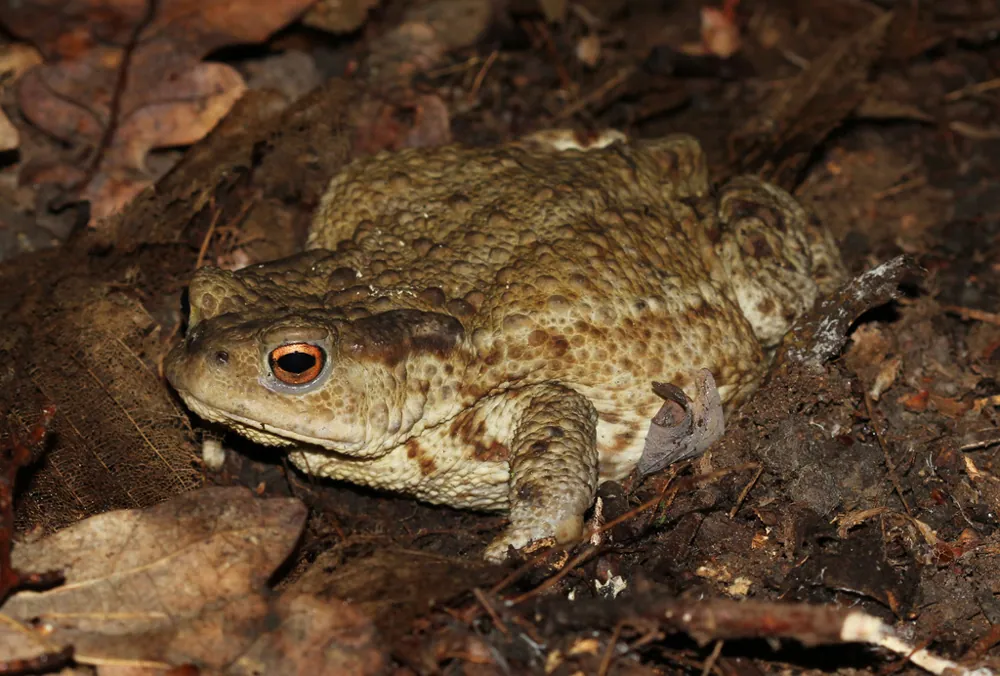
 Hoe om dit te herken
- Greyish-brown, olive-brown or brown skin covered in small, wart-like lumps1
- Bulging paratoid glands just behind the eyes, which are a clear sign of a toad1
- Yellow or copper-coloured eyes with horizontal, slit-shaped pupils1
- No tail, no teeth, and no neck visible between the head and body1
- Walks slowly or makes short shuffling hops, rather than leaping1
Word dikwels verwar met: The natterjack toad is usually smaller and has a yellow band down its back. The European green toad has a distinctive mottled pattern. The paratoid glands of both of these run parallel to each other, not slanting as in the common toad. The common frog has a less rounded snout, damp smooth skin, and usually leaps.1
Gifkrag
Sy vel is giftig. Dit is gevaarlik om aan te raak, te lek of te eet.
Wat doen sy gif as jy daaraan raak of dit eet?
The toad is poisonous rather than venomous, so it does not inject venom. Its paratoid glands and other skin glands secrete a noxious, foul-tasting substance containing bufotoxin, which is enough to deter many predators. Grass snakes seem to be unaffected by it.1
Hoe gevaarlik is dit vir mense?
Gevaar vir mense: PynlikDit kan regtig seermaak, maar dit is amper nooit ernstig nie.Wat doen dit as dit bang is?
When attacked, it inflates its body and stands with its hindquarters raised and its head lowered.1
 As iemand daaraan geraak of dit geëet het
- As iemand aan een geraak het: was die hande goed en moenie aan die oë of mond raak nie. As 'n kind of troeteldier een gelek of geëet het: bel 'n gifsentrum of jou noodnommer.
Bel altyd eers jou noodnommer (112, 000, 911). Dit is algemene noodhulpraad, nie mediese advies nie. Noodhulp-basiese beginsels
 Bly veilig
- Moet nooit aan 'n wilde dier raak, dit vang of terg nie, selfs nie 'n kleintjie nie, en selfs nie as dit lyk of dit slaap of dood is nie.
- Gee dit spasie. As jy een raakloop, bly kalm, stap stadig terug en laat dit sy eie pad gaan.
- As jy daaraan geraak of dit geëet het: moenie jou oë of mond vryf nie, was jou hande en kry mediese hulp.
Dit is nie uit om jou te kry nie. Sy gif is net daar sodat niks dit eet nie. Meer oor veilig bly
Waar in die wêreld?
Hoe groot is dit?
Hoe lank is dit?
 so lank soos 5 speelgoed-boublokke in 'n ry
 kan 100 meter in 180 sekondes aflê (die vinnigste mens het 9,6 nodig)
Hoe groot is Common toad in vergelyking met JOU?
Net wiskunde in jou blaaier. Niks word gestoor of enige plek heen gestuur nie.
Hoe vinnig is dit?


Feite
Common toads have been recorded at depths of about 99 m in Loch Ness, Scotland, which surprised researchers because it is an air-breathing animal.1
Crows have been seen puncturing the toad's skin and pecking out its liver to avoid the toxin.1
They can live for about ten to twelve years in the wild and have survived for fifty years in captivity.1
Toads can see prey in low light where humans cannot see anything.1
Adults often return to the same breeding pond year after year, and over 80% of males marked as juveniles were found to return to the pond where they were spawned.1
Vir gifkenners
- Wetenskaplike naam
- Bufo bufo
- Groep
- Gifpaddas, skurwepaddas & salamanders
- Familie
- Bufonidae2
- Orde
- Anura
- Kontinente
- Europa, Asië
- Babas
- The female lays eggs in gelatinous strings in the water. These hatch into tadpoles, which take several months to grow and sprout limbs before becoming tiny toads.1
- Lewensduur
- omtrent 10 jaar1
- Hoe dit in die natuur gaan
- Least Concern1
- Gevaar vir mense
- 2 / 5: Pynlik3
Waar die feite vandaan kom
- Common toad (Wikipedia (CC BY-SA 4.0))
- Bufo bufo (iNaturalist): name en klassifikasie.
- Venom Wiki: die gevaarvlak, die tipiese grootte en die spoedskatting is ons eie. Kyk hoe ons dit uitwerk: Hoe ons gevaar gradeer.
Elke feit op hierdie bladsy het 'n nommer wat na sy bron wys. As ons iets verkeerd het, jammer, ons is dierfanatici, nie 'n wetenskaplike joernaal nie. Laat weet ons by [email protected] en ons maak dit reg.
 Die skerpioen is honger! Venom Wiki is 'n eenmanprojek: gratis, sonder advertensies en sonder spoorsnyers. 'n Klein fooitjie help om dit aanlyn te hou.Voer die skerpioen
Meer uit dieselfde groep: Gifpaddas, skurwepaddas & salamanders
 Fire salamanderGifpaddas, skurwepaddas & salamandersMaak net seerMoenie aanraak nie
 Japanese fire-bellied newtGifpaddas, skurwepaddas & salamandersMoet 'n dokter sienMoenie aanraak nie
 European fire-bellied toadGifpaddas, skurwepaddas & salamandersOnskadelik
 Iberian ribbed newtGifpaddas, skurwepaddas & salamandersOnskadelik
 Natterjack toadGifpaddas, skurwepaddas & salamandersOnskadelik
 Oriental fire-bellied toadGifpaddas, skurwepaddas & salamandersOnskadelik
Leef ook in: Europa
 Common European adderAdders & vipersMoet 'n dokter sien
 Spanish flyAnder diere wat giftig is om aan te raak of te eetMoet 'n dokter sienMoenie aanraak nie
 Common waspBye, wespe & perdebyeMaak net seer
 European hornetBye, wespe & perdebyeMaak net seer
 Western honey beeBye, wespe & perdebyeMaak net seer
 Blunt-nosed viperAdders & vipersKan doodmaak