
 Afrika
 Asië
Asië Europa
 Suid-Amerika
 Australië & Oseanië
 Antarktika
 Stille Oseaan
 Atlantiese Oseaan
 Indiese Oseaan
 Arktiese Oseaan
 Middellandse See
 Rooi See
 Karibiese See
 Koraalsee
 Suid-Chinese See
 Filippynse See
 Andamansee
 Noordsee
 Timorsee & Arafurasee
 Baai van Bengale
 Golf van Kalifornië
Oriental fire-bellied toad
 Gif in sy velEet: InsekteGiftig om aan te raak of te eet, nie deur 'n byt of steek nie
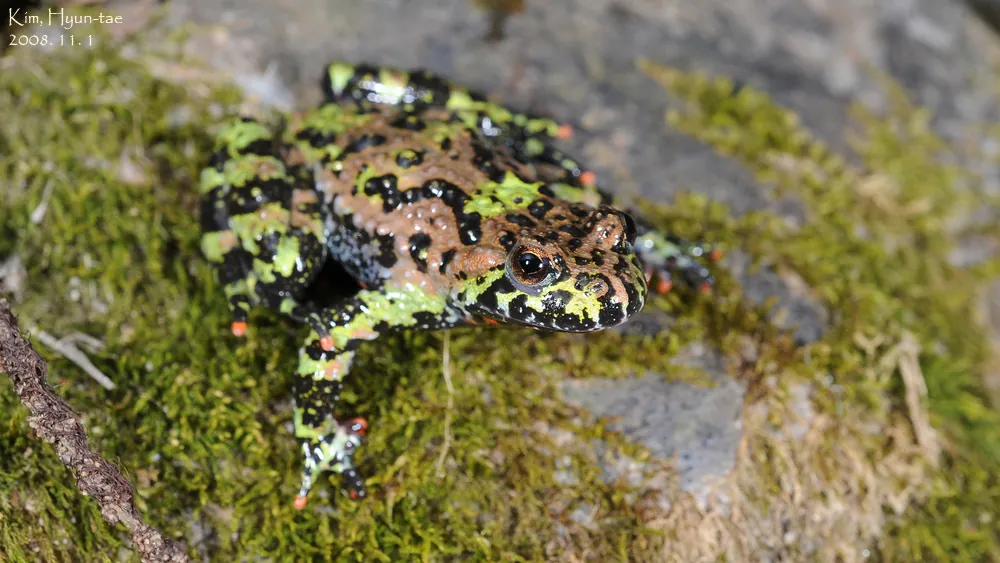
The Oriental fire-bellied toad is a small frog that lives in northeastern Asia, mostly near slow streams, ponds and forests. Its bright belly is a warning: when it is disturbed, it gives off a mild toxin through its skin. It is common across much of its range.1



 Hoe om dit te herken
- Bright grey, brownish or green upper skin with black mottling.1
- Bright yellow, red or orange-red belly, mottled with dark spots.1
- Red finger and toe tips are usually present.1
- Skin on the upper side is covered in small bumps called tubercles, which give it a toad-like look.1
- Adults are about 3.8 to 5.1 cm long.1
Word dikwels verwar met: It is often mistaken for a toad, but it is not a true toad. Compared with other Bombina frogs, it has no gular sacs (throat pouches), its belly is usually more red than yellow, and it has bright finger tips.1
Gifkrag
Sy vel is giftig. Dit is gevaarlik om aan te raak, te lek of te eet.
Wat doen sy gif as jy daaraan raak of dit eet?
The toad's skin releases a milky, mildly toxic substance when it is disturbed or frightened, mostly from the hind legs and sometimes the belly. Its toxins are described as mild, and the toxin does not pose a significant threat to human health. Captive toads are generally less toxic than wild ones, because their diet in the wild adds to their toxicity.1
Hoe gevaarlik is dit vir mense?
Gevaar vir mense: LigSoos 'n bysteek of minder. Basies onskadelik vir mense.The toxin does not pose a significant threat to human health, but its skin mucus can cause discomfort to the mouth and eyes if the toad is handled.1
Wat doen dit as dit bang is?
When threatened, it releases toxin from its skin, lies on its back to show its brightly coloured belly, and arches its head and holds up its limbs as a warning.1
 As iemand daaraan geraak of dit geëet het
- As iemand aan een geraak het: was die hande goed en moenie aan die oë of mond raak nie. As 'n kind of troeteldier een gelek of geëet het: bel 'n gifsentrum of jou noodnommer.
Bel altyd eers jou noodnommer (112, 000, 911). Dit is algemene noodhulpraad, nie mediese advies nie. Noodhulp-basiese beginsels
 Bly veilig
- Moet nooit aan 'n wilde dier raak, dit vang of terg nie, selfs nie 'n kleintjie nie, en selfs nie as dit lyk of dit slaap of dood is nie.
- Gee dit spasie. As jy een raakloop, bly kalm, stap stadig terug en laat dit sy eie pad gaan.
- As jy daaraan geraak of dit geëet het: moenie jou oë of mond vryf nie, was jou hande en kry mediese hulp.
Dit is nie uit om jou te kry nie. Sy gif is net daar sodat niks dit eet nie. Meer oor veilig bly
Waar in die wêreld?
Hoe groot is dit?
Hoe lank is dit?
Hoe swaar is dit?
 korter as jou pinkie
 kan 100 meter in 180 sekondes aflê (die vinnigste mens het 9,6 nodig)
Hoe groot is Oriental fire-bellied toad in vergelyking met JOU?
Net wiskunde in jou blaaier. Niks word gestoor of enige plek heen gestuur nie.
Hoe vinnig is dit?


Feite
Unusually for a frog, this species has no eardrum or resonator, and it makes its calls by inhaling.1
In experiments, these toads learned to solve mazes using water as a reward, which other frog types did not manage.1
Its skin contains bombesin, a peptide that affects stomach function in mammals. It was first found in its relative, the European fire-bellied toad.1
Males call to females with a light sound that is compared to a musical triangle.1
Grass snakes and other water-dwelling snakes are known to eat these toads without any ill effect.1
In captivity they often live for around 12 years, and some have lived up to 30 years.1
Mite-breker
Mite: It is a true toad.
Waarheid: It is not a true toad, although its bumpy skin gives it a toad-like appearance.1
Vir gifkenners
Waar die feite vandaan kom
- Oriental fire-bellied toad (Wikipedia (CC BY-SA 4.0))
- Bombina orientalis (iNaturalist): name en klassifikasie.
- Venom Wiki: die gevaarvlak, die tipiese grootte en die spoedskatting is ons eie. Kyk hoe ons dit uitwerk: Hoe ons gevaar gradeer.
Elke feit op hierdie bladsy het 'n nommer wat na sy bron wys. As ons iets verkeerd het, jammer, ons is dierfanatici, nie 'n wetenskaplike joernaal nie. Laat weet ons by [email protected] en ons maak dit reg.
 Die skerpioen is honger! Venom Wiki is 'n eenmanprojek: gratis, sonder advertensies en sonder spoorsnyers. 'n Klein fooitjie help om dit aanlyn te hou.Voer die skerpioen
Meer uit dieselfde groep: Gifpaddas, skurwepaddas & salamanders
 Japanese fire-bellied newtGifpaddas, skurwepaddas & salamandersMoet 'n dokter sienMoenie aanraak nie
 Common toadGifpaddas, skurwepaddas & salamandersMaak net seerMoenie aanraak nie
 Asian common toadGifpaddas, skurwepaddas & salamandersMoet 'n dokter sienMoenie aanraak nie
 Asiatic toadGifpaddas, skurwepaddas & salamandersMaak net seerMoenie aanraak nie
 Emperor newtGifpaddas, skurwepaddas & salamandersMaak net seerMoenie aanraak nie
 Himalayan newtGifpaddas, skurwepaddas & salamandersMaak net seerMoenie aanraak nie
 Deathstalker
 Indian cobra
 Indian saw-scaled viper
 King cobra
 Puff adder
 Russell-adder