
 Afrika
 Asië
Asië Europa
 Suid-Amerika
 Australië & Oseanië
 Antarktika
 Stille Oseaan
 Atlantiese Oseaan
 Indiese Oseaan
 Arktiese Oseaan
 Middellandse See
 Rooi See
 Karibiese See
 Koraalsee
 Suid-Chinese See
 Filippynse See
 Andamansee
 Noordsee
 Timorsee & Arafurasee
 Baai van Bengale
 Golf van Kalifornië
Flamboyant cuttlefish
 Giftig om te eetEet: VleisGiftig om aan te raak of te eet, nie deur 'n byt of steek nie
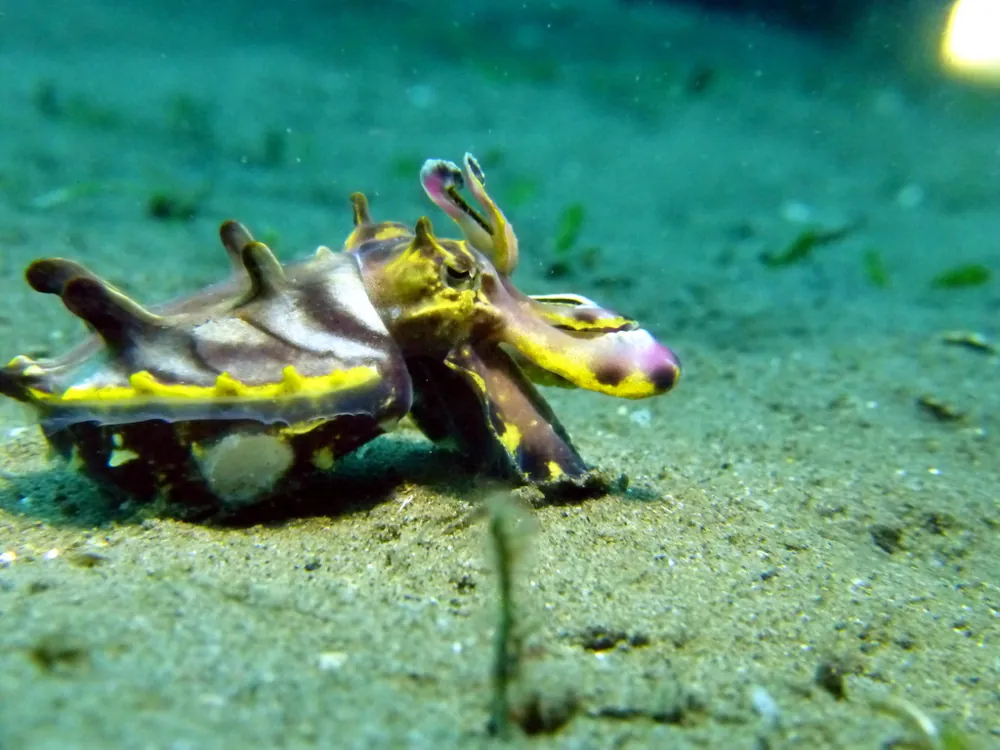
The flamboyant cuttlefish is a small sea creature that can change its colours and patterns in a flash. It lives in shallow tropical waters around northern Australia, New Guinea, the Philippines, Indonesia and Malaysia. It is special because its flesh is poisonous to eat, and it walks along the sea floor instead of swimming.1


 Hoe om dit te herken
- Has a very broad, oval body (mantle) and small, flat, fin-like flaps on the back1
- Broad, blade-like arms with four rows of suckers1
- Normal base colour is dark brown1
- When disturbed, it quickly turns black, dark brown and white, with yellow patches around the body, arms and eyes1
- Arm tips often flash bright red as a warning1
Gifkrag
Dit is net skadelik as iets dit eet.
Hoe gevaarlik is dit vir mense?
Gevaar vir mense: PynlikDit kan regtig seermaak, maar dit is amper nooit ernstig nie.Its muscle tissue is highly toxic, so eating it can be dangerous.1
Wat doen dit as dit bang is?
When disturbed or attacked, it changes colour to a dark, high-contrast pattern and shows bright red arm tips to warn off predators. It also walks along the sea floor while waving the wide membranes on its arms.1
 As iemand daaraan geraak of dit geëet het
- Drukimmobilisasie: draai 'n stewige elastiese verband oor die byt en dan op oor die hele arm of been, spalk dit en hou die persoon heeltemal stil totdat hulp opdaag.
- 'n Blouring-seekat of keëlslak kan 'n mens se asemhaling laat stop terwyl hy nog wakker is: roep hulp en wees gereed om asemhaling (mond-tot-mond) te gee totdat die ambulans oorneem.
Bel altyd eers jou noodnommer (112, 000, 911). Dit is algemene noodhulpraad, nie mediese advies nie. Noodhulp-basiese beginsels
 Bly veilig
- Moet nooit aan 'n wilde dier raak, dit vang of terg nie, selfs nie 'n kleintjie nie, en selfs nie as dit lyk of dit slaap of dood is nie.
- Gee dit spasie. As jy een raakloop, bly kalm, stap stadig terug en laat dit sy eie pad gaan.
- As jy daaraan geraak of dit geëet het: moenie jou oë of mond vryf nie, was jou hande en kry mediese hulp.
Dit is nie uit om jou te kry nie. Sy gif is net daar sodat niks dit eet nie. Meer oor veilig bly
Waar in die wêreld?
Hoe groot is dit?
Hoe lank is dit?
 so lank soos 2,5 speelgoed-boublokke in 'n ry
 kan die lengte van 'n groot swembad (50 m) in 12 sekondes swem
Hoe groot is Flamboyant cuttlefish in vergelyking met JOU?
Net wiskunde in jou blaaier. Niks word gestoor of enige plek heen gestuur nie.
Hoe vinnig is dit?

Feite
A toxicology report found its muscle tissue highly toxic, making it only the third cephalopod known to be poisonous.1
It is one of the only cuttlefish known to walk on the sea floor. This is because its cuttlebone lacks an outer cone, the part most other cuttlefish use to float.1
A female once laid about a dozen eggs inside an overturned half coconut husk, which kept them safe from fish.1
Its toxin has been compared with that of the blue-ringed octopus, but the strength of that link is disputed.1
Mite-breker
Mite: Its bright arm display means it is a dangerous, deadly poisonous animal.
Waarheid: The display is thought to warn predators that its flesh is poisonous. However, significant amounts of toxin have not yet been isolated from this species, and preliminary tests found only trace amounts of tetrodotoxin.1
Vir gifkenners
- Wetenskaplike naam
- Metasepia pfefferi
- Groep
- Keëlslakke & seekatte
- Familie
- Sepiidae2
- Orde
- Sepiida
- Kontinente
- Indiese Oseaan, Stille Oseaan, Koraalsee, Filippynse See, Timorsee & Arafurasee, Die oseane
- Babas
- Eggs are laid one at a time in crevices or on ledges in coral, rock or wood. Hatchlings look like adults and can copy the same camouflage patterns. They receive no care from their parents.1
- Gevaar vir mense
- 2 / 5: Pynlik3
Waar die feite vandaan kom
- Ascarosepion pfefferi (Wikipedia (CC BY-SA 4.0))
- Metasepia pfefferi (iNaturalist): name en klassifikasie.
- Venom Wiki: die gevaarvlak, die tipiese grootte en die spoedskatting is ons eie. Kyk hoe ons dit uitwerk: Hoe ons gevaar gradeer.
Elke feit op hierdie bladsy het 'n nommer wat na sy bron wys. As ons iets verkeerd het, jammer, ons is dierfanatici, nie 'n wetenskaplike joernaal nie. Laat weet ons by [email protected] en ons maak dit reg.
 Die skerpioen is honger! Venom Wiki is 'n eenmanprojek: gratis, sonder advertensies en sonder spoorsnyers. 'n Klein fooitjie help om dit aanlyn te hou.Voer die skerpioen
Meer uit dieselfde groep: Keëlslakke & seekatte
 Geography cone
 Greater blue-ringed octopus
 Southern blue-ringed octopus
 Blue sea dragon
 Common octopus
 Giant Pacific octopus
Leef ook in: Indiese Oseaan
 Australian box jellyfishJellievisse & see-steekdiereDodelikMoenie aanraak nie
 Hawksbill sea turtleAnder diere wat giftig is om aan te raak of te eetKan doodmaak
 Irukandji jellyfishJellievisse & see-steekdiereKan doodmaakMoenie aanraak nie
 Reef stonefishGiftige visseKan doodmaakMoenie aanraak nie
 Crown-of-thorns starfishSee-egels, seesterre & wurmsMoet 'n dokter sienMoenie aanraak nie
 Portuguese man o' warJellievisse & see-steekdiereMoet 'n dokter sienMoenie aanraak nie