
 Afrika
 Asië
Asië Europa
 Suid-Amerika
 Australië & Oseanië
 Antarktika
 Stille Oseaan
 Atlantiese Oseaan
 Indiese Oseaan
 Arktiese Oseaan
 Middellandse See
 Rooi See
 Karibiese See
 Koraalsee
 Suid-Chinese See
 Filippynse See
 Andamansee
 Noordsee
 Timorsee & Arafurasee
 Baai van Bengale
 Golf van Kalifornië
Garden tiger moth
 Brandhare
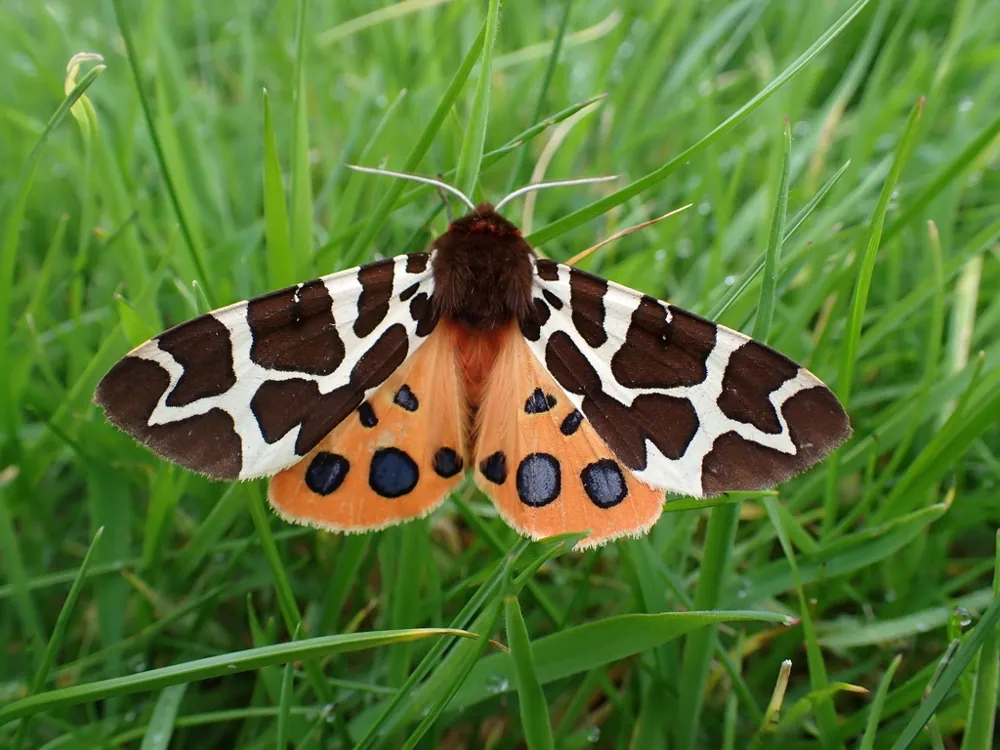
The garden tiger moth is a moth with bold patterned wings that warn predators it is unsafe to eat. It lives in cool, temperate parts of the northern United States, Canada, Europe and Asia. Its caterpillars are known as 'woolly bears' because of their fuzzy look.1

 Hoe om dit te herken
- Adults have a wingspan of 4.5 to 6.5 cm.1
- The front wings are brown with a white pattern, which is sometimes missing.1
- The back wings are orange with dark blue dots that have black outlines.1
- The moth often hides its orange hindwings under its brown forewings when resting.1
- Caterpillars are fuzzy and can grow up to 6 cm long.1
Gifkrag
Piepklein haartjies of borsels breek in die vel af en brand.
Wat doen sy gif as dit byt of steek?
This moth does not inject venom. Its body fluids are poisonous and contain neurotoxic choline esters, which are nerve-affecting chemicals that interfere with the acetylcholine receptor. The full effects of these toxins are not yet known. Caterpillars have hollow hairs that often contain irritating compounds.1
Hoe gevaarlik is dit vir mense?
Gevaar vir mense: LigSoos 'n bysteek of minder. Basies onskadelik vir mense.Wat doen dit as dit bang is?
When threatened, adults can spray an irritating compound from glands that are exposed at that moment, and their bright wing patterns warn predators.1
 As jy aan sy hare raak
- Vir ruspe-brandhare: lig hulle af met kleefband en was dan die vel. Moenie vryf nie.
- Vir byte: was en koel af. Kry mediese hulp as die persoon sleg voel of maklik bloei.
Bel altyd eers jou noodnommer (112, 000, 911). Dit is algemene noodhulpraad, nie mediese advies nie. Noodhulp-basiese beginsels
 Bly veilig
- Moet nooit aan 'n wilde dier raak, dit vang of terg nie, selfs nie 'n kleintjie nie, en selfs nie as dit lyk of dit slaap of dood is nie.
- Gee dit spasie. As jy een raakloop, bly kalm, stap stadig terug en laat dit sy eie pad gaan.
- As jy aan sy hare raak: bly kalm, bly stil, bel jou noodnommer (112, 000, 911) of kom vinnig by 'n hospitaal uit. Onthou hoe dit gelyk het, 'n foto help.
Dit is nie uit om jou te kry nie. Dit gebruik sy gif om kos te vang of om homself te beskerm, en kruip baie eerder weg. Meer oor veilig bly
Waar in die wêreld?
Hoe groot is dit?
Hoe lank is dit?
 so lank soos 2 speelgoed-boublokke in 'n ry
 stadiger as 'n tuinslak
Hoe groot is Garden tiger moth in vergelyking met JOU?
Net wiskunde in jou blaaier. Niks word gestoor of enige plek heen gestuur nie.
Hoe vinnig is dit?

Feite
Adults can make rasping sounds with their wings and high-pitched squeaks that people can hear, and bats tend to avoid them.1
Caterpillars can break down the toxins in their host plants and reuse them in altered form for their own protection.1
The French entomologist Oberthür described about 500 different wing pattern and colour variants.1
Adults are mostly active at night, from June to September.1
Vir gifkenners
- Wetenskaplike naam
- Arctia caja
- Groep
- Ruspes & goggas
- Familie
- Erebidae2
- Orde
- Lepidoptera
- Kontinente
- Europa, Asië, Noord-Amerika
- Babas
- Eggs are laid on the surfaces of leaves, and the caterpillars hatch and begin feeding soon after.1
- Hoe dit in die natuur gaan
- Protected in the UK under the Biodiversity Action Plan, after its UK numbers fell by 89% over 30 years1
- Gevaar vir mense
- 1 / 5: Lig3
Waar die feite vandaan kom
- Garden tiger moth (Wikipedia (CC BY-SA 4.0))
- Arctia caja (iNaturalist): name en klassifikasie.
- Venom Wiki: die gevaarvlak, die tipiese grootte en die spoedskatting is ons eie. Kyk hoe ons dit uitwerk: Hoe ons gevaar gradeer.
Elke feit op hierdie bladsy het 'n nommer wat na sy bron wys. As ons iets verkeerd het, jammer, ons is dierfanatici, nie 'n wetenskaplike joernaal nie. Laat weet ons by [email protected] en ons maak dit reg.
 Die skerpioen is honger! Venom Wiki is 'n eenmanprojek: gratis, sonder advertensies en sonder spoorsnyers. 'n Klein fooitjie help om dit aanlyn te hou.Voer die skerpioen
Meer uit dieselfde groep: Ruspes & goggas
 Giant water bugRuspes & goggasMaak net seer
 Oak processionaryRuspes & goggasMaak net seerMoenie aanraak nie
 Pine processionaryRuspes & goggasMaak net seerMoenie aanraak nie
 Puss caterpillarRuspes & goggasMaak net seerMoenie aanraak nie
 Saddleback caterpillarRuspes & goggasMaak net seerMoenie aanraak nie
 Wheel bugRuspes & goggasMaak net seer
Leef ook in: Europa
 Common European adderAdders & vipersMoet 'n dokter sien
 Spanish flyAnder diere wat giftig is om aan te raak of te eetMoet 'n dokter sienMoenie aanraak nie
 Common waspBye, wespe & perdebyeMaak net seer
 European hornetBye, wespe & perdebyeMaak net seer
 Fire salamanderGifpaddas, skurwepaddas & salamandersMaak net seerMoenie aanraak nie
 Western honey beeBye, wespe & perdebyeMaak net seer