
 Afrika
 Asië
Asië Europa
 Suid-Amerika
 Australië & Oseanië
 Antarktika
 Stille Oseaan
 Atlantiese Oseaan
 Indiese Oseaan
 Arktiese Oseaan
 Middellandse See
 Rooi See
 Karibiese See
 Koraalsee
 Suid-Chinese See
 Filippynse See
 Andamansee
 Noordsee
 Timorsee & Arafurasee
 Baai van Bengale
 Golf van Kalifornië
Long-spine porcupinefish
 Giftig om te eetEet: 'n Bietjie van allesGiftig om aan te raak of te eet, nie deur 'n byt of steek nie
The long-spine porcupinefish is a marine fish covered in long, sharp spines. It lives in warm tropical and subtropical seas around the world, often over muddy seabeds or on reefs. Its beak-like jaws can crush hard prey such as sea urchins and shellfish.1



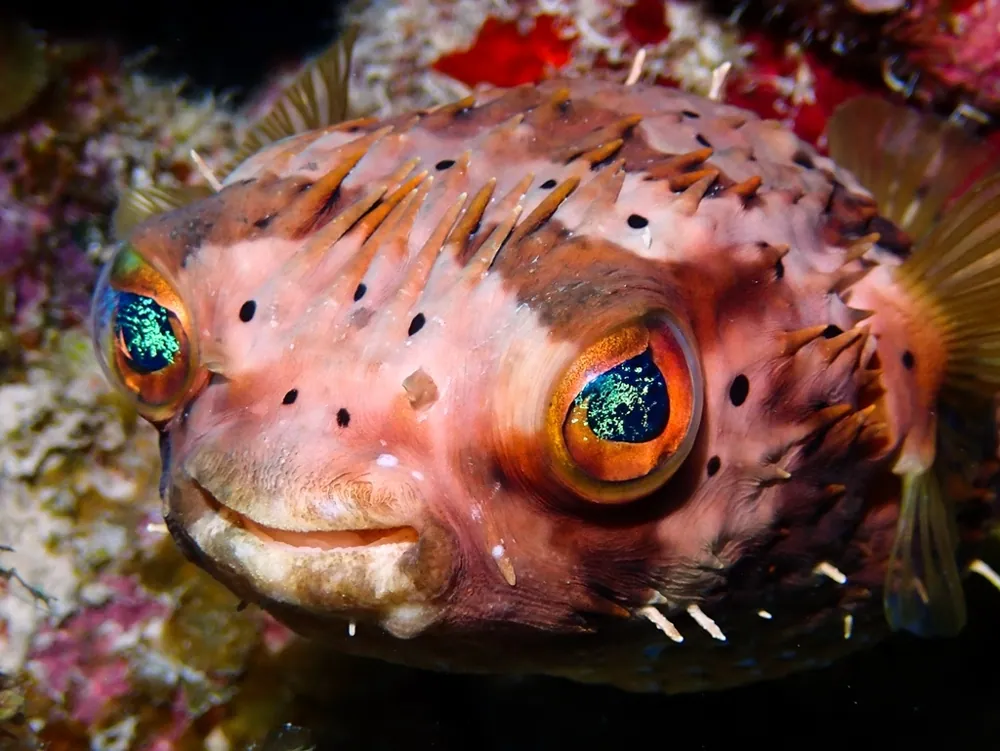
 Hoe om dit te herken
- Pale in colour, with large black blotches and smaller black spots. The spots become fewer as the fish gets older.1
- Many long spines, each with two roots, which can be raised or lowered. They are especially numerous on the head.1
- The teeth of the two jaws are fused into a parrot-like beak.1
- Adults can reach 50 cm in length.1
Word dikwels verwar met: The black-blotched porcupinefish (Diodon liturosus) is the only other fish it might be confused with. The long-spine porcupinefish has much longer spines.1
Gifkrag
Dit is net skadelik as iets dit eet.
Hoe gevaarlik is dit vir mense?
Gevaar vir mense: ErnstigAs iemand dit eet, moet hy dokter toe gaan. Sterftes is baie skaars. As iemand daaraan geraak of dit geëet het
- As iemand dit geëet het of simptome kry nadat hy dit geëet het: bel dadelik jou noodnommer of 'n gifsentrum.
Bel altyd eers jou noodnommer (112, 000, 911). Dit is algemene noodhulpraad, nie mediese advies nie. Noodhulp-basiese beginsels
 Bly veilig
- Moet nooit aan 'n wilde dier raak, dit vang of terg nie, selfs nie 'n kleintjie nie, en selfs nie as dit lyk of dit slaap of dood is nie.
- Gee dit spasie. As jy een raakloop, bly kalm, stap stadig terug en laat dit sy eie pad gaan.
- As jy daaraan geraak of dit geëet het: moenie jou oë of mond vryf nie, was jou hande en kry mediese hulp.
Dit is nie uit om jou te kry nie. Sy gif is net daar sodat niks dit eet nie. Meer oor veilig bly
Waar in die wêreld?
Hoe groot is dit?
Hoe lank is dit?
 so lank soos 3 piesangs punt aan punt
 so lank soos 16 speelgoed-boublokke in 'n ry
 kan die lengte van 'n groot swembad (50 m) in 45 sekondes swem
Hoe groot is Long-spine porcupinefish in vergelyking met JOU?
Net wiskunde in jou blaaier. Niks word gestoor of enige plek heen gestuur nie.
Hoe vinnig is dit?
Feite
Its jaws are fused into a beak that looks like a parrot's, and it uses it to crack open sea urchins and molluscs.1
Its spines have two roots and can be raised or lowered.1
The black spots on its pale body become fewer as it ages.1
Young fish are found in groups, and they stay in open water until they reach about 7 cm.1
Vir gifkenners
- Wetenskaplike naam
- Diodon holocanthus
- Groep
- Ander diere wat giftig is om aan te raak of te eet
- Familie
- Diodontidae2
- Orde
- Tetraodontiformes
- Kontinente
- Stille Oseaan, Atlantiese Oseaan, Indiese Oseaan, Rooi See, Karibiese See, Koraalsee, Filippynse See, Suid-Chinese See, Golf van Meksiko, Timorsee & Arafurasee, Baai van Bengale, Golf van Kalifornië, Die oseane
- Babas
- It spawns at the surface at dawn or dusk, in pairs or in groups of males with one female. The young stay pelagic (living in open water) until they are at least 7 cm long.1
- Gevaar vir mense
- 3 / 5: Ernstig3
Waar die feite vandaan kom
- Long-spine porcupinefish (Wikipedia (CC BY-SA 4.0))
- Diodon holocanthus (iNaturalist): name en klassifikasie.
- Venom Wiki: die gevaarvlak, die tipiese grootte en die spoedskatting is ons eie. Kyk hoe ons dit uitwerk: Hoe ons gevaar gradeer.
Elke feit op hierdie bladsy het 'n nommer wat na sy bron wys. As ons iets verkeerd het, jammer, ons is dierfanatici, nie 'n wetenskaplike joernaal nie. Laat weet ons by [email protected] en ons maak dit reg.
 Die skerpioen is honger! Venom Wiki is 'n eenmanprojek: gratis, sonder advertensies en sonder spoorsnyers. 'n Klein fooitjie help om dit aanlyn te hou.Voer die skerpioen
Meer uit dieselfde groep: Ander diere wat giftig is om aan te raak of te eet
 Japanese pufferfishAnder diere wat giftig is om aan te raak of te eetDodelik
 Hawksbill sea turtleAnder diere wat giftig is om aan te raak of te eetKan doodmaak
 Greenland sharkAnder diere wat giftig is om aan te raak of te eetMaak net seer
 Silver-cheeked toadfishAnder diere wat giftig is om aan te raak of te eetDodelik
 Blackspotted pufferAnder diere wat giftig is om aan te raak of te eetKan doodmaak
 White-spotted pufferAnder diere wat giftig is om aan te raak of te eetKan doodmaak
Leef ook in: Stille Oseaan
 Australian box jellyfishJellievisse & see-steekdiereDodelikMoenie aanraak nie
 Geography coneKeëlslakke & seekatteDodelik
 Greater blue-ringed octopusKeëlslakke & seekatteDodelik
 Southern blue-ringed octopusKeëlslakke & seekatteDodelik
 Irukandji jellyfishJellievisse & see-steekdiereKan doodmaakMoenie aanraak nie
 Reef stonefishGiftige visseKan doodmaakMoenie aanraak nie