
 Afrika
 Asië
Asië Europa
 Suid-Amerika
 Australië & Oseanië
 Antarktika
 Stille Oseaan
 Atlantiese Oseaan
 Indiese Oseaan
 Arktiese Oseaan
 Middellandse See
 Rooi See
 Karibiese See
 Koraalsee
 Suid-Chinese See
 Filippynse See
 Andamansee
 Noordsee
 Timorsee & Arafurasee
 Baai van Bengale
 Golf van Kalifornië
Textile cone
 Steke
StekeThe textile cone is a venomous sea snail. It is a mollusc with a patterned shell, and it hunts other snails at night. It lives in warm seas around Africa, Australia and the Pacific, and it can sting people, so it is important to know it.1

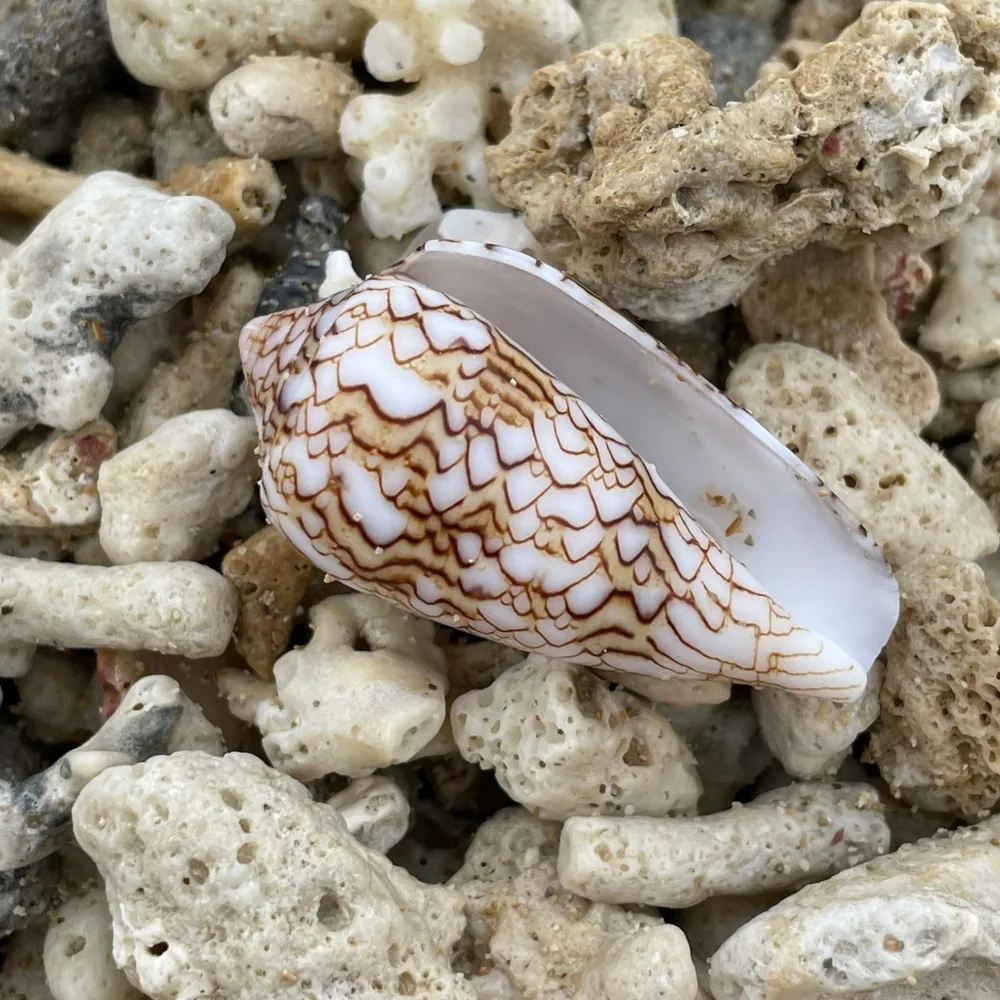
 Hoe om dit te herken
Gifkrag
Gif kom deur 'n angel uit.
Wat doen sy gif as dit byt of steek?
Its venom is a conotoxin, a mix of toxins injected through the harpoon-like radular tooth. The venom contains the neurotoxin RPRFamide, which attacks the nerves.1
Hoe gevaarlik is dit vir mense?
Gevaar vir mense: Baie gevaarlikDit kan 'n mens doodmaak wat geen behandeling kry nie.Several human deaths have been attributed to this species. A 2004 report linked about 30 human deaths to cone snails as a group. Live animals should be handled carefully or not at all, and anyone handling one without protecting exposed skin is at risk.1
 As dit steek
- Drukimmobilisasie: draai 'n stewige elastiese verband oor die byt en dan op oor die hele arm of been, spalk dit en hou die persoon heeltemal stil totdat hulp opdaag.
- 'n Blouring-seekat of keëlslak kan 'n mens se asemhaling laat stop terwyl hy nog wakker is: roep hulp en wees gereed om asemhaling (mond-tot-mond) te gee totdat die ambulans oorneem.
Bel altyd eers jou noodnommer (112, 000, 911). Dit is algemene noodhulpraad, nie mediese advies nie. Noodhulp-basiese beginsels
 Bly veilig
- Moet nooit aan 'n wilde dier raak, dit vang of terg nie, selfs nie 'n kleintjie nie, en selfs nie as dit lyk of dit slaap of dood is nie.
- Gee dit spasie. As jy een raakloop, bly kalm, stap stadig terug en laat dit sy eie pad gaan.
- As een jou steek: bly kalm, bly stil, bel jou noodnommer (112, 000, 911) of kom vinnig by 'n hospitaal uit. Onthou hoe dit gelyk het, 'n foto help.
Dit is nie uit om jou te kry nie. Dit gebruik sy gif om kos te vang of om homself te beskerm, en kruip baie eerder weg. Meer oor veilig bly
Waar in die wêreld?
Hoe groot is dit?
Hoe lank is dit?
 so lank soos 5 speelgoed-boublokke in 'n ry
 stadiger as 'n tuinslak
Hoe groot is Textile cone in vergelyking met JOU?
Net wiskunde in jou blaaier. Niks word gestoor of enige plek heen gestuur nie.
Hoe vinnig is dit?

Feite
Its shell pattern is made by natural cellular automata, and it resembles Wolfram's rule 30 pattern.1
The pigment cells that make the pattern sit in a narrow band along the shell's lip, and each cell responds to its neighbours.1
Its proboscis can reach any part of its own shell.1
In Australia it is most common in northern Queensland, but sightings are spreading south into New South Wales as ocean temperatures warm with climate change.1
Its larvae drift in the current for about 16 days before settling on the bottom of the sea.1
Vir gifkenners
- Wetenskaplike naam
- Conus textile
- Groep
- Keëlslakke & seekatte
- Familie
- Conidae2
- Orde
- Neogastropoda
- Kontinente
- Indiese Oseaan, Stille Oseaan, Koraalsee, Rooi See, Filippynse See, Arabiese See & Persiese Golf, Timorsee & Arafurasee, Baai van Bengale, Die oseane
- Babas
- The female lays several hundred eggs at a time. They hatch after about 16 or 17 days, and the larvae float in the current for about 16 days before settling on the sea floor at about 1.5 mm long.1
- Gevaar vir mense
- 4 / 5: Baie gevaarlik3
Waar die feite vandaan kom
- Conus textile (Wikipedia (CC BY-SA 4.0))
- Conus textile (iNaturalist): name en klassifikasie.
- Venom Wiki: die gevaarvlak, die tipiese grootte en die spoedskatting is ons eie. Kyk hoe ons dit uitwerk: Hoe ons gevaar gradeer.
Elke feit op hierdie bladsy het 'n nommer wat na sy bron wys. As ons iets verkeerd het, jammer, ons is dierfanatici, nie 'n wetenskaplike joernaal nie. Laat weet ons by [email protected] en ons maak dit reg.
 Die skerpioen is honger! Venom Wiki is 'n eenmanprojek: gratis, sonder advertensies en sonder spoorsnyers. 'n Klein fooitjie help om dit aanlyn te hou.Voer die skerpioen
Meer uit dieselfde groep: Keëlslakke & seekatte
 Geography cone
 Greater blue-ringed octopus
 Southern blue-ringed octopus
 Blue sea dragon
 Common octopus
 Giant Pacific octopus
Leef ook in: Indiese Oseaan
 Australian box jellyfishJellievisse & see-steekdiereDodelikMoenie aanraak nie
 Hawksbill sea turtleAnder diere wat giftig is om aan te raak of te eetKan doodmaak
 Irukandji jellyfishJellievisse & see-steekdiereKan doodmaakMoenie aanraak nie
 Reef stonefishGiftige visseKan doodmaakMoenie aanraak nie
 Crown-of-thorns starfishSee-egels, seesterre & wurmsMoet 'n dokter sienMoenie aanraak nie
 Portuguese man o' warJellievisse & see-steekdiereMoet 'n dokter sienMoenie aanraak nie