
 Afrika
 Asië
Asië Europa
 Suid-Amerika
 Australië & Oseanië
 Antarktika
 Stille Oseaan
 Atlantiese Oseaan
 Indiese Oseaan
 Arktiese Oseaan
 Middellandse See
 Rooi See
 Karibiese See
 Koraalsee
 Suid-Chinese See
 Filippynse See
 Andamansee
 Noordsee
 Timorsee & Arafurasee
 Baai van Bengale
 Golf van Kalifornië
West African night adder
 Byte
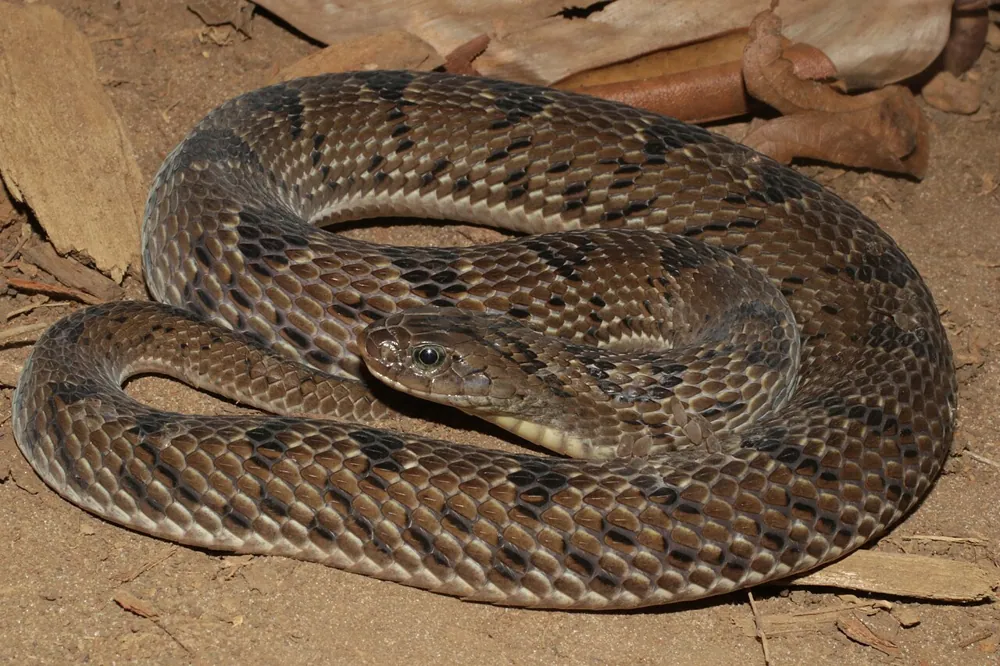
ByteThe West African night adder is a small, stout snake that lives in forests, savannas and dry semi-desert across West and Central Africa. It is venomous, but its bite usually causes only mild symptoms. It is known for hunting frogs and toads.1

 Hoe om dit te herken
- Small and stout, usually 30 to 60 cm (12 to 24 in) long including the tail.1
- Brown background colour, sometimes grey, olive or light green, with a row of dark brown or blackish patches down the back.1
- Flanks sprinkled with black scales.1
- A distinct V-shaped mark on the head. It is solid black in young snakes and brown with a black outline in adults.1
- Some snakes, especially from drier areas, have no back pattern at all, which makes them hard to identify. Those from DR Congo are often plain brown.1
Gifkrag
Gif kom deur sy giftande of tande uit wanneer dit byt.
Wat doen sy gif as dit byt of steek?
Bites cause mild symptoms, including pain, moderate swelling, swollen lymph nodes near the bite (local lymphadenitis) and a mild fever. Blistering has not been reported, and tissue death (necrosis) is rare and usually happens only as a secondary effect. The symptoms usually fade after two to three days, normally without complications.1
Hoe gevaarlik is dit vir mense?
Gevaar vir mense: PynlikDit kan regtig seermaak, maar dit is amper nooit ernstig nie.Bites from this snake are described as causing mild symptoms that normally clear up without complications.1
 As dit byt
- Hou die persoon stil en kalm, hou die gebyte arm of been op hartvlak, haal ringe en stywe goed af, en kom vinnig by 'n hospitaal uit.
Bel altyd eers jou noodnommer (112, 000, 911). Dit is algemene noodhulpraad, nie mediese advies nie. Noodhulp-basiese beginsels
 Bly veilig
- Moet nooit aan 'n wilde dier raak, dit vang of terg nie, selfs nie 'n kleintjie nie, en selfs nie as dit lyk of dit slaap of dood is nie.
- Gee dit spasie. As jy een raakloop, bly kalm, stap stadig terug en laat dit sy eie pad gaan.
- As een jou byt: bly kalm, bly stil, bel jou noodnommer (112, 000, 911) of kom vinnig by 'n hospitaal uit. Onthou hoe dit gelyk het, 'n foto help.
Dit is nie uit om jou te kry nie. Dit gebruik sy gif om kos te vang of om homself te beskerm, en kruip baie eerder weg. Meer oor veilig bly
Waar in die wêreld?
Hoe groot is dit?
Hoe lank is dit?
 so lank soos 4 piesangs punt aan punt
 kan 100 meter in 110 sekondes aflê (die vinnigste mens het 9,6 nodig)
Hoe groot is West African night adder in vergelyking met JOU?
Net wiskunde in jou blaaier. Niks word gestoor of enige plek heen gestuur nie.
Hoe vinnig is dit?


Feite
Despite its name, the night adder is active at any time of day or night, and it has sometimes been seen basking in the sun.1
It is a slow-moving snake, but it can strike quickly. It tends to lash at its target rather than stab.1
It is most active in the rainy season, from March to October, when its prey is plentiful. It almost disappears during the dry season.1
Its back pattern varies a lot. Some snakes have no pattern at all, and snakes from DR Congo are often a uniform brown.1
Waar die feite vandaan kom
- Causus maculatus (Wikipedia (CC BY-SA 4.0))
- Causus maculatus (iNaturalist): name en klassifikasie.
- Venom Wiki: die gevaarvlak, die tipiese grootte en die spoedskatting is ons eie. Kyk hoe ons dit uitwerk: Hoe ons gevaar gradeer.
Elke feit op hierdie bladsy het 'n nommer wat na sy bron wys. As ons iets verkeerd het, jammer, ons is dierfanatici, nie 'n wetenskaplike joernaal nie. Laat weet ons by [email protected] en ons maak dit reg.
 Die skerpioen is honger! Venom Wiki is 'n eenmanprojek: gratis, sonder advertensies en sonder spoorsnyers. 'n Klein fooitjie help om dit aanlyn te hou.Voer die skerpioen
 Puff adder
 Gaboon viper
 Northeast African carpet viper
 West African carpet viper
 Rhinoceros viper
 West African Gaboon viper
 Black mamba
 Deathstalker
 Egyptian cobra
 Boomslang
 Fat-tailed scorpion
 Western honey bee