
 Àfrica
 Àsia
Àsia Europa
 Amèrica del Sud
 Austràlia i Oceania
 Antàrtida
 Oceà Pacífic
 Oceà Atlàntic
 Oceà Índic
 Oceà Àrtic
 Mar Mediterrània
 Mar Roja
 Mar Carib
 Mar del Corall
 Mar de la Xina Meridional
 Mar de les Filipines
 Mar d'Andaman
 Mar del Nord
 Mar de Timor i d'Arafura
 Golf de Bengala
 Golf de Califòrnia
Climbing mantella
 Toxines a la pell
The climbing mantella is a small, brightly coloured frog that lives in the lowland rainforests of northeast Madagascar. It is a poison frog, so its skin holds chemicals that can harm predators. It is special because it is one of the few frogs whose parents care for their tadpoles by feeding them eggs.1



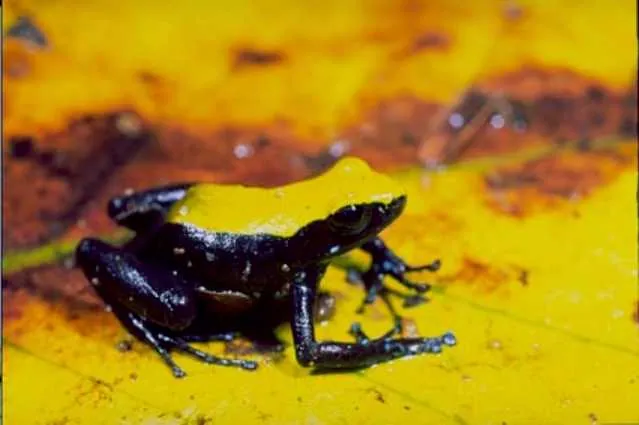
 Com reconèixer-lo
- Adults are 24–30 mm long and weigh 1.2–2.0 g1
- Front of the back is bright yellow or pale green1
- Arms, legs, belly and rear are black, with blue spots on the limbs1
- Eyes are completely black1
- Has discs at the tips of its fingers and toes, and the toes are webbed1
Sovint es confon amb: M. betsileo, M. viridis and M. expectata look similar but are differently coloured. They often have blue spots on the throat rather than the limbs, and they have a faint line along the upper lip, which the climbing mantella lacks.1
Poder tòxic
La seva pell és tòxica. És perillós tocar-lo, llepar-lo o menjar-se'l.
Què fan les seves toxines?
This frog is poisonous rather than venomous. Its skin glands contain lipophilic alkaloids, the chemicals that make up its poison, which it gets from the arthropods it eats. Researchers have found 41 different potent alkaloids in its skin. Captive frogs lose their toxicity over time.1
Com de perillós és per a les persones?
Perill per a les persones: LleuCom una picada d'abella o menys. Pràcticament inofensiu per a les persones.Què fa quan té por?
Its bright colours warn predators that its skin is toxic.1
 Si algú l'ha tocat o se l'ha menjat
- Si algú n'ha tocat un: renta-li bé les mans i que no es toqui els ulls ni la boca. Si un nen o una mascota n'ha llepat o menjat un: truca al centre de toxicologia o al número d'emergències.
Truca sempre primer al número d'emergències (112, 000, 911). Això són pautes generals de primers auxilis, no consells mèdics. Primers auxilis bàsics
 Estigues segur
- No toquis, atrapis ni molestis mai un animal salvatge, encara que sigui petit i encara que sembli adormit o mort.
- Deixa-li espai. Si en trobes un, mantén la calma, recula a poc a poc i deixa que segueixi el seu camí.
- Si l'has tocat o te l'has menjat: no et freguis els ulls ni la boca, renta't les mans i busca ajuda mèdica.
No va a per tu. Les seves toxines només hi són perquè ningú no se'l mengi. Més sobre com estar segur
Que gran és?
Quant fa de llarg?
Quant pesa?
 més o menys el que fa de llarg un clip
 tan lleuger que no el notaries a la mà
 podria recórrer 100 metres en 100 segons (l'humà més ràpid necessita 9,6)
Que gran és Climbing mantella comparat amb TU?
Només càlculs al teu navegador. No es desa ni s'envia res enlloc.
Com de ràpid va?


Dades
Its tadpoles eat only the eggs of their own species, and the parents feed them unfertilized eggs.1
Males defend territories of about 2 square metres and fight by wrestling, chasing and leaping, sometimes for over 1.5 hours.1
Female frogs choose a mate based on the quality of the male's well, not on his call.1
The climbing mantella is the only member of the Mantella genus that breeds in water-filled wells in trees, tree holes or broken bamboo stalks.1
Its chemical defence has developed in a similar way to that of the dart frogs of Dendrobatidae, although the two families are only distantly related.1
Per a experts en verins
- Nom científic
- Mantella laevigata
- Grup
- Granotes punta de fletxa, gripaus i tritons
- Família
- Mantellidae2
- Ordre
- Anura
- Continents
- Àfrica
- Cries
- Usually lays only one large egg, 3–3.5 mm across, at the side of a water-filled well or above the water line. The parents feed tadpoles unfertilized eggs.1
- Com li va a la natura
- Least Concern (IUCN Red List, 2016), though its population is suspected to be decreasing1
- Perill per a les persones
- 1 / 5: Lleu3
D'on surten les dades
- Climbing mantella (Wikipedia (CC BY-SA 4.0))
- Mantella laevigata (iNaturalist): noms i classificació.
- Venom Wiki: el nivell de perill, la mida típica i la velocitat estimada són nostres. Mira com els calculem: Com valorem el perill.
Cada dada d'aquesta pàgina té un número que porta a la seva font. Si ens hem equivocat en alguna cosa, perdona, som fans dels animals, no una revista científica. Escriu-nos a [email protected] i ho arreglarem.
 L'escorpí té gana! Venom Wiki és un projecte d'una sola persona: gratuït, sense anuncis i sense rastrejadors. Una petita propina ajuda a mantenir-lo en línia.Dona menjar a l'escorpí
Més del mateix grup: Granotes punta de fletxa, gripaus i tritons
 Golden mantellaGranotes punta de fletxa, gripaus i tritonsInofensiu
 Iberian ribbed newtGranotes punta de fletxa, gripaus i tritonsInofensiu
 Tomato frogGranotes punta de fletxa, gripaus i tritonsInofensiu
 African common toadGranotes punta de fletxa, gripaus i tritonsNomés fa malNo ho toquis
 Baron's mantellaGranotes punta de fletxa, gripaus i tritonsInofensiu
 Blue-legged mantellaGranotes punta de fletxa, gripaus i tritonsInofensiu
 Black mamba
 Deathstalker
 Egyptian cobra
 Puff adder
 Boomslang
 Fat-tailed scorpion