
 Àfrica
 Àsia
Àsia Europa
 Amèrica del Sud
 Austràlia i Oceania
 Antàrtida
 Oceà Pacífic
 Oceà Atlàntic
 Oceà Índic
 Oceà Àrtic
 Mar Mediterrània
 Mar Roja
 Mar Carib
 Mar del Corall
 Mar de la Xina Meridional
 Mar de les Filipines
 Mar d'Andaman
 Mar del Nord
 Mar de Timor i d'Arafura
 Golf de Bengala
 Golf de Califòrnia
Clinging jellyfish
 Tentacles urticants
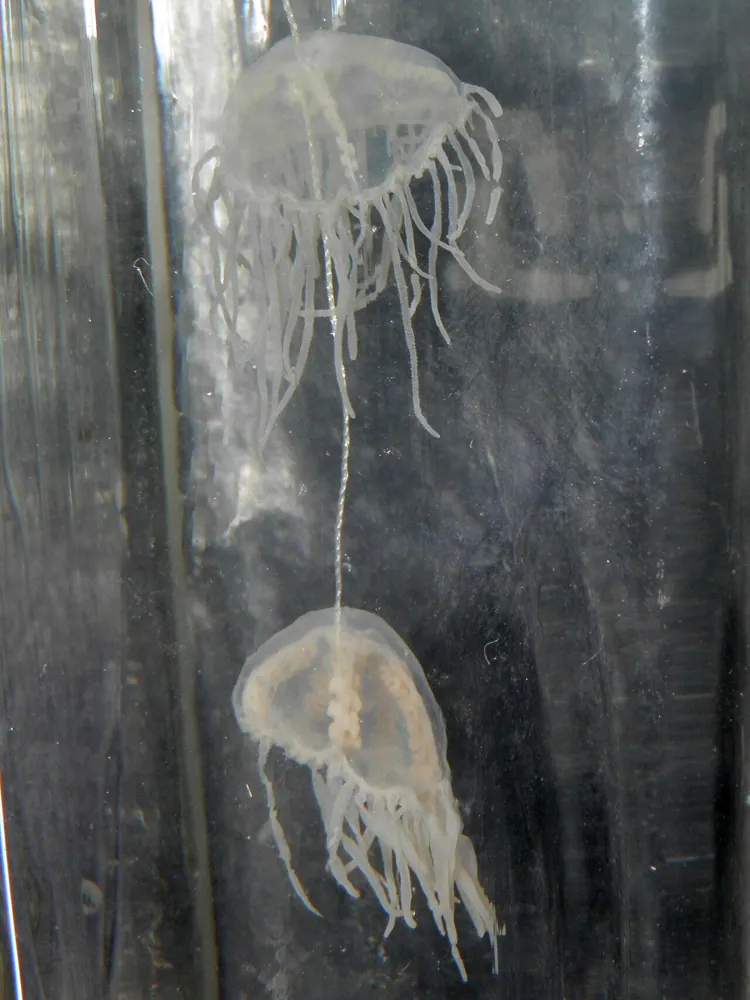
The clinging jellyfish is a small jellyfish, with a bell only 1 to 3 cm across. It lives in shallow coastal waters across much of the Northern Hemisphere. Its sting can be strong in some areas, so it is worth knowing what it looks like.1



 Com reconèixer-lo
- Has a transparent bell lined with about 60 to 80 tentacles1
- Gonads are orange, red or violet in females and yellow-brown in males1
- The tan manubrium (mouth structure) hangs down in the middle of the bell1
- Bell is usually 1 to 3 cm across; a tentacle can be twice the bell's diameter when fully extended1
Poder del verí
Milers de cèl·lules urticants petitones es disparen quan alguna cosa les toca.
Què fa el seu verí?
Its sting can cause pain, a swollen throat, chest tightness, muscle cramps, neuropsychiatric changes (effects on mood, thinking or behaviour) and anaphylactic shock, a severe allergic reaction.1
Com de perillós és per a les persones?
Perill per a les persones: GreuUna picada necessita un metge. Les morts són molt rares.In much of its range the sting is strong enough to cause serious symptoms. Stinging incidents have been reported from East Asia, Europe and the Atlantic coast of the United States. Off North America's northeast Pacific coast, its sting cannot be felt and it is considered harmless to people.1
 Si pica
- Surt de l'aigua i treu els tentacles que quedin (amb guants o un drap).
- Per a les cubomeduses tropicals: tira vinagre sobre les picades durant almenys 30 segons, demana ajuda i prepara't per fer RCP. Per a les caravel·les portugueses i la majoria de les altres: esbandeix amb aigua de mar i després amb aigua calenta per al dolor.
Truca sempre primer al número d'emergències (112, 000, 911). Això són pautes generals de primers auxilis, no consells mèdics. Primers auxilis bàsics
 Estigues segur
- No toquis, atrapis ni molestis mai un animal salvatge, encara que sigui petit i encara que sembli adormit o mort.
- Deixa-li espai. Si en trobes un, mantén la calma, recula a poc a poc i deixa que segueixi el seu camí.
- Si te'n pica un: mantén la calma, no et moguis, truca al número d'emergències (112, 000, 911) o ves de pressa a un hospital. Recorda com era, una foto ajuda.
No va a per tu. Fa servir el verí per caçar o per defensar-se, i prefereix mil vegades amagar-se. Més sobre com estar segur
On del món?
Que gran és?
Quant fa de llarg?
 més o menys el que fa de llarg un clip
Que gran és Clinging jellyfish comparat amb TU?
Només càlculs al teu navegador. No es desa ni s'envia res enlloc.
Com de ràpid va?


Dades
Some scientists think the clinging jellyfish may be a group of closely related species, because its sting and body shape vary from place to place.1
The jellyfish appear once the water warms to about 17 to 18 °C, so they follow a yearly pattern and sometimes appear in large numbers at once.1
The medusa (jellyfish) stage usually lasts no more than three months, but the polyp stage can last for years.1
Polyps can split into several new polyps by budding.1
In Europe, the species is non-native and has been found in the Mediterranean and along the Atlantic coast from Portugal to Norway and Sweden.1
Desmuntamites
Mite: The clinging jellyfish is harmless everywhere.
Veritat: Its sting is harmless off the northeast Pacific coast of North America, but it can be strong and dangerous in East Asia, Europe and the Atlantic coast of the United States.1
Per a experts en verins
- Nom científic
- Gonionemus vertens
- Grup
- Meduses i altres urticants marins
- Família
- Olindiidae2
- Ordre
- Limnomedusae
- Continents
- Oceà Pacífic, Oceà Atlàntic, Els oceans
- Cries
- Medusae release tens of thousands of eggs and sperm into the sea. The fertilised young become planula larvae, which settle on the seabed as tiny polyps.1
- Perill per a les persones
- 3 / 5: Greu3
D'on surten les dades
- Gonionemus vertens (Wikipedia (CC BY-SA 4.0))
- Gonionemus vertens (iNaturalist): noms i classificació.
- Venom Wiki: el nivell de perill, la mida típica i la velocitat estimada són nostres. Mira com els calculem: Com valorem el perill.
Cada dada d'aquesta pàgina té un número que porta a la seva font. Si ens hem equivocat en alguna cosa, perdona, som fans dels animals, no una revista científica. Escriu-nos a [email protected] i ho arreglarem.
 L'escorpí té gana! Venom Wiki és un projecte d'una sola persona: gratuït, sense anuncis i sense rastrejadors. Una petita propina ajuda a mantenir-lo en línia.Dona menjar a l'escorpí
Més del mateix grup: Meduses i altres urticants marins
 Australian box jellyfishMeduses i altres urticants marinsMortalNo ho toquis
 Irukandji jellyfishMeduses i altres urticants marinsPot matarNo ho toquis
 Portuguese man o' warMeduses i altres urticants marinsCal anar al metgeNo ho toquis
 Lion's mane jellyfishMeduses i altres urticants marinsNomés fa malNo ho toquis
 Moon jellyfishMeduses i altres urticants marinsInofensiu
 Common kingslayerMeduses i altres urticants marinsPot matarNo ho toquis
 Geography cone
 Greater blue-ringed octopus
 Japanese pufferfish
 Southern blue-ringed octopus
 Hawksbill sea turtle
 Reef stonefish