
 Àfrica
 Àsia
Àsia Europa
 Amèrica del Sud
 Austràlia i Oceania
 Antàrtida
 Oceà Pacífic
 Oceà Atlàntic
 Oceà Índic
 Oceà Àrtic
 Mar Mediterrània
 Mar Roja
 Mar Carib
 Mar del Corall
 Mar de la Xina Meridional
 Mar de les Filipines
 Mar d'Andaman
 Mar del Nord
 Mar de Timor i d'Arafura
 Golf de Bengala
 Golf de Califòrnia
Estuarine stonefish
 Punxes verinoses
The estuarine stonefish is a fish that looks like a stone lying on the seabed. It lives in shallow reefs and estuaries across the Indo-Pacific, including northern Australia. It is considered one of the most dangerous venomous fish in the world, so it is important to know what it looks like.1



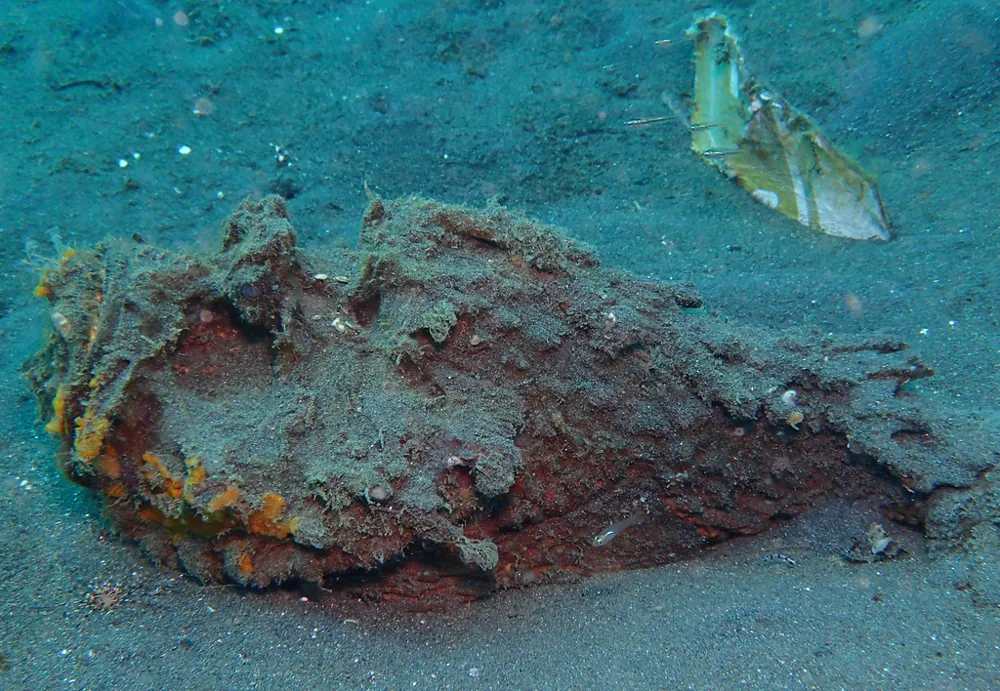
 Com reconèixer-lo
- Drab brownish-grey, reddish or greenish-brown colour1
- Skin has no scales and is covered in warts, often with filamentous algae growing on it1
- Head is flattened, with small eyes set high and pointing upwards, and a deep pit behind and under each eye1
- Large, almost vertical mouth with fringing cirri on the lips1
- Camouflaged to look like a stone resting on the bottom; it has no bright warning colours1
- Grows to a maximum of 60 cm1
Poder del verí
Unes punxes esmolades porten el verí. Trepitjar-lo o agafar-lo fa mal.
Què fa el seu verí?
Each fin spine has two venom-producing glands. The venom affects the cardiovascular and neuromuscular systems. The sting is extremely painful and has been known to be lethal.1
Com de perillós és per a les persones?
Perill per a les persones: Molt perillósPot matar una persona que no rep tractament.It is considered one of the most dangerous venomous fishes. Stings are extremely painful and have been known to be fatal. Since European settlement, there have been no recorded deaths in Australia from stonefish venom, but deaths have been recorded elsewhere in its range.1
 Bona notícia: els metges tenen un medicament (l'antiverí) o un tractament per a això.1
Què fa quan té por?
When disturbed, it erects its venomous spines, which inject venom if the fish is stepped on.1
 Si se't claven les seves punxes
- Antivenom can be given after envenomation. Immersing the sting wound in hot water can be used to denature the venom.1
- Posa la ferida en aigua calenta, tan calenta com la persona pugui aguantar sense cremar-se (prova-la amb la teva mà), de 30 a 90 minuts. Busca ajuda mèdica, sobretot amb peixos pedra i rajades.
Truca sempre primer al número d'emergències (112, 000, 911). Això són pautes generals de primers auxilis, no consells mèdics. Primers auxilis bàsics
 Estigues segur
- No toquis, atrapis ni molestis mai un animal salvatge, encara que sigui petit i encara que sembli adormit o mort.
- Deixa-li espai. Si en trobes un, mantén la calma, recula a poc a poc i deixa que segueixi el seu camí.
- Si se't claven les seves punxes: mantén la calma, no et moguis, truca al número d'emergències (112, 000, 911) o ves de pressa a un hospital. Recorda com era, una foto ajuda.
No va a per tu. Fa servir el verí per caçar o per defensar-se, i prefereix mil vegades amagar-se. Més sobre com estar segur
On del món?
Que gran és?
Quant fa de llarg?
 fa de llarg com 3 plàtans en fila
 podria nedar la llargada d'una piscina gran (50 m) en 90 segons
Que gran és Estuarine stonefish comparat amb TU?
Només càlculs al teu navegador. No es desa ni s'envia res enlloc.
Com de ràpid va?


Dades
It can tolerate being out of the water for up to 24 hours.1
It scoops out a shallow hollow in the seabed with its large pectoral fins and curls its tail around its body to hide.1
It is camouflaged to look like a stone, unlike many venomous animals that use bright warning colours.1
Females are larger than males.1
Desmuntamites
Mite: The species name horrida refers to its dangerous spines.
Veritat: The name means "dreadful" or "frightful" and alludes to its appearance, not its venomous spines.1
D'on surten les dades
- Synanceia horrida (Wikipedia (CC BY-SA 4.0))
- Synanceia horrida (iNaturalist): noms i classificació.
- Venom Wiki: el nivell de perill, la mida típica i la velocitat estimada són nostres. Mira com els calculem: Com valorem el perill.
Cada dada d'aquesta pàgina té un número que porta a la seva font. Si ens hem equivocat en alguna cosa, perdona, som fans dels animals, no una revista científica. Escriu-nos a [email protected] i ho arreglarem.
 L'escorpí té gana! Venom Wiki és un projecte d'una sola persona: gratuït, sense anuncis i sense rastrejadors. Una petita propina ajuda a mantenir-lo en línia.Dona menjar a l'escorpí
Més del mateix grup: Peixos verinosos
 Reef stonefishPeixos verinososPot matarNo ho toquis
 Red lionfishPeixos verinososCal anar al metgeNo ho toquis
 Short-tail stingrayPeixos verinososPot matar
 Striped eel catfishPeixos verinososPot matarNo ho toquis
 Bluespotted ribbontail rayPeixos verinososCal anar al metge
 Common stingrayPeixos verinososCal anar al metge
També viu a: Oceà Índic
 Australian box jellyfishMeduses i altres urticants marinsMortalNo ho toquis
 Geography coneCargols con i popsMortal
 Greater blue-ringed octopusCargols con i popsMortal
 Southern blue-ringed octopusCargols con i popsMortal
 Hawksbill sea turtleAltres animals tòxicsPot matar
 Irukandji jellyfishMeduses i altres urticants marinsPot matarNo ho toquis