
 Àfrica
 Àsia
Àsia Europa
 Amèrica del Sud
 Austràlia i Oceania
 Antàrtida
 Oceà Pacífic
 Oceà Atlàntic
 Oceà Índic
 Oceà Àrtic
 Mar Mediterrània
 Mar Roja
 Mar Carib
 Mar del Corall
 Mar de la Xina Meridional
 Mar de les Filipines
 Mar d'Andaman
 Mar del Nord
 Mar de Timor i d'Arafura
 Golf de Bengala
 Golf de Califòrnia
Tiny clinging box jellyfish
 Tentacles urticants
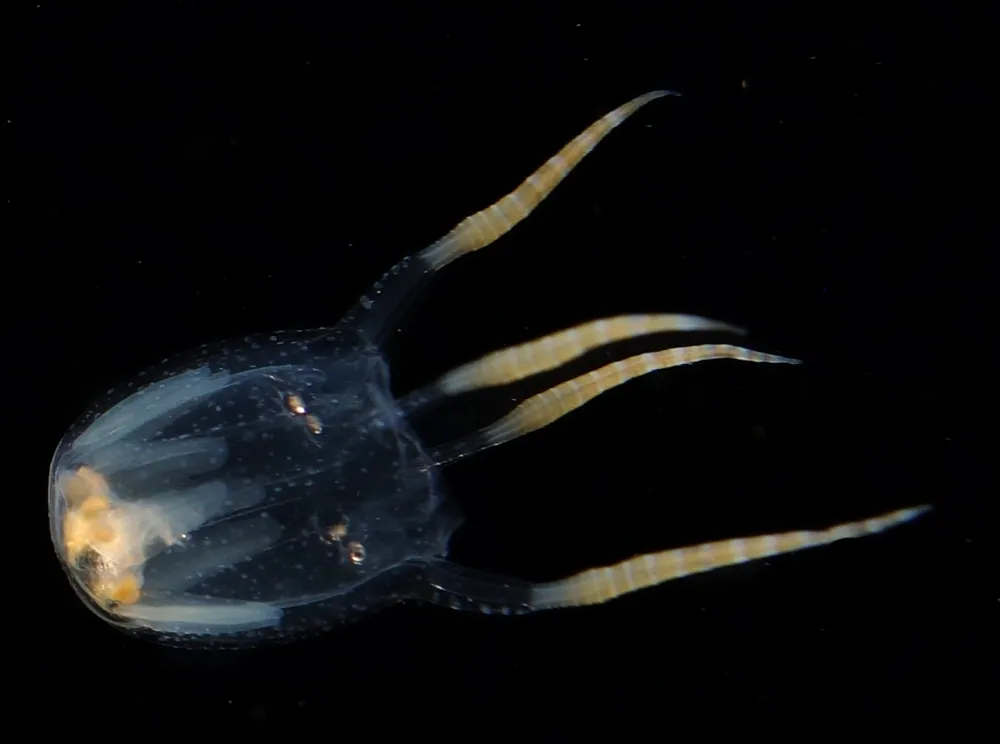
Copula sivickisi is a tiny box jellyfish, about 1 cm across, that lives in shallow warm seas. It is the only species in its genus and is active only at night. It is unusual among box jellyfish because it has a mating ritual and fertilises its eggs inside the body.1



 Com reconèixer-lo
- The bell is boxy in shape, unlike the umbrella shape of true jellyfish.1
- It has four slender tentacles hanging from the rim, each banded with orange.1
- The eight gonads (reproductive organs) can be seen through the transparent bell. In males they are orange, and in females they are white-speckled.1
- Mature females have orange-brown markings around the edge of the bell.1
- It is most active at night and hides during the day, folding its tentacles inside the bell and flattening itself.1
Poder del verí
Milers de cèl·lules urticants petitones es disparen quan alguna cosa les toca.
Com de perillós és per a les persones?
Perill per a les persones: LleuCom una picada d'abella o menys. Pràcticament inofensiu per a les persones.Què fa quan té por?
When disturbed by day it hides, folding its tentacles inside the bell and flattening itself against the seabed.1
 Si pica
- Surt de l'aigua i treu els tentacles que quedin (amb guants o un drap).
- Per a les cubomeduses tropicals: tira vinagre sobre les picades durant almenys 30 segons, demana ajuda i prepara't per fer RCP. Per a les caravel·les portugueses i la majoria de les altres: esbandeix amb aigua de mar i després amb aigua calenta per al dolor.
Truca sempre primer al número d'emergències (112, 000, 911). Això són pautes generals de primers auxilis, no consells mèdics. Primers auxilis bàsics
 Estigues segur
- No toquis, atrapis ni molestis mai un animal salvatge, encara que sigui petit i encara que sembli adormit o mort.
- Deixa-li espai. Si en trobes un, mantén la calma, recula a poc a poc i deixa que segueixi el seu camí.
- Si te'n pica un: mantén la calma, no et moguis, truca al número d'emergències (112, 000, 911) o ves de pressa a un hospital. Recorda com era, una foto ajuda.
No va a per tu. Fa servir el verí per caçar o per defensar-se, i prefereix mil vegades amagar-se. Més sobre com estar segur
On del món?
Que gran és?
Quant fa de llarg?
 tan petit que cap a la teva ungla
Que gran és Tiny clinging box jellyfish comparat amb TU?
Només càlculs al teu navegador. No es desa ni s'envia res enlloc.
Com de ràpid va?


Dades
It has twenty-four eyes, grouped on four stalked structures called rhopalia on the rim of the bell.1
Unlike most box jellyfish, it has an elaborate mating ritual. A male grabs a female by one tentacle and pulls her around while they entwine.1
A female has been seen mating with several males, up to eight times in a two-hour period.1
It is attracted to light, and it chooses a spot on the seabed soon after dawn, spending a few minutes selecting a good location before settling there.1
Its average maximum swimming speed is 4.9 cm per second, which is faster than the currents near the surface of the shallow waters where it lives.1
The male passes a red bundle of sperm (a spermatophore) to one of the female's tentacles, which pushes it into her manubrium, the tube hanging from the underside of the bell.1
Per a experts en verins
- Nom científic
- Copula sivickisi
- Grup
- Meduses i altres urticants marins
- Família
- Tripedaliidae2
- Ordre
- Carybdeida
- Continents
- Oceà Pacífic, Oceà Atlàntic, Mar de Timor i d'Arafura, Els oceans
- Cries
- Eggs are fertilised inside the female's bell. About two or three days later she releases a mucous strand of embryos into the sea, and these develop into polyps.1
- Perill per a les persones
- 1 / 5: Lleu3
D'on surten les dades
- Copula sivickisi (Wikipedia (CC BY-SA 4.0))
- Copula sivickisi (iNaturalist): noms i classificació.
- Venom Wiki: el nivell de perill, la mida típica i la velocitat estimada són nostres. Mira com els calculem: Com valorem el perill.
Cada dada d'aquesta pàgina té un número que porta a la seva font. Si ens hem equivocat en alguna cosa, perdona, som fans dels animals, no una revista científica. Escriu-nos a [email protected] i ho arreglarem.
 L'escorpí té gana! Venom Wiki és un projecte d'una sola persona: gratuït, sense anuncis i sense rastrejadors. Una petita propina ajuda a mantenir-lo en línia.Dona menjar a l'escorpí
Més del mateix grup: Meduses i altres urticants marins
 Australian box jellyfishMeduses i altres urticants marinsMortalNo ho toquis
 Irukandji jellyfishMeduses i altres urticants marinsPot matarNo ho toquis
 Portuguese man o' warMeduses i altres urticants marinsCal anar al metgeNo ho toquis
 Lion's mane jellyfishMeduses i altres urticants marinsNomés fa malNo ho toquis
 Moon jellyfishMeduses i altres urticants marinsInofensiu
 Common kingslayerMeduses i altres urticants marinsPot matarNo ho toquis
 Geography cone
 Greater blue-ringed octopus
 Japanese pufferfish
 Southern blue-ringed octopus
 Hawksbill sea turtle
 Reef stonefish