
 Àfrica
 Àsia
Àsia Europa
 Amèrica del Sud
 Austràlia i Oceania
 Antàrtida
 Oceà Pacífic
 Oceà Atlàntic
 Oceà Índic
 Oceà Àrtic
 Mar Mediterrània
 Mar Roja
 Mar Carib
 Mar del Corall
 Mar de la Xina Meridional
 Mar de les Filipines
 Mar d'Andaman
 Mar del Nord
 Mar de Timor i d'Arafura
 Golf de Bengala
 Golf de Califòrnia
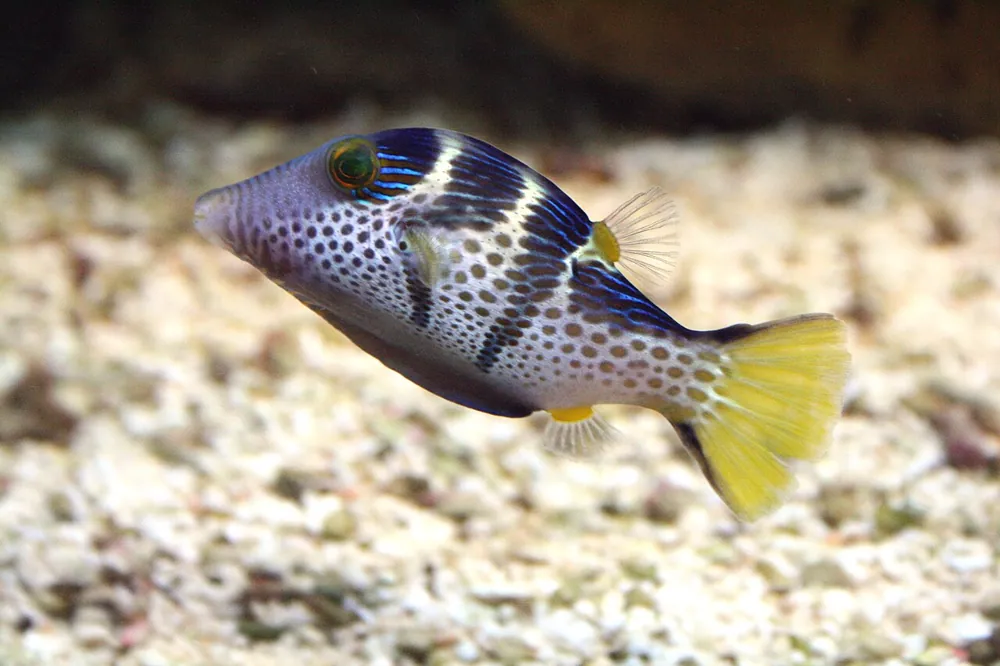
Valentin's sharpnose puffer
 Tòxic si te'l menges
Valentin's sharpnose puffer is a small reef fish with four black stripes across its back. It lives in warm seas across the Indian Ocean, the Red Sea and parts of the Pacific. It is special because its skin holds one of the most potent natural poisons known, which keeps most predators away.1



 Com reconèixer-lo
- Four distinct black stripes, called saddles, run across its back.1
- The head is blue-grey.1
- The main body is white, speckled with blue-grey spots.1
- The tail and fins show hints of yellow, and a rainbow streak sits behind the eyes.1
Sovint es confon amb: The filefish Paraluteres prionurus has similar colours and sometimes swims in schools with this puffer. It mimics the puffer's appearance for protection, but it is not toxic.1
Poder tòxic
Només és perjudicial si alguna cosa se'l menja.
Què fan les seves toxines?
Its skin and other tissues contain tetrodotoxin, a neurotoxin, which attacks the nerves. It is one of the most potent naturally occurring toxins and is lethal to many species of fish. This makes the fish unpalatable to predators.1
Com de perillós és per a les persones?
Perill per a les persones: GreuSi algú se'l menja, cal anar al metge. Les morts són molt rares.It is highly poisonous to eat.1
Què fa quan té por?
It gulps water to puff its body up to three or four times its normal volume, and its toxic skin deters predators.1
 Si algú l'ha tocat o se l'ha menjat
- Si algú se l'ha menjat o té símptomes després de menjar-se'l: truca de seguida al número d'emergències o al centre de toxicologia.
Truca sempre primer al número d'emergències (112, 000, 911). Això són pautes generals de primers auxilis, no consells mèdics. Primers auxilis bàsics
 Estigues segur
- No toquis, atrapis ni molestis mai un animal salvatge, encara que sigui petit i encara que sembli adormit o mort.
- Deixa-li espai. Si en trobes un, mantén la calma, recula a poc a poc i deixa que segueixi el seu camí.
- Si l'has tocat o te l'has menjat: no et freguis els ulls ni la boca, renta't les mans i busca ajuda mèdica.
No va a per tu. Les seves toxines només hi són perquè ningú no se'l mengi. Més sobre com estar segur
On del món?
Que gran és?
Quant fa de llarg?
 fa de llarg com 3 peces de construcció de joguina en fila
 podria nedar la llargada d'una piscina gran (50 m) en 45 segons
Que gran és Valentin's sharpnose puffer comparat amb TU?
Només càlculs al teu navegador. No es desa ni s'envia res enlloc.
Com de ràpid va?
Dades
Its tetrodotoxin is one of the most potent naturally occurring toxins, and it is lethal to many fish.1
A non-toxic filefish, Paraluteres prionurus, has evolved to look like this puffer, which helps it avoid predators.1
Its eggs are unpalatable, so predatory fish rarely eat them, and any swallowed eggs are quickly passed out again. This means the parents need not guard them.1
Juveniles of the grouper Plectropomus laevis also mimic its colours.1
Its eggs, at 0.68 to 0.72 mm across, are among the smallest in the puffer family Tetraodontidae.1
Desmuntamites
Mite: Pufferfish hold their breath while they puff up.
Veritat: A 2014 study found that oxygen consumption actually increases while the fish is inflated. Oxygen intake through the gills is almost five times higher than normal.1
Per a experts en verins
- Nom científic
- Canthigaster valentini
- Grup
- Altres animals tòxics
- Família
- Tetraodontidae2
- Ordre
- Tetraodontiformes
- Continents
- Oceà Pacífic, Oceà Índic, Mar Roja, Mar del Corall, Mar de les Filipines, Mar de la Xina Meridional, Mar de Timor i d'Arafura, Els oceans
- Cries
- Females lay anywhere between fifteen and over 800 eggs at a time, every four to ten days depending on the season.1
- Perill per a les persones
- 3 / 5: Greu3
D'on surten les dades
- Valentin's sharpnose puffer (Wikipedia (CC BY-SA 4.0))
- Canthigaster valentini (iNaturalist): noms i classificació.
- Venom Wiki: el nivell de perill, la mida típica i la velocitat estimada són nostres. Mira com els calculem: Com valorem el perill.
Cada dada d'aquesta pàgina té un número que porta a la seva font. Si ens hem equivocat en alguna cosa, perdona, som fans dels animals, no una revista científica. Escriu-nos a [email protected] i ho arreglarem.
 L'escorpí té gana! Venom Wiki és un projecte d'una sola persona: gratuït, sense anuncis i sense rastrejadors. Una petita propina ajuda a mantenir-lo en línia.Dona menjar a l'escorpí
Més del mateix grup: Altres animals tòxics
 Japanese pufferfish
 Hawksbill sea turtle
 Greenland shark
 Silver-cheeked toadfish
 Blackspotted puffer
 White-spotted puffer
També viu a: Oceà Pacífic
 Australian box jellyfishMeduses i altres urticants marinsMortalNo ho toquis
 Geography coneCargols con i popsMortal
 Greater blue-ringed octopusCargols con i popsMortal
 Southern blue-ringed octopusCargols con i popsMortal
 Irukandji jellyfishMeduses i altres urticants marinsPot matarNo ho toquis
 Reef stonefishPeixos verinososPot matarNo ho toquis