
 Àfrica
 Àsia
Àsia Europa
 Amèrica del Sud
 Austràlia i Oceania
 Antàrtida
 Oceà Pacífic
 Oceà Atlàntic
 Oceà Índic
 Oceà Àrtic
 Mar Mediterrània
 Mar Roja
 Mar Carib
 Mar del Corall
 Mar de la Xina Meridional
 Mar de les Filipines
 Mar d'Andaman
 Mar del Nord
 Mar de Timor i d'Arafura
 Golf de Bengala
 Golf de Califòrnia
Variable harlequin toad
 Toxines a la pell
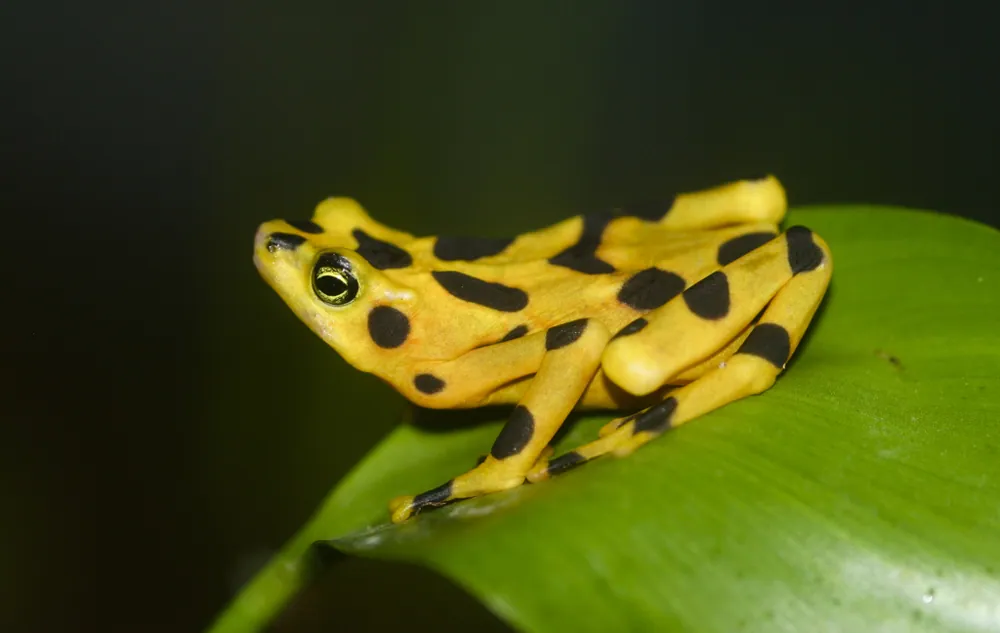
The variable harlequin toad is a small, brightly coloured toad from the forests of Central America. It lives on rocks and in crevices beside streams. It is critically endangered, which means it is at very high risk of disappearing from the wild.1
 Com reconèixer-lo
Poder tòxic
La seva pell és tòxica. És perillós tocar-lo, llepar-lo o menjar-se'l.
Què fan les seves toxines?
This animal is poisonous rather than venomous, so it does not bite or sting. Its skin contains tetrodotoxin, a potent neurotoxin (a poison that attacks the nerves).1
Com de perillós és per a les persones?
Perill per a les persones: DolorósPot fer molt de mal, però gairebé mai no és greu.Què fa quan té por?
Its bright, conspicuous colours warn predators that its skin is toxic.1
 Si algú l'ha tocat o se l'ha menjat
- Si algú n'ha tocat un: renta-li bé les mans i que no es toqui els ulls ni la boca. Si un nen o una mascota n'ha llepat o menjat un: truca al centre de toxicologia o al número d'emergències.
Truca sempre primer al número d'emergències (112, 000, 911). Això són pautes generals de primers auxilis, no consells mèdics. Primers auxilis bàsics
 Estigues segur
- No toquis, atrapis ni molestis mai un animal salvatge, encara que sigui petit i encara que sembli adormit o mort.
- Deixa-li espai. Si en trobes un, mantén la calma, recula a poc a poc i deixa que segueixi el seu camí.
- Si l'has tocat o te l'has menjat: no et freguis els ulls ni la boca, renta't les mans i busca ajuda mèdica.
No va a per tu. Les seves toxines només hi són perquè ningú no se'l mengi. Més sobre com estar segur
Que gran és?
Quant fa de llarg?
 més o menys el que fa de llarg un clip
 podria recórrer 100 metres en 180 segons (l'humà més ràpid necessita 9,6)
Que gran és Variable harlequin toad comparat amb TU?
Només càlculs al teu navegador. No es desa ni s'envia res enlloc.
Com de ràpid va?


Dades
Its only known predator is a parasitic fly, Notochaeta bufonivora. The fly lays larvae on the frog's thigh, and the larvae burrow inside and eat the frog from within.1
A census between 1990 and 1992 near Monteverde, Costa Rica, found zero individuals where the population had once peaked at 751 adults.1
By 1996 it was believed to be extinct throughout Costa Rica, but a 2019 assessment found two subpopulations in the country.1
It was rediscovered near Quepos, Costa Rica, in 2003.1
The chytrid fungus Batrachochytrium dendrobatidis can spread between individuals through shed skin cells and harms the skin, which affects breathing and the balance of water and salts in the body.1
In March 2021 the species was bred in captivity outside Panama for the first time.1
D'on surten les dades
- Atelopus varius (Wikipedia (CC BY-SA 4.0))
- Atelopus varius (iNaturalist): noms i classificació.
- Venom Wiki: el nivell de perill, la mida típica i la velocitat estimada són nostres. Mira com els calculem: Com valorem el perill.
Cada dada d'aquesta pàgina té un número que porta a la seva font. Si ens hem equivocat en alguna cosa, perdona, som fans dels animals, no una revista científica. Escriu-nos a [email protected] i ho arreglarem.
 L'escorpí té gana! Venom Wiki és un projecte d'una sola persona: gratuït, sense anuncis i sense rastrejadors. Una petita propina ajuda a mantenir-lo en línia.Dona menjar a l'escorpí
Més del mateix grup: Granotes punta de fletxa, gripaus i tritons
 Cane toadGranotes punta de fletxa, gripaus i tritonsCal anar al metgeNo ho toquis
 Strawberry poison-dart frogGranotes punta de fletxa, gripaus i tritonsNomés fa malNo ho toquis
 California newtGranotes punta de fletxa, gripaus i tritonsPot matarNo ho toquis
 Rough-skinned newtGranotes punta de fletxa, gripaus i tritonsPot matarNo ho toquis
 Colorado River toadGranotes punta de fletxa, gripaus i tritonsCal anar al metgeNo ho toquis
 Panamanian golden frogGranotes punta de fletxa, gripaus i tritonsCal anar al metgeNo ho toquis
 Terciopelo
 Eastern coral snake
 Eastern diamondback rattlesnake
 Eyelash viper
 Timber rattlesnake
 Western diamondback rattlesnake