
 Bitten or stung?
 All animals
 Pick a continent
 Africa
 Asia
 Europe
 South America
 Australia & Oceania
 Antarctica
 Pacific Ocean
 Atlantic Ocean
 Indian Ocean
 Arctic Ocean
 Mediterranean Sea
 Red Sea
 Caribbean Sea
 Coral Sea
 South China Sea
 Philippine Sea
 Andaman Sea
 North Sea
 Timor & Arafura Sea
 Bay of Bengal
 Gulf of California
 Games
 Venom battle
 Animal race
 Field notebook
 Venom TOP lists
 Stay safe
 Surprise me

Bullet ant
 Stings
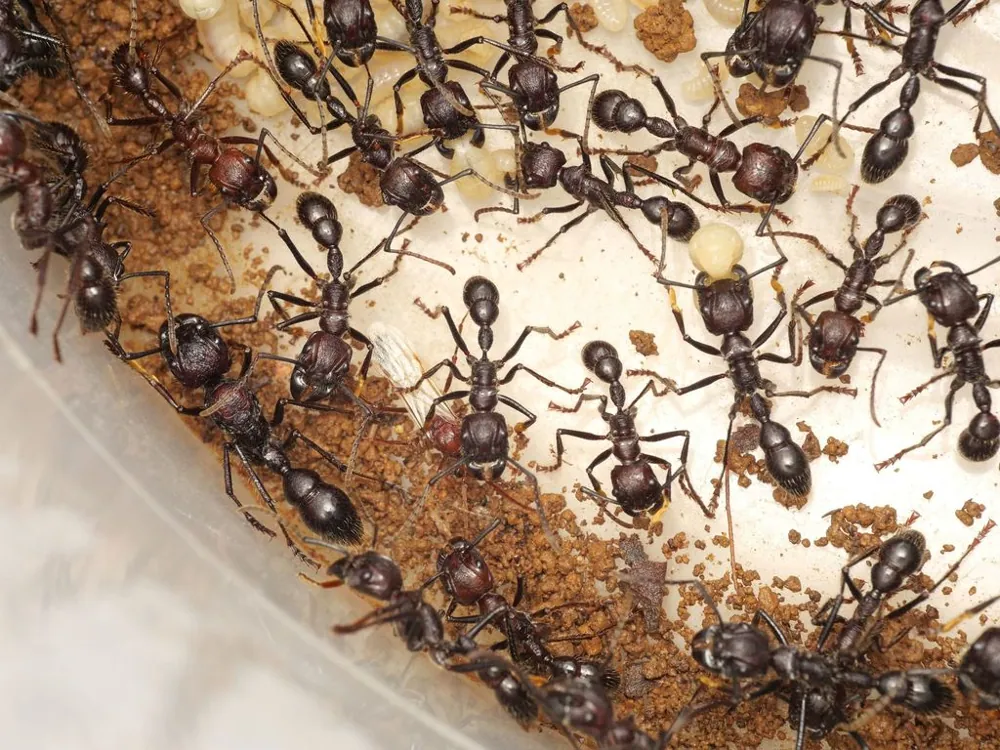
The bullet ant is a large rainforest ant with a sting that is famously painful. It lives in humid lowland rainforests in Central and South America. Its sting ranks as the most painful of all insect stings on one informal pain scale.1
 How to recognise it
Venom power
Venom comes out through a stinger.
What does its venom do?
The sting delivers poneratoxin, a paralysing neurotoxic peptide (a small protein that attacks the nerves). It affects sodium ion channels, which are needed to send nerve signals, and blocks signal transmission in the central nervous system. Common symptoms from even one sting include swollen lymph nodes, swelling (oedema), a fast heartbeat (tachycardia) and fresh blood in the faeces.1
How dangerous is it to people?
Danger to people: PainfulIt can really hurt, but it is almost never serious.The pain is described as burning, throbbing and all-consuming, and it can last for up to 24 hours. Workers are vicious when defending the nest, so people who disturb a nest risk being stung.1
What does it do when it is scared?
The ants are not aggressive in general, but they defend the nest viciously, producing a stridulating sound and stinging with ferocity.1
 If it stings
Call your emergency number at once if the person has trouble breathing, swelling of the face or throat, or feels faint.
- Wash and cool the stings.
- If the person has trouble breathing, swelling of the face or throat, or feels faint, it is an allergic emergency: call your emergency number.
This is general first aid guidance, not medical advice. Based on the first aid guidelines of the World Health Organization and the Australian Resuscitation Council. Facts come from public sources and may contain mistakes. When in doubt, always get medical help. First aid basics
 Stay safe
- Never touch, catch or tease a wild animal, even a small one, and even if it looks asleep or dead.
- Give it space. If you meet one, stay calm, step back slowly and let it go its own way.
- If it hurts you: wash the spot, stay calm and get medical help if the pain is strong or spreads, or the person feels unwell.
It is not out to get you. It uses its venom to catch food or to protect itself, and it would much rather hide. More about staying safe
Where in the world?
How big is it?
How long is it?
 about as long as a paper clip
How big is Bullet ant compared to you?
Just maths in your browser. Nothing is saved or sent anywhere.
How fast is it?


Facts
Its sting is compared to walking over flaming charcoal with a three-inch nail in your heel, and some victims say it feels like being shot, which gives the ant its name.1
The Sateré-Mawé people of Brazil use bullet ant stings in initiation rites for becoming warriors or leaders. Ants are sedated and woven into gloves, and the initiate wears them for 5 to 10 minutes or longer.1
A tiny parasitic fly, Apocephalus paraponerae, lays eggs in injured bullet ants, and a crushed ant can attract flies within two to three minutes.1
Poneratoxin from its venom is being investigated for possible medical uses.1
The bullet ant preys on the caterpillars of the glasswing butterfly, Greta oto. The caterpillars defend themselves with chemicals that these ants find unpalatable.1
Fossils of relatives were found in Dominican amber. The extinct Paraponera dieteri lived 15 to 45 million years ago in the Early Miocene.1
Where the facts come from
- Paraponera clavata (Wikipedia (CC BY-SA 4.0))
- Paraponera clavata (iNaturalist): names and classification.
- Venom Wiki: the danger level, the typical size and the speed guess are our own. See how we work them out: How we rate danger.
Every fact on this page has a number that points to its source. If we got something wrong, sorry, we are animal fans, not a science journal. Tell us at [email protected] and we will fix it.
Get the Venom Wiki app
Every creature, every picture and the games in your pocket, even without internet.


 Support Venom Wiki Venom Wiki is a one-man project: free, with no ads and no cookies. A small tip helps keep it online.Feed the scorpion
 Red imported fire ant
 Army ant
 Giant Amazonian ant
 Maricopa harvester ant
 Trap-jaw ant
 Acacia ant
 Terciopelo
 Eastern coral snake
 Eastern diamondback rattlesnake
 Timber rattlesnake
 Western diamondback rattlesnake
 Arizona bark scorpion