
 Bitten or stung?
 All animals
 Pick a continent
 Africa
 Asia
 Europe
 South America
 Australia & Oceania
 Antarctica
 Pacific Ocean
 Atlantic Ocean
 Indian Ocean
 Arctic Ocean
 Mediterranean Sea
 Red Sea
 Caribbean Sea
 Coral Sea
 South China Sea
 Philippine Sea
 Andaman Sea
 North Sea
 Timor & Arafura Sea
 Bay of Bengal
 Gulf of California
 Games
 Venom battle
 Animal race
 Field notebook
 Venom TOP lists
 Stay safe
 Surprise me

Common desert centipede
 Bites
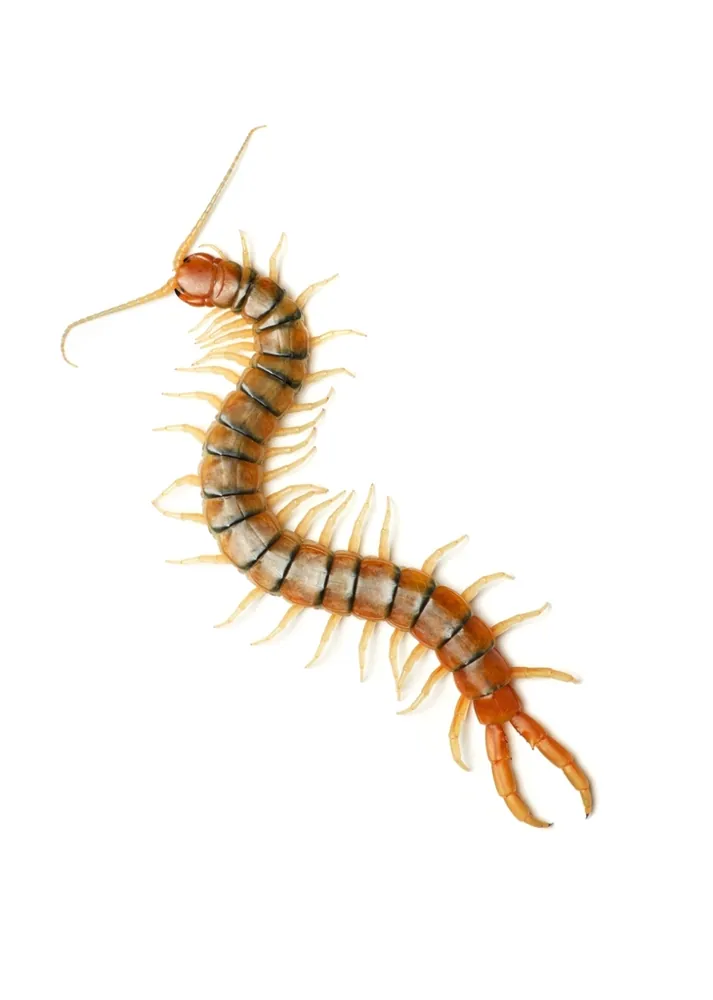
The common desert centipede is a large centipede that lives in the deserts and dry grasslands of western North America. It is known for its striped body and for its venom, which scientists are studying for possible medical uses.1
 How to recognise it
- Adults usually measure 10 to 18 cm long.1
- Each body segment has one dark stripe along its side, which gives it the name tiger centipede.1
- Most have a darker brown, red or orange head, lighter brown, tan or orange body segments and yellow legs.1
- Some populations, such as those in Southern California, are entirely light blue with indigo stripes and turquoise legs.1
- Its antennae have seven or more smooth segments.1
Venom power
Venom goes in through two fang-like front legs under the head, not through teeth.
What does its venom do?
Its venom contains a peptide called SPC13 that kills or slows some bacteria, including Staphylococcus aureus and Pseudomonas aeruginosa. In studies on mice, the venom damaged muscle, causing tissue death and abnormal mitochondria (the parts of cells that make energy). It may also affect the respiratory complexes, the chemical systems cells use to make energy, of the animals it hunts.1
How dangerous is it to people?
Danger to people: PainfulIt can really hurt, but it is almost never serious.What does it do when it is scared?
Its venom is used to defend itself, but it cannot fully rebuild its venom within 48 hours, which limits how well it can defend itself.1
 If it bites
Call your emergency number at once if the person has trouble breathing, swelling of the face or throat, or feels faint.
- Wash the bite with soap and water. Warm water or a cold pack can ease the pain. See a doctor if the pain is severe, the swelling keeps growing or gets infected, or if a small child is bitten.1
- Wash the bite, cool it or soak it in warm water for the pain, and get medical help if it gets worse.
This is general first aid guidance, not medical advice. Based on the first aid guidelines of the World Health Organization and the Australian Resuscitation Council. Facts come from public sources and may contain mistakes. When in doubt, always get medical help. First aid basics
 Stay safe
- Never touch, catch or tease a wild animal, even a small one, and even if it looks asleep or dead.
- Give it space. If you meet one, stay calm, step back slowly and let it go its own way.
- If it hurts you: wash the spot, stay calm and get medical help if the pain is strong or spreads, or the person feels unwell.
It is not out to get you. It uses its venom to catch food or to protect itself, and it would much rather hide. More about staying safe
Where in the world?
How big is it?
How long is it?
 as long as 2 bank cards end to end
 could cover 100 metres in 220 seconds (the fastest human needs 9.6)
How big is Common desert centipede compared to you?
Just maths in your browser. Nothing is saved or sent anywhere.
How fast is it?


Facts
Its venom contains a peptide that has shown antimicrobial activity against bacteria that cause hospital infections.1
Within two days it regenerates 65 to 86% of its venom volume, but its venom levels do not return to their original amounts even after 7 months.1
The bigger the centipede, the slower its venom regenerates, so body size limits how quickly it can recover its venom.1
Its colours are so varied that its species name, polymorpha, means "many forms".1
It is most active at night during the cool winter months, or during the summer New Mexico Monsoon, when it is cooler and wetter.1
Where the facts come from
- Scolopendra polymorpha (Wikipedia (CC BY-SA 4.0))
- Scolopendra polymorpha (iNaturalist): names and classification.
- Venom Wiki: the danger level, the typical size and the speed guess are our own. See how we work them out: How we rate danger.
Every fact on this page has a number that points to its source. If we got something wrong, sorry, we are animal fans, not a science journal. Tell us at [email protected] and we will fix it.
Get the Venom Wiki app
Every creature, every picture and the games in your pocket, even without internet.


 Support Venom Wiki Venom Wiki is a one-man project: free, with no ads and no cookies. A small tip helps keep it online.Feed the scorpion
 Giant desert centipede
 Green centipede
 Haitian giant centipede
 Eastern red centipede
 Florida blue centipede
 Peruvian giant centipede
 Terciopelo
 Eastern coral snake
 Eastern diamondback rattlesnake
 Timber rattlesnake
 Western diamondback rattlesnake
 Arizona bark scorpion