
 Bitten or stung?
 All animals
 Pick a continent
 Africa
 Asia
 Europe
 South America
 Australia & Oceania
 Antarctica
 Pacific Ocean
 Atlantic Ocean
 Indian Ocean
 Arctic Ocean
 Mediterranean Sea
 Red Sea
 Caribbean Sea
 Coral Sea
 South China Sea
 Philippine Sea
 Andaman Sea
 North Sea
 Timor & Arafura Sea
 Bay of Bengal
 Gulf of California
 Games
 Venom battle
 Animal race
 Field notebook
 Venom TOP lists
 Stay safe
 Surprise me

European hornet
 Stings
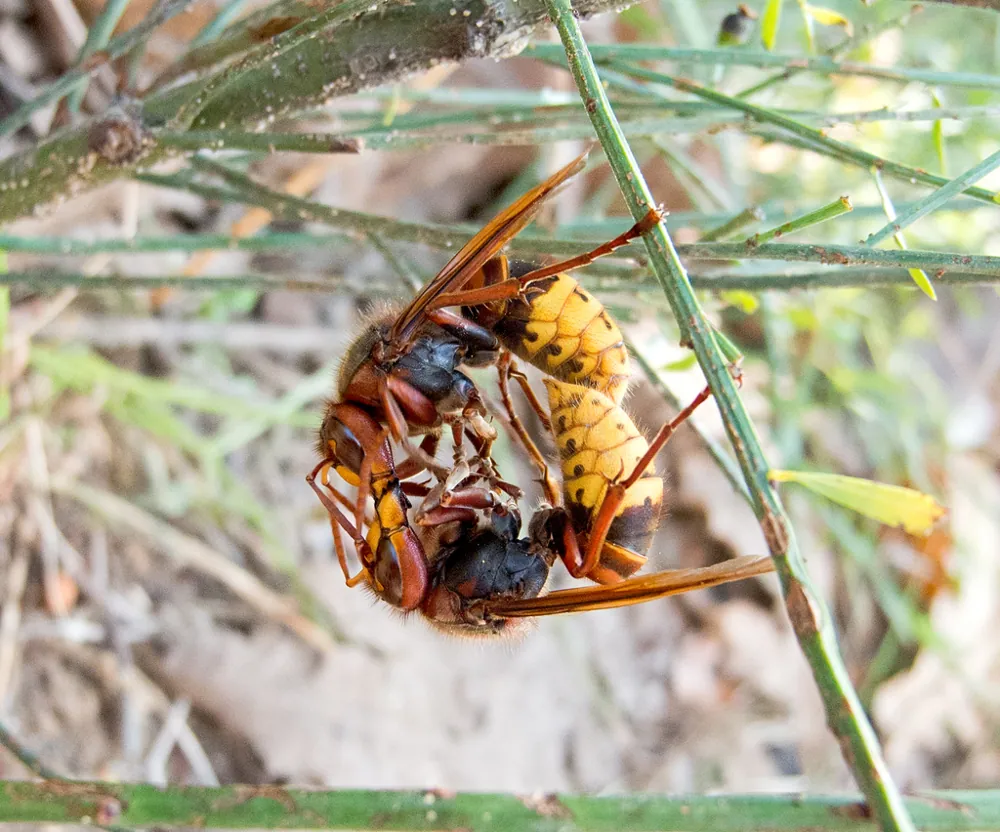
The European hornet is the largest wasp that lives in Europe. It is a true hornet, and it was introduced to North America from Europe. It is best known for its large paper nests and its striking reddish wings and striped abdomen.1
 How to recognise it
- Eyes deeply indented and shaped like a "C"1
- Reddish-orange wings1
- Abdomen striped with brown and yellow1
- Workers average about 2.5 cm long; queens can reach about 3.5 cm1
- Has hair on the thorax and abdomen, but is not as hairy as most bees1
Often confused with: It is often mistaken for the Asian giant hornet because of its colours and abdomen pattern. The European hornet is significantly smaller than the Asian giant hornet, and it is larger than most common wasps, such as Vespula vulgaris.1
Venom power
Venom comes out through a stinger.
What does its venom do?
Its venom contains neurotransmitters such as dopamine, serotonin, histamine and noradrenaline, along with enzymes, proteins such as melittin and bradykinin, and a neurotoxin called apamin, which attacks the nerves. In one documented case, a person developed tingling at the sting, headaches and shortness of breath, along with a fast, irregular heartbeat.1
How dangerous is it to people?
Danger to people: PainfulIt can really hurt, but it is almost never serious.Most stings do not need medical attention, but in rare cases they can be serious. In one documented case the victim needed hospital treatment, though that person may have been unusually sensitive to hornet and wasp stings.1
What does it do when it is scared?
It stings when it is stepped on or grabbed and is defensive of its nest, and it may sting without warning when near its nest or food. When alarmed, it performs a dance outside the nest with loud buzzing, darting in and out, and attacking or approaching the target.1
 If it stings
Call your emergency number at once if the person has trouble breathing, swelling of the face or throat, or feels faint.
- Move calmly away from the nest. Wash the sting, put a cold pack on it and take a painkiller or antihistamine if needed. Call your emergency number at once if the person has trouble breathing, swelling of the face or throat, feels faint, or has many stings.1
- Scrape out a bee sting and cool the spot.
- If the person has trouble breathing, swelling of the face or throat, or feels faint, it is an allergic emergency: call your emergency number and use their adrenaline pen if they have one.
This is general first aid guidance, not medical advice. Based on the first aid guidelines of the World Health Organization and the Australian Resuscitation Council. Facts come from public sources and may contain mistakes. When in doubt, always get medical help. First aid basics
 Stay safe
- Never touch, catch or tease a wild animal, even a small one, and even if it looks asleep or dead.
- Give it space. If you meet one, stay calm, step back slowly and let it go its own way.
- If it hurts you: wash the spot, stay calm and get medical help if the pain is strong or spreads, or the person feels unwell.
It is not out to get you. It uses its venom to catch food or to protect itself, and it would much rather hide. More about staying safe
Where in the world?
How big is it?
How long is it?
How heavy is it?
 about as long as a paper clip
 so light you would not feel it on your hand
 could fly across a whole football pitch in 11 seconds
How big is European hornet compared to you?
Just maths in your browser. Nothing is saved or sent anywhere.
How fast is it?


Facts
It is known to steal prey from spiders. This was first documented in 2011, when one took a wrapped insect from a yellow garden spider's web.1
It is the largest eusocial wasp native to Europe.1
Only females have a stinger, because it is a modified egg-laying device. Males cannot sting.1
In Germany, killing a European hornet or destroying its nest has been illegal since 1 January 1987, with a fine of up to €50,000, though fines are rarely imposed.1
It was introduced to North America from Europe as early as 1840, and for a long time it was the only true hornet there.1
Myth buster
Myth: European hornets are aggressive and will attack people for no reason.
Truth: It generally avoids conflict. It stings mainly when it is stepped on or grabbed, or when its nest or food is threatened.1
For venom experts
- Scientific name
- Vespa crabro
- Group
- Bees, wasps & hornets
- Also called
- Giant Hornet1
- Family
- Vespidae2
- Order
- Hymenoptera
- Continents
- Europe, Asia
- Babies
- The queen lays eggs in the combs inside the nest. In laboratory data, egg-laying averaged 2.31 eggs per day.1
- How it is doing in the wild
- Locally threatened or endangered in some areas1
- Danger to people
- 2 / 5: Painful3
Where the facts come from
- European hornet (Wikipedia (CC BY-SA 4.0))
- Vespa crabro (iNaturalist): names and classification.
- Venom Wiki: the danger level, the typical size and the speed guess are our own. See how we work them out: How we rate danger.
Every fact on this page has a number that points to its source. If we got something wrong, sorry, we are animal fans, not a science journal. Tell us at [email protected] and we will fix it.
Get the Venom Wiki app
Every creature, every picture and the games in your pocket, even without internet.


 Support Venom Wiki Venom Wiki is a one-man project: free, with no ads and no cookies. A small tip helps keep it online.Feed the scorpion
 Asian giant hornet
 Common wasp
 Western honey bee
 Giant honey bee
 Asian hornet
 European paper wasp
 Common European adder
 Spanish fly
 Fire salamander
 Blunt-nosed viper
 Nose-horned viper
 Ottoman viper