
 Bitten or stung?
 All animals
 Pick a continent
 Africa
 Asia
 Europe
 South America
 Australia & Oceania
 Antarctica
 Pacific Ocean
 Atlantic Ocean
 Indian Ocean
 Arctic Ocean
 Mediterranean Sea
 Red Sea
 Caribbean Sea
 Coral Sea
 South China Sea
 Philippine Sea
 Andaman Sea
 North Sea
 Timor & Arafura Sea
 Bay of Bengal
 Gulf of California
 Games
 Venom battle
 Animal race
 Field notebook
 Venom TOP lists
 Stay safe
 Surprise me

Texas brown tarantula
 Bites
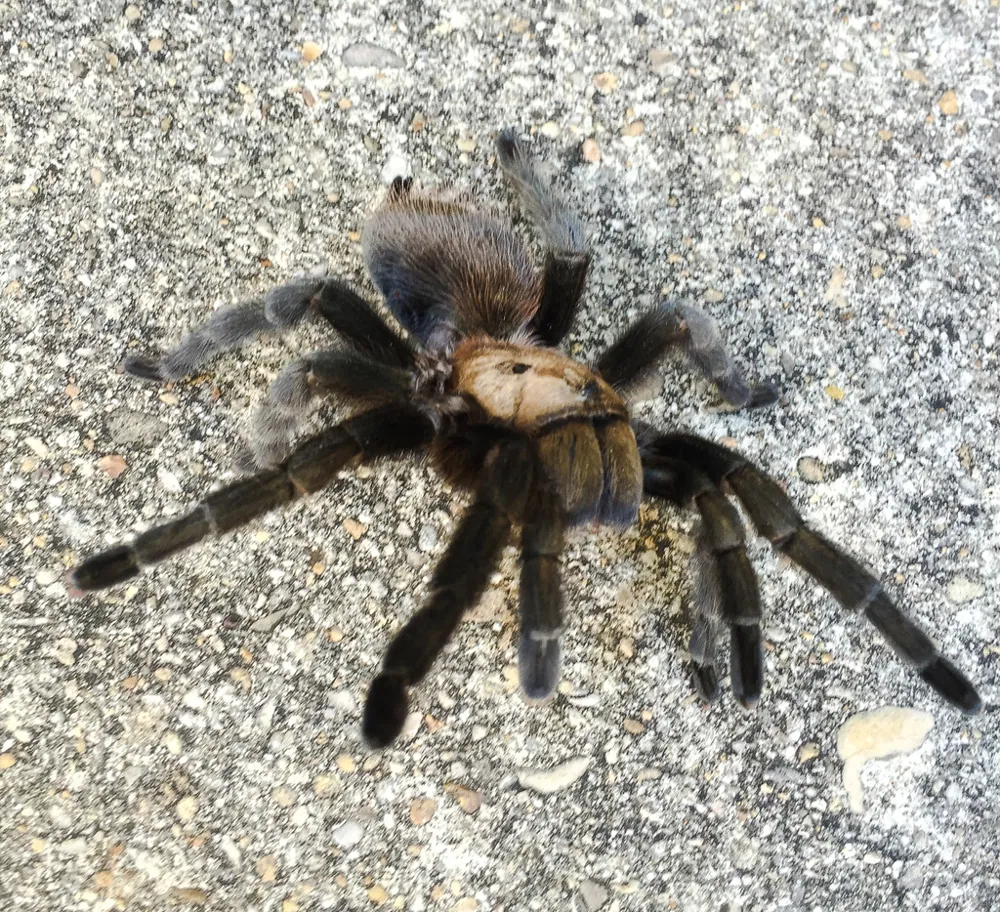
The Texas brown tarantula is one of the most common tarantulas in the Southern United States today. It is a large, mostly calm spider that lives in burrows and grasslands. It is not known for being aggressive.1
 How to recognise it
- The body is dark brown, though shades vary between individual spiders.1
- The colours look more distinct after a moult.1
- Males have black legs and a copper-coloured carapace (the hard shell covering the front of the body).1
- Immatures and males come in many shades of brown, with variation in greys and reds.1
- Adults can have a leg span over 10 cm and weigh more than 85 g.1
Venom power
Venom comes out through its fangs or teeth when it bites.
How dangerous is it to people?
Danger to people: MildLike a bee sting or less. Basically harmless to people, unless the person is allergic.Bites are generally not a serious harm to humans, except in the case of an allergic reaction. Because the fangs are large, the puncture wound can be painful and can become infected if not treated properly.1
What does it do when it is scared?
When disturbed, it rises onto its hind legs, raises its front legs in a threatening pose, and kicks small, coarse urticating hairs from its abdomen towards the threat.1
 If it bites
Call your emergency number at once if the person has trouble breathing, swelling of the face or throat, or feels faint.
- Bite wounds should be treated properly to prevent secondary infection. Seek care if an allergic reaction occurs.1
- Wash the bite and cool it. Get medical help if the pain is strong or the person feels unwell.
This is general first aid guidance, not medical advice. Based on the first aid guidelines of the World Health Organization and the Australian Resuscitation Council. Facts come from public sources and may contain mistakes. When in doubt, always get medical help. First aid basics
 Stay safe
- Never touch, catch or tease a wild animal, even a small one, and even if it looks asleep or dead.
- Give it space. If you meet one, stay calm, step back slowly and let it go its own way.
- If it hurts you: wash the spot, stay calm and get medical help if the pain is strong or spreads, or the person feels unwell.
It is not out to get you. It uses its venom to catch food or to protect itself, and it would much rather hide. More about staying safe
Where in the world?
How big is it?
How long is it?
How heavy is it?

 about as long as a bank card
 could cover 100 metres in 220 seconds (the fastest human needs 9.6)
How big is Texas brown tarantula compared to you?
Just maths in your browser. Nothing is saved or sent anywhere.
How fast is it?


Facts
Narrow-mouthed toads have been seen sharing the tarantula's burrow. The toads gain protection from snakes and eat small invertebrates there, but they ignore newly hatched spiderlings.1
This species is the main prey of the tarantula hawk wasp (Pepsis grossa) in areas where the two overlap.1
Males travel looking for females, usually in the fall, and have been recorded travelling as far as 1.7 km.1
Newly hatched spiderlings often stay with their mother for several days before they disperse to build their own burrows.1
Males usually live little more than a year after they mature.1
For venom experts
- Scientific name
- Aphonopelma hentzi
- Group
- Tarantulas & funnel-webs
- Also called
- Oklahoma brown tarantula, Missouri tarantula1
- Family
- Theraphosidae2
- Order
- Araneae
- Continents
- North America
- Babies
- A female can lay between about 200 and 1,000 eggs in a hammock-shaped web inside her burrow, and she guards them. The eggs hatch in 45 to 60 days, and the spiderlings often stay with the female for several days before leaving to make their own burrows.1
- Lifespan
- about 40 years1
- Danger to people
- 1 / 5: Mild3
Where the facts come from
- Texas brown tarantula (Wikipedia (CC BY-SA 4.0))
- Aphonopelma hentzi (iNaturalist): names and classification.
- Venom Wiki: the danger level, the typical size and the speed guess are our own. See how we work them out: How we rate danger.
Every fact on this page has a number that points to its source. If we got something wrong, sorry, we are animal fans, not a science journal. Tell us at [email protected] and we will fix it.
Get the Venom Wiki app
Every creature, every picture and the games in your pocket, even without internet.


 Support Venom Wiki Venom Wiki is a one-man project: free, with no ads and no cookies. A small tip helps keep it online.Feed the scorpion
More from the same group: Tarantulas & funnel-webs
 Mexican redknee tarantulaTarantulas & funnel-websMild
 Arizona blond tarantulaTarantulas & funnel-websMild
 Ravine trapdoor spiderTarantulas & funnel-websMild
 Trinidad chevron tarantulaTarantulas & funnel-websPainful
 Antilles pinktoe tarantulaTarantulas & funnel-websMild
 California trapdoor spiderTarantulas & funnel-websMild
 Terciopelo
 Eastern coral snake
 Eastern diamondback rattlesnake
 Timber rattlesnake
 Western diamondback rattlesnake
 Arizona bark scorpion