
 Afrika
 Asien
Asien Europa
 Sydamerika
 Australien & Oceanien
 Antarktis
 Stillehavet
 Atlanterhavet
 Det Indiske Ocean
 Det Nordlige Ishav
 Middelhavet
 Det Røde Hav
 Det Caribiske Hav
 Koralhavet
 Det Sydkinesiske Hav
 Det Filippinske Hav
 Andamanhavet
 Nordsøen
 Timorhavet & Arafurahavet
 Den Bengalske Bugt
 Californiens Golf
Turkish deathstalker
 Stik
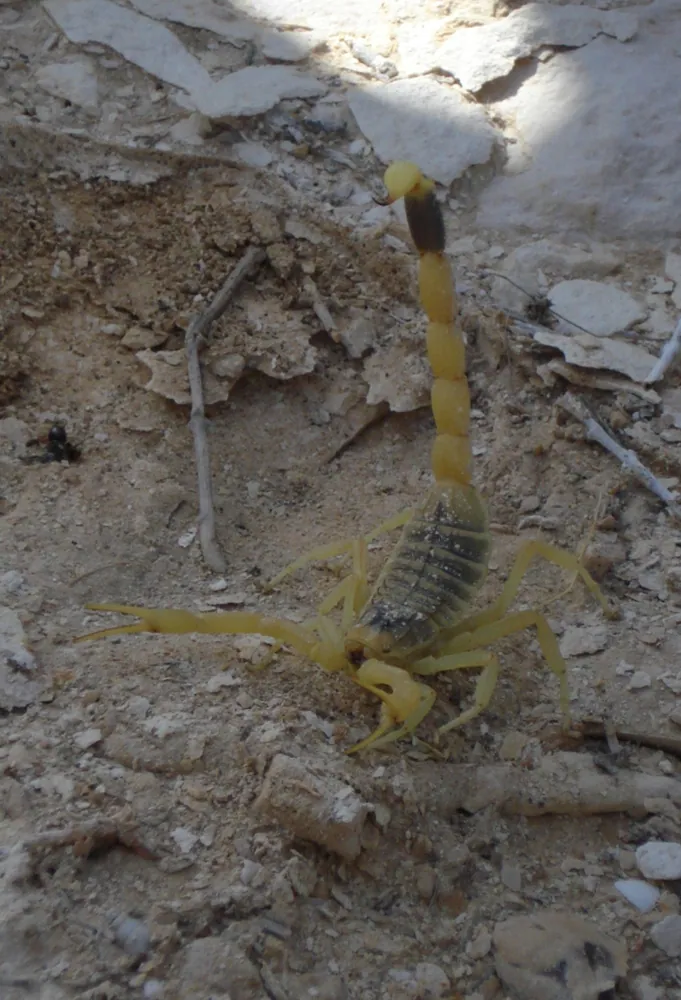
StikThe Turkish deathstalker is a scorpion from the family Buthidae. Its venom is highly toxic to humans, but scientists also use scorpion venom in medical research. It lives in dry, rocky places and usually keeps away from people.1


 Sådan genkender du det
- Brown front body section (cephalothorax), with a yellow head, legs and tail.1
- The very last segment of the tail is brown instead of yellow.1
- Its pincers and other body parts are yellowish, against a mostly black background on the front body and tail.1
Forveksles ofte med: It was once considered the same species as the deathstalker (L. quinquestriatus), but was reclassified as a separate species in 2009 based on mitochondrial DNA analysis. Its tail segments are shorter than those of the deathstalker.1
Giftkraft
Giften kommer ud gennem en brod.
Hvad gør dets gift, når det bider eller stikker?
Its venom comes from two venom glands and is mainly made of proteins. It stimulates voltage-gated sodium and potassium channels, which control the electrical signals in nerves and muscles. Symptoms can be severe: after a sting, pain can come in waves with seizures, and blisters can form at the site of the sting.1
Hvor farligt er det for mennesker?
Fare for mennesker: Meget farligDet kan dræbe et menneske, der ikke får behandling.Only a small portion of scorpions are harmful to humans, but this species' venom is very toxic and can cause severe symptoms from a single sting. The sting is much worse in children, and it may pose a serious health threat to infants because of their small body weight.1
Hvad gør det, når det er bange?
Its venom is used for self-defence as well as for hunting.1
 Hvis det stikker
- Anyone who has been stung should have an early echocardiogram, which is a heart ultrasound, because the venom can affect the heart. In the case described, the patient was given sodium chloride (saline) and a local painkiller at hospital.1
- Køl stikket med en ispose, og hold personen i ro. Få hurtigt lægehjælp, især til børn: Nogle skorpioner er dødelige for børn.
Ring altid først til dit alarmnummer (112, 000, 911). Dette er generel førstehjælpsvejledning, ikke lægelig rådgivning. Grundlæggende førstehjælp
 Pas på dig selv
- Rør aldrig ved, fang eller dril et vildt dyr, heller ikke et lille et, og heller ikke hvis det ser ud til at sove eller være dødt.
- Giv det plads. Hvis du møder et, så bliv rolig, træd langsomt tilbage, og lad det gå sin egen vej.
- Hvis et stikker dig: Bevar roen, hold dig i ro, ring til dit alarmnummer (112, 000, 911), eller kom hurtigt på hospitalet. Husk, hvordan det så ud, et billede hjælper.
Det er ikke ude efter dig. Det bruger sin gift til at fange føde eller beskytte sig selv, og det gemmer sig meget hellere. Mere om sikkerhed
Hvor stort er det?
Hvor langt er det?
 lige så lang som 3 byggeklodser på række
 kunne løbe 100 meter på 200 sekunder (det hurtigste menneske skal bruge 9,6)
Hvor stor er Turkish deathstalker i forhold til DIG?
Bare matematik i din browser. Intet bliver gemt eller sendt nogen steder hen.
Hvor hurtigt er det?


Fakta
In one recorded case, a sting on the thumb of a 30-year-old man caused pain, reddening, seizures and blisters, and he was unable to move his arm up for a time.1
When a male wants to mate, he injects a small dose of venom into the female to calm her before they move together in a dance-like pattern.1
In tests on rats, the venom of this species had a greater effect than the venom of the Arabian fat-tailed scorpion (Androctonus crassicauda).1
Its venom is studied for treating nervous, immune, infection, cardiovascular and cancer (neoplastic) diseases.1
Birds, bats and mice prey on scorpions, which is why they are more active on moonless nights.1
Hvor fakta kommer fra
- Leiurus abdullahbayrami (Wikipedia (CC BY-SA 4.0))
- Leiurus abdullahbayrami (iNaturalist): navne og klassifikation.
- Venom Wiki: fareniveauet, den typiske størrelse og hastighedsgættet er vores egne. Se, hvordan vi regner dem ud: Sådan vurderer vi faren.
Hvert faktum på denne side har et nummer, der peger på kilden. Hvis vi har taget fejl, så undskyld, vi er dyrefans, ikke et videnskabeligt tidsskrift. Skriv til os på [email protected], så retter vi det.
 Skorpionen er sulten! Venom Wiki er et enmandsprojekt: gratis, uden reklamer og uden trackere. Lidt drikkepenge hjælper med at holde det online.Giv skorpionen mad
 Deathstalker
 Indian red scorpion
 Arabian fat-tailed scorpion
 Chinese scorpion
 Asian forest scorpion
 Giant forest scorpion
 Brilleslange
 Indisk savskælshugorm
 Kongekobra
 Puffotter
 Russells hugorm
 Asian giant hornet