
 Afrika
 Asien
Asien Europa
 Südamerika
 Australien & Ozeanien
 Antarktis
 Pazifischer Ozean
 Atlantischer Ozean
 Indischer Ozean
 Nordpolarmeer
 Mittelmeer
 Rotes Meer
 Karibisches Meer
 Korallenmeer
 Südchinesisches Meer
 Philippinensee
 Andamanensee
 Nordsee
 Timorsee & Arafurasee
 Golf von Bengalen
 Golf von Kalifornien
Army ant
 Stiche
The Burchell's army ant is a tropical ant that moves in huge, organised swarms called raids. It lives in the jungles of Central and South America. Its raids are so large that many other animals, including birds, follow them to catch prey.1
 So erkennst du es
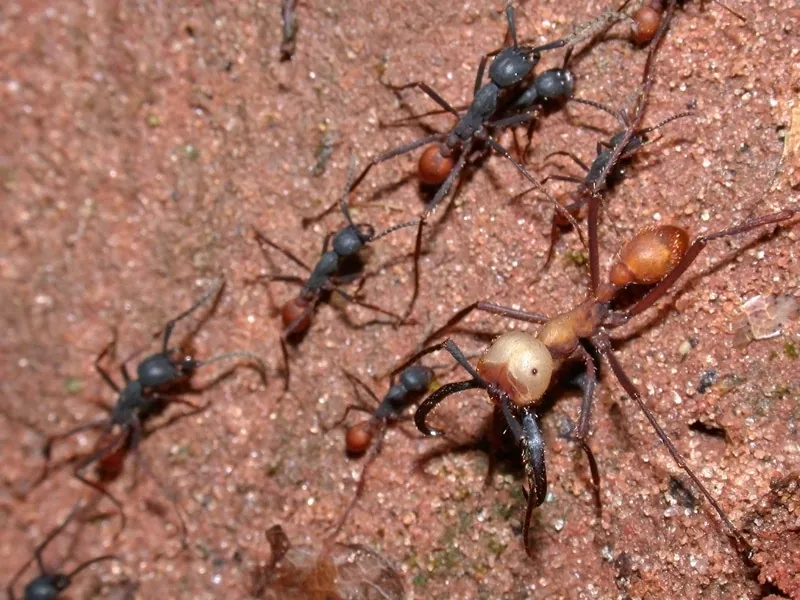
- Colour varies from deep golden to dark brown.1
- Workers are 3 mm to 12 mm long, and there are four sizes of worker.1
- Soldiers have much larger heads and long, pointed, sickle-shaped jaws (mandibles).1
- Long legs and an elongated body give it a spider-like appearance.1
- Raids move as a loose swarm over the leaf litter on the forest floor.1
Giftkraft
Das Gift kommt durch einen Stachel heraus.
Wie gefährlich ist es für Menschen?
Gefahr für Menschen: SchmerzhaftEs kann richtig wehtun, ist aber fast nie gefährlich.Was macht es, wenn es Angst hat?
Soldier ants have much larger heads and specialised jaws for defence, and workers have a well-developed sting.1
 Wenn es sticht
- Wasch und kühl die Stiche.
- Wenn die Person Atemnot hat, Gesicht oder Hals anschwellen oder ihr schwindlig wird, ist das ein allergischer Notfall: Ruf deine Notrufnummer an.
Ruf immer zuerst deine Notrufnummer an (112, 000, 911). Das sind allgemeine Erste-Hilfe-Hinweise, keine ärztliche Beratung. Erste-Hilfe-Grundlagen
 Bleib sicher
- Fass ein wildes Tier niemals an, fang es nicht und ärgere es nicht, auch kein kleines, und auch nicht, wenn es schlafend aussieht oder tot.
- Halte Abstand. Wenn du einem begegnest, bleib ruhig, geh langsam zurück und lass es seiner Wege gehen.
- Wenn dich eines sticht: Bleib ruhig, halt still, ruf deine Notrufnummer an (112, 000, 911) oder fahr schnell in ein Krankenhaus. Merk dir, wie es aussah, ein Foto hilft.
Es hat es nicht auf dich abgesehen. Es benutzt sein Gift, um Futter zu fangen oder sich zu schützen, und versteckt sich viel lieber. Mehr über Sicherheit
Wo auf der Welt?
Wie groß ist es?
Wie lang ist es?
 so klein, dass es auf deinen Fingernagel passt
Wie groß ist Army ant im Vergleich zu DIR?
Nur Rechnen in deinem Browser. Nichts wird gespeichert oder irgendwohin geschickt.
Wie schnell ist es?


Fakten
Workers can link their bodies to form living bridges and fill holes in the trail, so the whole colony can move faster.1
A single raid can be up to 200 metres long and use up to 200,000 ants.1
Over 500 other species live around these colonies, more than for any other single species, and over 300 are thought to depend on them.1
Colonies move their living nest, called a bivouac, almost every night, taking six to eight hours to relocate.1
Colonies can have 100,000 to 600,000 adult ants, all from one queen.1
Workers are a mix of four sizes, and genetics as well as diet affect which size an ant becomes.1
Woher die Fakten kommen
- Eciton burchellii (Wikipedia (CC BY-SA 4.0))
- Eciton burchellii (iNaturalist): Namen und Klassifikation.
- Venom Wiki: die Gefahrenstufe, die typische Größe und die geschätzte Geschwindigkeit sind von uns. So berechnen wir sie: So bewerten wir die Gefahr.
Jeder Fakt auf dieser Seite hat eine Nummer, die auf seine Quelle zeigt. Wenn wir etwas falsch haben: Entschuldigung, wir sind Tierfans, keine Fachzeitschrift. Schreib uns an [email protected] und wir korrigieren es.
 Der Skorpion hat Hunger! Venom Wiki ist ein Ein-Mann-Projekt: kostenlos, ohne Werbung und ohne Tracker. Ein kleines Trinkgeld hilft, es online zu halten.Füttere den Skorpion
 Bullet ant
 Red imported fire ant
 Giant Amazonian ant
 Maricopa harvester ant
 Trap-jaw ant
 Acacia ant
 Terciopelo
 Eastern coral snake
 Eastern diamondback rattlesnake
 Eyelash viper
 Timber rattlesnake
 Western diamondback rattlesnake