
 Afrika
 Asien
Asien Europa
 Südamerika
 Australien & Ozeanien
 Antarktis
 Pazifischer Ozean
 Atlantischer Ozean
 Indischer Ozean
 Nordpolarmeer
 Mittelmeer
 Rotes Meer
 Karibisches Meer
 Korallenmeer
 Südchinesisches Meer
 Philippinensee
 Andamanensee
 Nordsee
 Timorsee & Arafurasee
 Golf von Bengalen
 Golf von Kalifornien
Timber rattlesnake
 Bisse
BisseThe timber rattlesnake is a venomous pit viper that lives in forests and rocky land in the eastern United States. It is the only rattlesnake in most of the crowded northeastern states, and it is one of the most northerly venomous snakes in North America.1



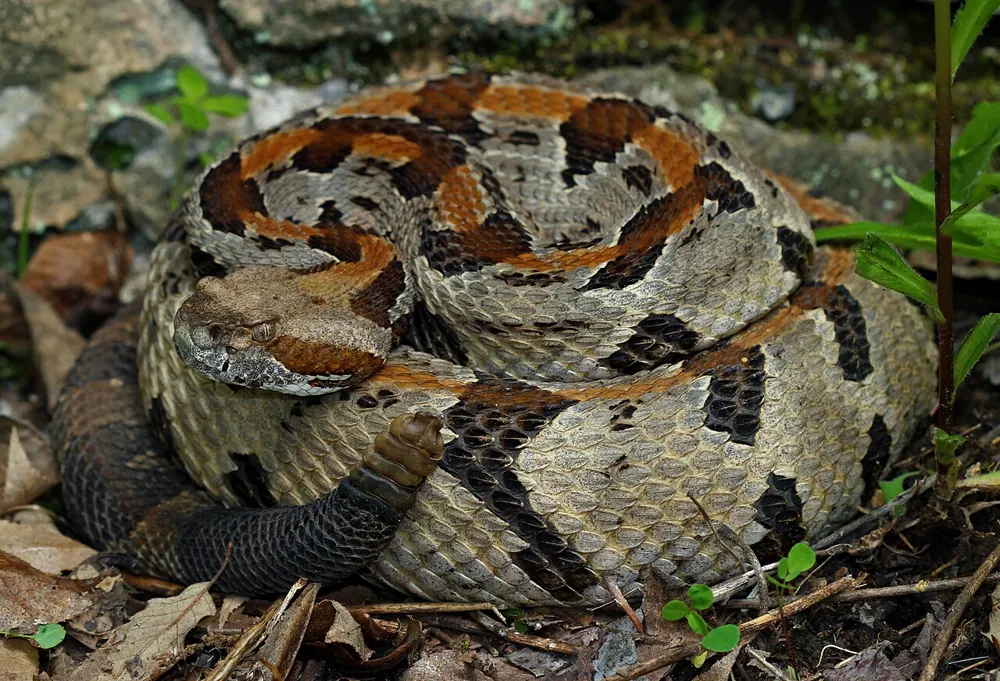
 So erkennst du es
- Dark brown or black crossbands on a yellowish-brown or greyish background1
- The crossbands have irregular zig-zag edges and may be V- or M-shaped1
- A rust-coloured stripe often runs down the middle of the back1
- The tail is black and looks 'velvety'1
- Melanism (very dark colouring) is common, and some individuals are almost solid black1
Giftkraft
Das Gift kommt beim Beißen durch die Giftzähne oder Zähne heraus.
Was macht sein Gift, wenn es beißt oder sticht?
Its venom is extremely potent and can be haemorrhagic (damaging blood vessels and causing bleeding) or neurotoxic (attacking the nerves), depending on the population and location. Its long fangs, large size and high venom yield make it potentially one of North America's most dangerous snakes. Venom-induced incapacitation can progress rapidly.1
Wie gefährlich ist es für Menschen?
Gefahr für Menschen: Sehr gefährlichEs kann einen Menschen töten, der keine Behandlung bekommt.It is potentially one of North America's most dangerous snakes, but it is usually shy and calm. It will retreat if it can and attacks mainly when cornered. Over many years in western Pennsylvania, one naturalist heard of only one death from its bite. Bites are widespread in some areas of Iowa's forests. Its remote, wooded habitat can make emergency medical care difficult or even impossible.1
Was macht es, wenn es Angst hat?
It rattles and feints a good deal before striking, and it will try to retreat first if it feels threatened.1
 Wenn es beißt
- Halte die Person still und ruhig, halte den gebissenen Arm oder das Bein auf Herzhöhe, nimm Ringe und alles Enge ab und bring sie schnell in ein Krankenhaus.
Ruf immer zuerst deine Notrufnummer an (112, 000, 911). Das sind allgemeine Erste-Hilfe-Hinweise, keine ärztliche Beratung. Erste-Hilfe-Grundlagen
 Bleib sicher
- Fass ein wildes Tier niemals an, fang es nicht und ärgere es nicht, auch kein kleines, und auch nicht, wenn es schlafend aussieht oder tot.
- Halte Abstand. Wenn du einem begegnest, bleib ruhig, geh langsam zurück und lass es seiner Wege gehen.
- Wenn dich eines beißt: Bleib ruhig, halt still, ruf deine Notrufnummer an (112, 000, 911) oder fahr schnell in ein Krankenhaus. Merk dir, wie es aussah, ein Foto hilft.
Es hat es nicht auf dich abgesehen. Es benutzt sein Gift, um Futter zu fangen oder sich zu schützen, und versteckt sich viel lieber. Mehr über Sicherheit
Wo auf der Welt?
Wie groß ist es?
Wie lang ist es?
Wie schwer ist es?
 so lang wie 4 Hauskatzen von Nase bis Schwanz
 so lang wie 11 Bananen hintereinanderetwa so schwer wie eine Hauskatze
 könnte 100 Meter in 95 Sekunden schaffen (der schnellste Mensch braucht 9,6)
Wie groß ist Timber rattlesnake im Vergleich zu DIR?
Nur Rechnen in deinem Browser. Nichts wird gespeichert oder irgendwohin geschickt.
Wie schnell ist es?


Fakten
Timber rattlesnakes return to the same winter den each year, and juveniles can track chemical cues to find relatives in it.1
Female timber rattlesnakes bask in the sun on open rocky areas called basking knolls before they give birth.1
They share winter dens with copperheads and rat snakes.1
It is the only rattlesnake in most of the populous Northeastern United States, and one of the most northerly venomous snakes in North America.1
Males often mate farther from the winter dens than females do.1
Mythen-Check
Mythos: Rattlesnakes attack people as soon as they see them.
Wahrheit: Timber rattlesnakes are shy and will try to retreat from danger first. They attack mainly when they are cornered, so leaving them alone keeps people safe.1
Für Giftexperten
- Wissenschaftlicher Name
- Crotalus horridus
- Gruppe
- Klapperschlangen
- Familie
- Viperidae2
- Ordnung
- Squamata
- Kontinente
- Nordamerika
- Babys
- Females first reproduce at a mean age of 9.6 years and average 7.7 offspring per litter. Most females reproduce only once in their lifetime.1
- Wie es ihm in der Natur geht
- Extirpated in Canada, as listed under the Canadian Species at Risk Act in May 2001.1
- Gefahr für Menschen
- 4 / 5: Sehr gefährlich3
Woher die Fakten kommen
- Timber rattlesnake (Wikipedia (CC BY-SA 4.0))
- Crotalus horridus (iNaturalist): Namen und Klassifikation.
- Venom Wiki: die Gefahrenstufe, die typische Größe und die geschätzte Geschwindigkeit sind von uns. So berechnen wir sie: So bewerten wir die Gefahr.
Jeder Fakt auf dieser Seite hat eine Nummer, die auf seine Quelle zeigt. Wenn wir etwas falsch haben: Entschuldigung, wir sind Tierfans, keine Fachzeitschrift. Schreib uns an [email protected] und wir korrigieren es.
 Der Skorpion hat Hunger! Venom Wiki ist ein Ein-Mann-Projekt: kostenlos, ohne Werbung und ohne Tracker. Ein kleines Trinkgeld hilft, es online zu halten.Füttere den Skorpion
Mehr aus derselben Gruppe: Klapperschlangen
 Eastern diamondback rattlesnakeKlapperschlangenKann töten
 Western diamondback rattlesnakeKlapperschlangenKann töten
 SidewinderKlapperschlangenBraucht einen Arzt
 Mojave rattlesnakeKlapperschlangenKann töten
 Aruba rattlesnakeKlapperschlangenBraucht einen Arzt
 Black-tailed rattlesnakeKlapperschlangenBraucht einen Arzt
 Terciopelo
 Eastern coral snake
 Eyelash viper
 Arizona bark scorpion
 Brown recluse
 Cane toad
_-_Flickr_-_2ndPeter.jpg)