
 Afrika
 Asien
Asien Europa
 Südamerika
 Australien & Ozeanien
 Antarktis
 Pazifischer Ozean
 Atlantischer Ozean
 Indischer Ozean
 Nordpolarmeer
 Mittelmeer
 Rotes Meer
 Karibisches Meer
 Korallenmeer
 Südchinesisches Meer
 Philippinensee
 Andamanensee
 Nordsee
 Timorsee & Arafurasee
 Golf von Bengalen
 Golf von Kalifornien
Common wasp
 Stiche
The common wasp is a yellow and black wasp that lives in colonies. It is found in parts of Europe, Asia, Australia, New Zealand and South America, and it often comes into gardens, orchards and buildings. It matters because it can sting people and damage fruit crops.1
 So erkennst du es
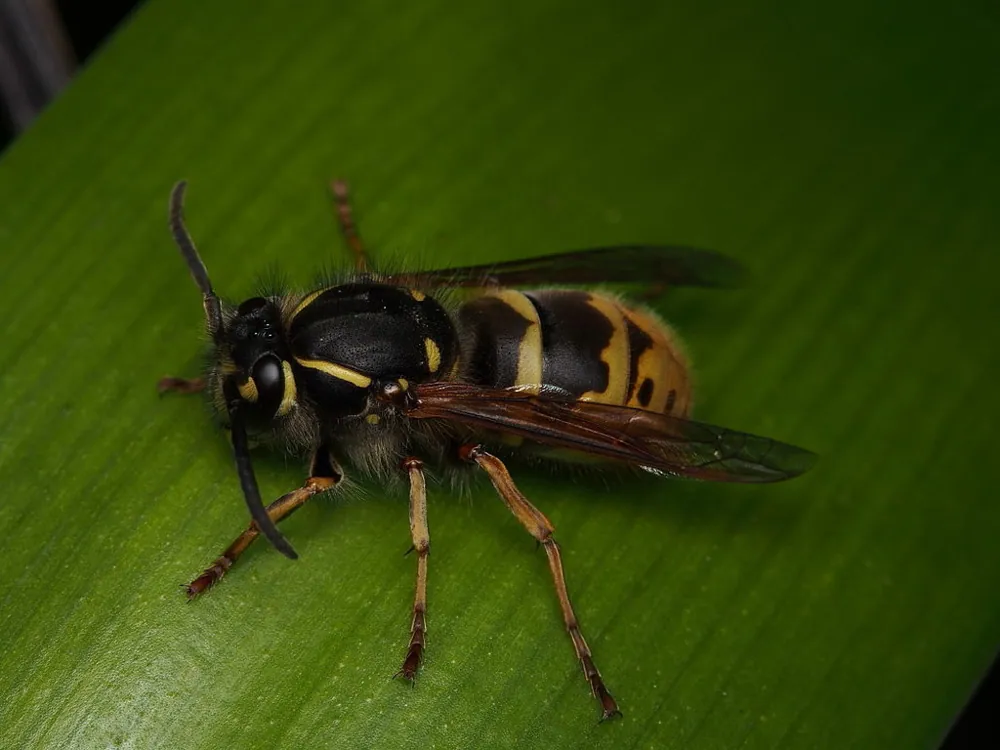
- Black and yellow warning colours, with yellow bands on the thorax and black dots and rings on the abdomen.1
- Seen from the front, the face has a single black mark on the clypeus, shaped like an anchor or a dagger.1
- Workers measure about 12–17 mm from head to tip of abdomen, while queens are about 20 mm long.1
- Its paper nest is brittle and tan coloured, with open cells and a column attaching it to the surface.1
Oft verwechselt mit: The common wasp looks very similar to Vespula germanica, the German wasp. Seen head on, the German wasp has three black dots on its face, while the common wasp has only one black mark. Males of the two species are almost impossible to tell apart by eye and need the shape of their genitalia to identify them.1
Giftkraft
Das Gift kommt durch einen Stachel heraus.
Wie gefährlich ist es für Menschen?
Gefahr für Menschen: SchmerzhaftEs kann richtig wehtun, ist aber fast nie gefährlich.The common wasp frequently damages fruit crops and can endanger humans.1
 Wenn es sticht
- Kratz den Bienenstachel heraus und kühl die Stelle.
- Wenn die Person Atemnot hat, Gesicht oder Hals anschwellen oder ihr schwindlig wird, ist das ein allergischer Notfall: Ruf deine Notrufnummer an und benutze ihren Adrenalin-Autoinjektor, wenn sie einen hat.
Ruf immer zuerst deine Notrufnummer an (112, 000, 911). Das sind allgemeine Erste-Hilfe-Hinweise, keine ärztliche Beratung. Erste-Hilfe-Grundlagen
 Bleib sicher
- Fass ein wildes Tier niemals an, fang es nicht und ärgere es nicht, auch kein kleines, und auch nicht, wenn es schlafend aussieht oder tot.
- Halte Abstand. Wenn du einem begegnest, bleib ruhig, geh langsam zurück und lass es seiner Wege gehen.
- Wenn dich eines sticht: Bleib ruhig, halt still, ruf deine Notrufnummer an (112, 000, 911) oder fahr schnell in ein Krankenhaus. Merk dir, wie es aussah, ein Foto hilft.
Es hat es nicht auf dich abgesehen. Es benutzt sein Gift, um Futter zu fangen oder sich zu schützen, und versteckt sich viel lieber. Mehr über Sicherheit
Wo auf der Welt?
Wie groß ist es?
Wie lang ist es?
 etwa so lang wie eine Büroklammer
 könnte in 16 Sekunden über ein ganzes Fußballfeld fliegen
Wie groß ist Common wasp im Vergleich zu DIR?
Nur Rechnen in deinem Browser. Nichts wird gespeichert oder irgendwohin geschickt.
Wie schnell ist es?


Fakten
The nest has a chemical that repels ants, which is spread around the base of the nest column to stop ants attacking it.1
Workers use their wings as fans to cool the nest when it gets too hot, as its best temperature is around 32 °C.1
A new queen searches for a nest site and performs a dance-like wing movement that helps her find the spot again after she has left.1
The wasps mark the path from their nest to their food with pheromone trails, which are specific to the species rather than to each colony.1
The queen dies in autumn, and once she is gone the colony breaks down and the workers die of cold or starvation.1
Mythen-Check
Mythos: Common wasps found in North America are the same species as the common wasp of Europe.
Wahrheit: Until 2010 they were thought to be the same, but the North American ones are a different species, Vespula alascensis.1
Woher die Fakten kommen
- Vespula vulgaris (Wikipedia (CC BY-SA 4.0))
- Vespula vulgaris (iNaturalist): Namen und Klassifikation.
- Venom Wiki: die Gefahrenstufe, die typische Größe und die geschätzte Geschwindigkeit sind von uns. So berechnen wir sie: So bewerten wir die Gefahr.
Jeder Fakt auf dieser Seite hat eine Nummer, die auf seine Quelle zeigt. Wenn wir etwas falsch haben: Entschuldigung, wir sind Tierfans, keine Fachzeitschrift. Schreib uns an [email protected] und wir korrigieren es.
 Der Skorpion hat Hunger! Venom Wiki ist ein Ein-Mann-Projekt: kostenlos, ohne Werbung und ohne Tracker. Ein kleines Trinkgeld hilft, es online zu halten.Füttere den Skorpion
Mehr aus derselben Gruppe: Bienen, Wespen & Hornissen
 Asian giant hornetBienen, Wespen & HornissenKann töten
 European hornetBienen, Wespen & HornissenTut nur weh
 Western honey beeBienen, Wespen & HornissenTut nur weh
 Giant honey beeBienen, Wespen & HornissenBraucht einen Arzt
 Asian hornetBienen, Wespen & HornissenTut nur weh
 European paper waspBienen, Wespen & HornissenTut nur weh
Lebt auch in: Europa
 Common European adderVipern & OtternBraucht einen Arzt
 Spanish flyAndere passiv giftige TiereBraucht einen ArztNicht anfassen
 Fire salamanderPfeilgiftfrösche, Kröten & MolcheTut nur wehNicht anfassen
 Blunt-nosed viperVipern & OtternKann töten
 Nose-horned viperVipern & OtternKann töten
 Ottoman viperVipern & OtternKann töten