
 Afrika
 Asien
Asien Europa
 Südamerika
 Australien & Ozeanien
 Antarktis
 Pazifischer Ozean
 Atlantischer Ozean
 Indischer Ozean
 Nordpolarmeer
 Mittelmeer
 Rotes Meer
 Karibisches Meer
 Korallenmeer
 Südchinesisches Meer
 Philippinensee
 Andamanensee
 Nordsee
 Timorsee & Arafurasee
 Golf von Bengalen
 Golf von Kalifornien
Fire salamander
 Gift in der Haut
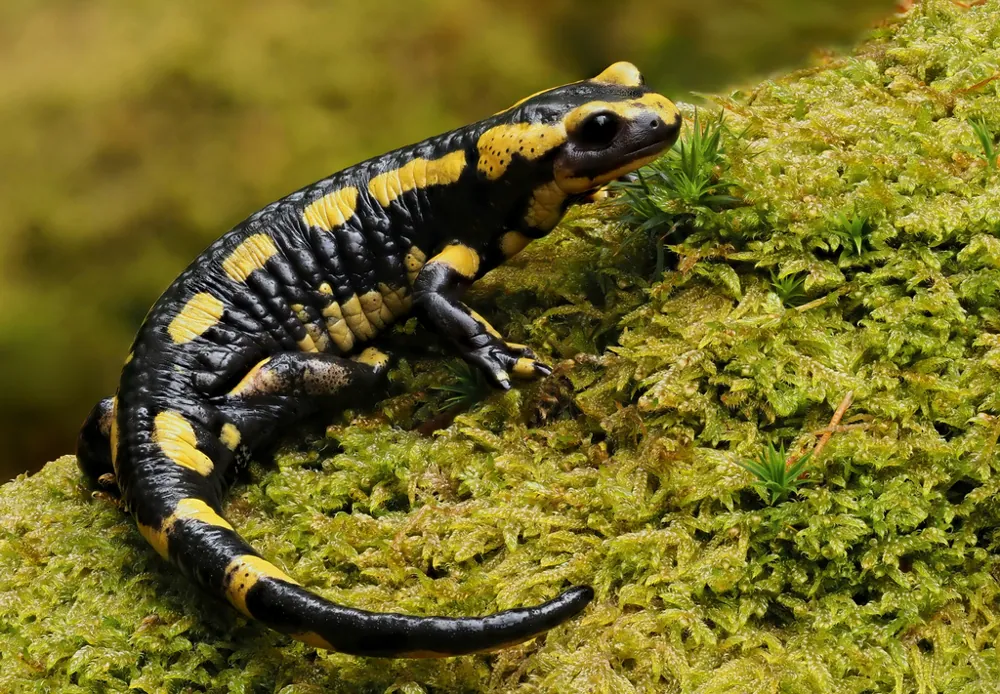
The fire salamander is a black amphibian with bright yellow, and sometimes red or orange, markings. It lives in forests across most of southern and central Europe. Its bright colours warn predators that its skin is poisonous.1
 So erkennst du es
- Black with yellow spots or stripes; the amount of yellow varies, and some are almost completely black1
- Shades of red or orange may appear, replacing or mixing with the yellow, depending on the subspecies1
- Grows to 15 to 25 cm long, making it one of Europe's largest salamanders1
- Males and females look very similar, except in the breeding season, when the male has a swollen gland near his vent1
Giftkraft
Seine Haut ist giftig. Es ist gefährlich, es anzufassen, abzulecken oder zu essen.
Was macht sein Gift, wenn man es anfasst oder isst?
The fire salamander is poisonous rather than venomous, so it does not inject venom with a bite. Its skin secretions contain alkaloid toxins, mainly samandarin, which cause strong muscle convulsions and high blood pressure, combined with fast breathing, in all vertebrates. Another alkaloid, samandarone, has also been found in its skin secretions. The poison comes from glands concentrated around the head and along the back.1
Wie gefährlich ist es für Menschen?
Gefahr für Menschen: SchmerzhaftEs kann richtig wehtun, ist aber fast nie gefährlich.Some compounds in its skin secretions are potentially dangerous to human life. Touching the animal or handling its skin can expose people to the poison.1
Was macht es, wenn es Angst hat?
Its bright yellow, red or orange colours warn predators that it is poisonous, and it releases toxins from its skin glands.1
 Wenn jemand es angefasst oder gegessen hat
- Wenn jemand eines angefasst hat: Hände gründlich waschen und nicht an Augen oder Mund fassen. Wenn ein Kind oder Haustier eines abgeleckt oder gegessen hat: Ruf den Giftnotruf oder deine Notrufnummer an.
Ruf immer zuerst deine Notrufnummer an (112, 000, 911). Das sind allgemeine Erste-Hilfe-Hinweise, keine ärztliche Beratung. Erste-Hilfe-Grundlagen
 Bleib sicher
- Fass ein wildes Tier niemals an, fang es nicht und ärgere es nicht, auch kein kleines, und auch nicht, wenn es schlafend aussieht oder tot.
- Halte Abstand. Wenn du einem begegnest, bleib ruhig, geh langsam zurück und lass es seiner Wege gehen.
- Wenn du es angefasst oder gegessen hast: Reib dir nicht die Augen oder den Mund, wasch dir die Hände und hol ärztliche Hilfe.
Es hat es nicht auf dich abgesehen. Sein Gift ist nur dazu da, dass es niemand frisst. Mehr über Sicherheit
Wo auf der Welt?
Wie groß ist es?
Wie lang ist es?
Wie schwer ist es?

 so lang wie 8 Bausteine in einer Reihe
Wie groß ist Fire salamander im Vergleich zu DIR?
Nur Rechnen in deinem Browser. Nichts wird gespeichert oder irgendwohin geschickt.
Wie schnell ist es?


Fakten
One fire salamander lived for more than 50 years in Museum Koenig, a natural history museum in Germany.1
Larvae do not make the poison. It develops as the salamander matures, in the ovaries, liver and testes.1
Its skin poison may also help protect it against bacterial and fungal infections of the skin.1
Its bright colours are a warning signal. Scientists call this aposematism, meaning the animal advertises that it is poisonous.1
Some subspecies give birth to live young, while others release larvae into water. Only two subspecies, fastuosa and bernadezi, give birth to fully formed young.1
In captivity, females can store sperm for a long time and use it to produce another clutch of eggs. This has not been seen in the wild.1
Für Giftexperten
- Wissenschaftlicher Name
- Salamandra salamandra
- Gruppe
- Pfeilgiftfrösche, Kröten & Molche
- Familie
- Salamandridae2
- Ordnung
- Caudata
- Kontinente
- Europa
- Babys
- Eggs develop inside the female, and she puts the larvae into water as they hatch. In some subspecies, the young develop inside the female until she gives birth to fully formed young.1
- Lebensdauer
- etwa 50 Jahre1
- Wie es ihm in der Natur geht
- Vulnerable (IUCN Red List, 2023)1
- Gefahr für Menschen
- 2 / 5: Schmerzhaft3
Woher die Fakten kommen
- Fire salamander (Wikipedia (CC BY-SA 4.0))
- Salamandra salamandra (iNaturalist): Namen und Klassifikation.
- Venom Wiki: die Gefahrenstufe, die typische Größe und die geschätzte Geschwindigkeit sind von uns. So berechnen wir sie: So bewerten wir die Gefahr.
Jeder Fakt auf dieser Seite hat eine Nummer, die auf seine Quelle zeigt. Wenn wir etwas falsch haben: Entschuldigung, wir sind Tierfans, keine Fachzeitschrift. Schreib uns an [email protected] und wir korrigieren es.
 Der Skorpion hat Hunger! Venom Wiki ist ein Ein-Mann-Projekt: kostenlos, ohne Werbung und ohne Tracker. Ein kleines Trinkgeld hilft, es online zu halten.Füttere den Skorpion
Mehr aus derselben Gruppe: Pfeilgiftfrösche, Kröten & Molche
 Common toadPfeilgiftfrösche, Kröten & MolcheTut nur wehNicht anfassen
 European fire-bellied toadPfeilgiftfrösche, Kröten & MolcheHarmlos
 Iberian ribbed newtPfeilgiftfrösche, Kröten & MolcheHarmlos
 Natterjack toadPfeilgiftfrösche, Kröten & MolcheHarmlos
 Alpine salamanderPfeilgiftfrösche, Kröten & MolcheHarmlos
 European green toadPfeilgiftfrösche, Kröten & MolcheHarmlos
Lebt auch in: Europa
 Common European adderVipern & OtternBraucht einen Arzt
 Spanish flyAndere passiv giftige TiereBraucht einen ArztNicht anfassen
 Common waspBienen, Wespen & HornissenTut nur weh
 European hornetBienen, Wespen & HornissenTut nur weh
 Western honey beeBienen, Wespen & HornissenTut nur weh
 Blunt-nosed viperVipern & OtternKann töten