
 Afrika
 Asien
Asien Europa
 Südamerika
 Australien & Ozeanien
 Antarktis
 Pazifischer Ozean
 Atlantischer Ozean
 Indischer Ozean
 Nordpolarmeer
 Mittelmeer
 Rotes Meer
 Karibisches Meer
 Korallenmeer
 Südchinesisches Meer
 Philippinensee
 Andamanensee
 Nordsee
 Timorsee & Arafurasee
 Golf von Bengalen
 Golf von Kalifornien
Ethiopian mountain adder
 Bisse
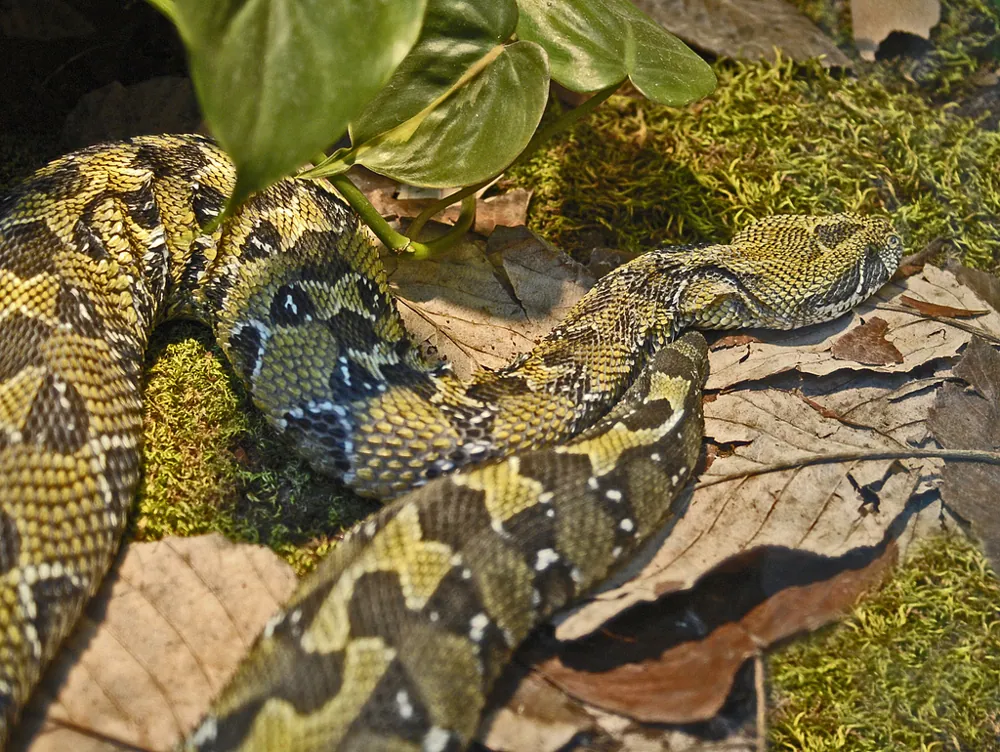
BisseThe Ethiopian mountain adder is a large venomous viper that lives only in Ethiopia. It has a broad head and striking geometric patterns along its back. Scientists knew very little about it for many years, and it is still being studied.1
 So erkennst du es
- It is large, with a broad, flat, triangular head that is distinct from its thin neck.1
- A pattern of black hexagons or diamonds runs down the centre of the back, linked by yellow butterfly-shaped markings.1
- Black triangular spots with white centres run down the upper flanks, and greenish-grey triangles with yellow edges sit on the lower flanks.1
- The head is brown with a dark triangle between the eyes and a dark hammer shape behind it.1
- The upper lip scales are white, and the chin and throat are white with black speckling.1
Giftkraft
Das Gift kommt beim Beißen durch die Giftzähne oder Zähne heraus.
Was macht sein Gift, wenn es beißt oder sticht?
Its venom was essentially unknown until recently, so its toxicity and make-up are still poorly understood. It is assumed to cause at least some of the bites reported in the densely populated areas where it lives. The venom can be neutralised by SAIMR antivenom.1
Wie gefährlich ist es für Menschen?
Gefahr für Menschen: Sehr gefährlichEs kann einen Menschen töten, der keine Behandlung bekommt.Local people regard it as very dangerous. The only well-documented bite involved a herpetologist from Texas in 2009, who was bitten on the finger by a young captive snake and survived.1
 Gute Nachricht: Ärzte haben dafür ein Medikament (Gegengift) oder eine Behandlung.1
Was macht es, wenn es Angst hat?
In the one living specimen studied, it was less irritable than the puff adder and was not inclined to strike, but it hissed when teased and struggled furiously when restrained.1
 Wenn es beißt
- Halte die Person still und ruhig, halte den gebissenen Arm oder das Bein auf Herzhöhe, nimm Ringe und alles Enge ab und bring sie schnell in ein Krankenhaus.
Ruf immer zuerst deine Notrufnummer an (112, 000, 911). Das sind allgemeine Erste-Hilfe-Hinweise, keine ärztliche Beratung. Erste-Hilfe-Grundlagen
 Bleib sicher
- Fass ein wildes Tier niemals an, fang es nicht und ärgere es nicht, auch kein kleines, und auch nicht, wenn es schlafend aussieht oder tot.
- Halte Abstand. Wenn du einem begegnest, bleib ruhig, geh langsam zurück und lass es seiner Wege gehen.
- Wenn dich eines beißt: Bleib ruhig, halt still, ruf deine Notrufnummer an (112, 000, 911) oder fahr schnell in ein Krankenhaus. Merk dir, wie es aussah, ein Foto hilft.
Es hat es nicht auf dich abgesehen. Es benutzt sein Gift, um Futter zu fangen oder sich zu schützen, und versteckt sich viel lieber. Mehr über Sicherheit
Wo auf der Welt?
Wie groß ist es?
Wie lang ist es?
 so lang wie 2,5 Hauskatzen von Nase bis Schwanz
 so lang wie 7 Bananen hintereinander
 könnte 100 Meter in 100 Sekunden schaffen (der schnellste Mensch braucht 9,6)
Wie groß ist Ethiopian mountain adder im Vergleich zu DIR?
Nur Rechnen in deinem Browser. Nichts wird gespeichert oder irgendwohin geschickt.
Wie schnell ist es?


Fakten
The first specimen known to science was a road kill on the east side of the Rift Valley in Ethiopia.1
In 1995, the species was known from only three specimens.1
In 2007, an exporter transported 20 of these snakes to the United States.1
In 2014, the San Diego Zoo became the first U.S. zoo to successfully breed the species in captivity.1
Woher die Fakten kommen
- Bitis parviocula (Wikipedia (CC BY-SA 4.0))
- Bitis parviocula (iNaturalist): Namen und Klassifikation.
- Venom Wiki: die Gefahrenstufe, die typische Größe und die geschätzte Geschwindigkeit sind von uns. So berechnen wir sie: So bewerten wir die Gefahr.
Jeder Fakt auf dieser Seite hat eine Nummer, die auf seine Quelle zeigt. Wenn wir etwas falsch haben: Entschuldigung, wir sind Tierfans, keine Fachzeitschrift. Schreib uns an [email protected] und wir korrigieren es.
 Der Skorpion hat Hunger! Venom Wiki ist ein Ein-Mann-Projekt: kostenlos, ohne Werbung und ohne Tracker. Ein kleines Trinkgeld hilft, es online zu halten.Füttere den Skorpion
 Puff adder
 Gaboon viper
 Northeast African carpet viper
 West African carpet viper
 Rhinoceros viper
 West African Gaboon viper
 Black mamba
 Deathstalker
 Egyptian cobra
 Boomslang
 Fat-tailed scorpion
 Western honey bee