
 Afrika
 Asien
Asien Europa
 Südamerika
 Australien & Ozeanien
 Antarktis
 Pazifischer Ozean
 Atlantischer Ozean
 Indischer Ozean
 Nordpolarmeer
 Mittelmeer
 Rotes Meer
 Karibisches Meer
 Korallenmeer
 Südchinesisches Meer
 Philippinensee
 Andamanensee
 Nordsee
 Timorsee & Arafurasee
 Golf von Bengalen
 Golf von Kalifornien
Forest cobra
 Bisse
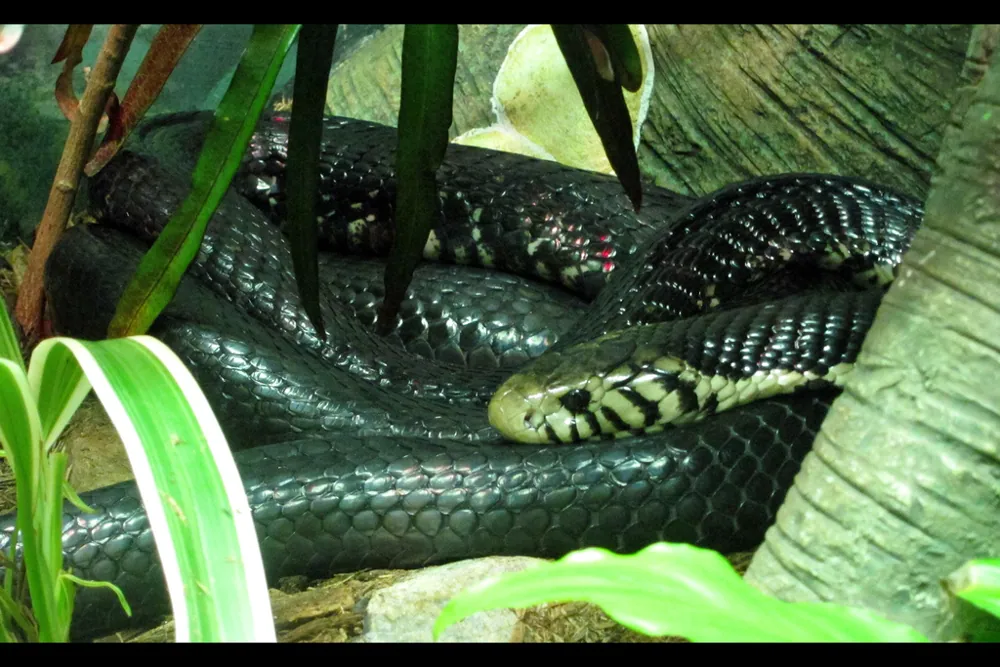
BisseThe forest cobra is a large, highly venomous snake that lives in central and western Africa. It is the largest true cobra, and it is one of the few African cobras that lives in high forest. It is dangerous, so anyone bitten needs urgent medical care.1



 So erkennst du es
- Forest and forest-edge forms are glossy black, with cream or white chin, throat and belly, and broad black cross-bars and blotches.1
- The sides of the head show black and white markings that look like vertical bars on the lips.1
- West African savanna forms are banded black and yellow, with a black tail and yellow lips, chin and throat.1
- East African coastal forms are brownish or blackish-brown above, with a yellow or cream belly speckled with brown or black.1
- Adults are usually 140 to 220 cm long.1
Giftkraft
Das Gift kommt beim Beißen durch die Giftzähne oder Zähne heraus.
Was macht sein Gift, wenn es beißt oder sticht?
Its venom is a postsynaptic neurotoxin, which attacks the nerves and causes severe neurotoxicity. Symptoms can include drooping eyelids, drowsiness, limb paralysis, hearing loss, inability to speak, dizziness, shock, low blood pressure, stomach pain, fever and breathing problems. A large amount of venom can be injected in one bite.1
Wie gefährlich ist es für Menschen?
Gefahr für Menschen: Sehr gefährlichEs kann einen Menschen töten, der keine Behandlung bekommt.It is one of the least frequent causes of snake bites among African cobras, largely because it lives in forests. Even so, it ranks as the 4th most venomous Naja (true cobra) species, and a bite is a life-threatening emergency. Deaths from respiratory failure have been reported. A child in Ghana died within 20 minutes of being bitten by a snake thought to be this species.1
 Gute Nachricht: Ärzte haben dafür ein Medikament (Gegengift) oder eine Behandlung.1
Was macht es, wenn es Angst hat?
When threatened, it raises the front of its body off the ground, spreads a narrow hood and hisses loudly. If cornered or agitated, it can attack quickly.1
 Wenn es beißt
- Most victims survive if antivenom is given promptly, as soon as signs of envenomation appear. Because a bite is a life-threatening emergency, the bitten person needs urgent medical care.1
- Halte die Person still und ruhig, nimm Ringe und alles Enge ab und bring sie schnell in ein Krankenhaus: Gegengift (Antiserum) ist die Behandlung.
Ruf immer zuerst deine Notrufnummer an (112, 000, 911). Das sind allgemeine Erste-Hilfe-Hinweise, keine ärztliche Beratung. Erste-Hilfe-Grundlagen
 Bleib sicher
- Fass ein wildes Tier niemals an, fang es nicht und ärgere es nicht, auch kein kleines, und auch nicht, wenn es schlafend aussieht oder tot.
- Halte Abstand. Wenn du einem begegnest, bleib ruhig, geh langsam zurück und lass es seiner Wege gehen.
- Wenn dich eines beißt: Bleib ruhig, halt still, ruf deine Notrufnummer an (112, 000, 911) oder fahr schnell in ein Krankenhaus. Merk dir, wie es aussah, ein Foto hilft.
Es hat es nicht auf dich abgesehen. Es benutzt sein Gift, um Futter zu fangen oder sich zu schützen, und versteckt sich viel lieber. Mehr über Sicherheit
Wo auf der Welt?
Wie groß ist es?
Wie lang ist es?
Wie schwer ist es?
 so lang wie 3 Hunde von Nase bis Schwanz
 so lang wie 18 Bananen hintereinander
 etwa so schwer wie eine Hauskatze
 könnte 100 Meter in 41 Sekunden schaffen (der schnellste Mensch braucht 9,6)
Wie groß ist Forest cobra im Vergleich zu DIR?
Nur Rechnen in deinem Browser. Nichts wird gespeichert oder irgendwohin geschickt.
Wie schnell ist es?


Fakten
It is the largest true cobra species and possibly the largest of all Naja species in the world.1
It is an excellent climber and has been known to climb trees to 10 m or more.1
It swims well and is often considered semi-aquatic.1
It does not spit or spray its venom.1
It is mainly active during the day in quiet areas, but it can be active at night in towns.1
Woher die Fakten kommen
- Forest cobra (Wikipedia (CC BY-SA 4.0))
- Naja melanoleuca (iNaturalist): Namen und Klassifikation.
- Venom Wiki: die Gefahrenstufe, die typische Größe und die geschätzte Geschwindigkeit sind von uns. So berechnen wir sie: So bewerten wir die Gefahr.
Jeder Fakt auf dieser Seite hat eine Nummer, die auf seine Quelle zeigt. Wenn wir etwas falsch haben: Entschuldigung, wir sind Tierfans, keine Fachzeitschrift. Schreib uns an [email protected] und wir korrigieren es.
 Der Skorpion hat Hunger! Venom Wiki ist ein Ein-Mann-Projekt: kostenlos, ohne Werbung und ohne Tracker. Ein kleines Trinkgeld hilft, es online zu halten.Füttere den Skorpion
 Black mamba
 Egyptian cobra
 Cape cobra
 Eastern green mamba
 Jameson's mamba
 Western green mamba
 Deathstalker
 Puff adder
 Boomslang
 Fat-tailed scorpion
 Gaboon viper
 Western honey bee