
 Afrika
 Asien
Asien Europa
 Südamerika
 Australien & Ozeanien
 Antarktis
 Pazifischer Ozean
 Atlantischer Ozean
 Indischer Ozean
 Nordpolarmeer
 Mittelmeer
 Rotes Meer
 Karibisches Meer
 Korallenmeer
 Südchinesisches Meer
 Philippinensee
 Andamanensee
 Nordsee
 Timorsee & Arafurasee
 Golf von Bengalen
 Golf von Kalifornien
Giant golden orb-weaver
 Bisse
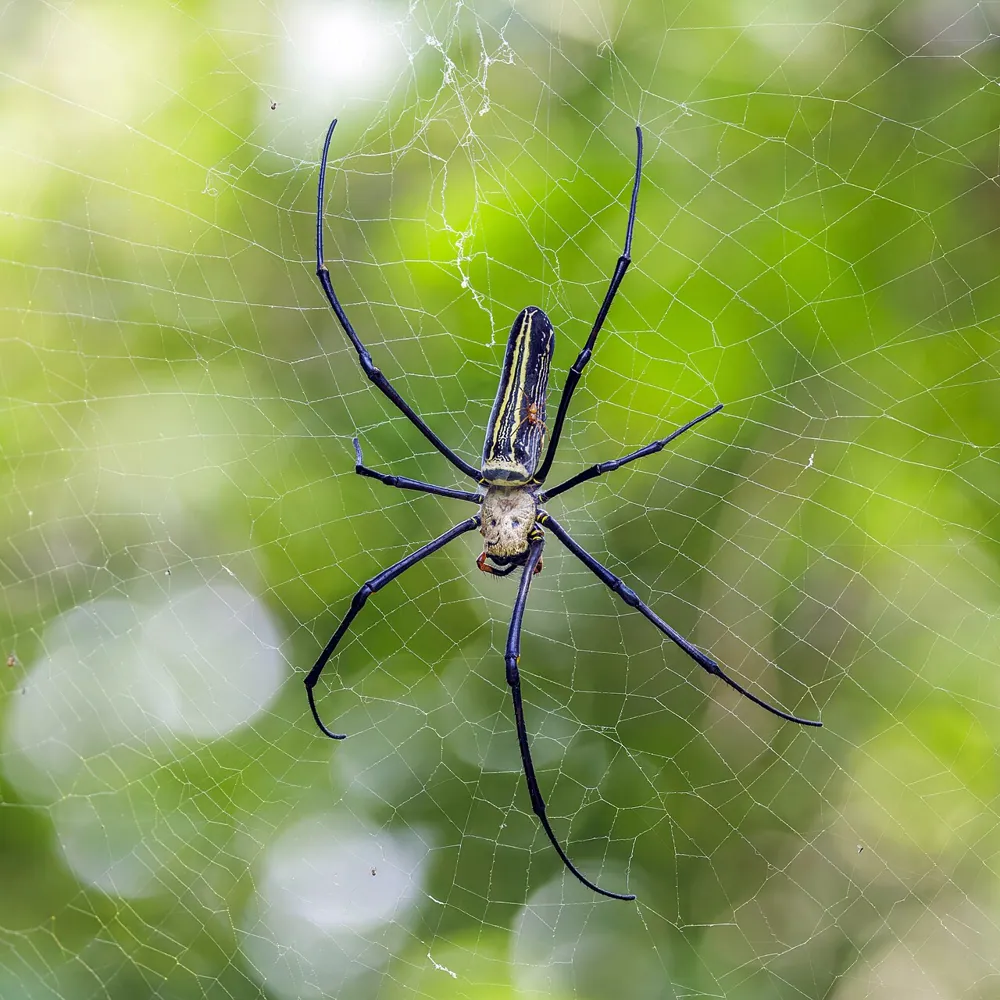
BisseThe giant golden orb-weaver is a large spider found across East and Southeast Asia and in Oceania. Adult females have bodies up to 50 mm long, while the males are tiny by comparison. Its big, yellowish webs are often seen in forests and against buildings.1

 So erkennst du es
- Adult females are very large, with a body length of 25 to 50 mm.1
- The abdomen is mostly dark yellow-brown with yellow stripes.1
- The legs are long and black and yellow.1
- Females have a horn-like bulge on the back of the body (tergum).1
- Males are tiny, measuring about 4 to 6 mm, with light brown legs.1
Oft verwechselt mit: Trichonephila clavata has no horn-like bulge on its back, which the giant golden orb-weaver does have. Nephila laurinae lacks the pair of yellow stripes at the back of the abdomen that this species has.1
Giftkraft
Das Gift kommt beim Beißen durch die Giftzähne oder Zähne heraus.
Wie gefährlich ist es für Menschen?
Gefahr für Menschen: LeichtWie ein Bienenstich oder weniger. Für Menschen praktisch harmlos. Wenn es beißt
- Wasch den Biss und leg gegen die Schmerzen ein Kühlpack darauf. Hol ärztliche Hilfe, wenn die Schmerzen stark sind, sich ausbreiten oder es der Person schlecht geht.
Ruf immer zuerst deine Notrufnummer an (112, 000, 911). Das sind allgemeine Erste-Hilfe-Hinweise, keine ärztliche Beratung. Erste-Hilfe-Grundlagen
 Bleib sicher
- Fass ein wildes Tier niemals an, fang es nicht und ärgere es nicht, auch kein kleines, und auch nicht, wenn es schlafend aussieht oder tot.
- Halte Abstand. Wenn du einem begegnest, bleib ruhig, geh langsam zurück und lass es seiner Wege gehen.
- Wenn dich eines beißt: Bleib ruhig, halt still, ruf deine Notrufnummer an (112, 000, 911) oder fahr schnell in ein Krankenhaus. Merk dir, wie es aussah, ein Foto hilft.
Es hat es nicht auf dich abgesehen. Es benutzt sein Gift, um Futter zu fangen oder sich zu schützen, und versteckt sich viel lieber. Mehr über Sicherheit
Wo auf der Welt?
Wie groß ist es?
Wie lang ist es?
 kürzer als dein kleiner Finger
 könnte 100 Meter in 130 Sekunden schaffen (der schnellste Mensch braucht 9,6)
Wie groß ist Giant golden orb-weaver im Vergleich zu DIR?
Nur Rechnen in deinem Browser. Nichts wird gespeichert oder irgendwohin geschickt.
Wie schnell ist es?


Fakten
Its silk is more robust than most human-made materials, which has drawn attention from materials scientists.1
Males can be 4 to 10 times smaller than the females, one of the biggest size differences among land animals.1
Adult females keep growing by moulting after they mature, which most spiders do not do.1
Females do not shed their genitals when they moult, so they can keep collecting sperm.1
When temperatures rise above 40 °C, it will abandon its web.1
Für Giftexperten
- Wissenschaftlicher Name
- Nephila pilipes
- Gruppe
- Spinnen
- Familie
- Nephilidae2
- Ordnung
- Araneae
- Kontinente
- Asien, Australien & Ozeanien
- Babys
- Females do not hang egg sacs in the web. Instead they dig a pit, lay eggs in it and cover it with plant debris or soil. Adult females lay eggs continuously.1
- Gefahr für Menschen
- 1 / 5: Leicht3
Woher die Fakten kommen
- Nephila pilipes (Wikipedia (CC BY-SA 4.0))
- Nephila pilipes (iNaturalist): Namen und Klassifikation.
- Venom Wiki: die Gefahrenstufe, die typische Größe und die geschätzte Geschwindigkeit sind von uns. So berechnen wir sie: So bewerten wir die Gefahr.
Jeder Fakt auf dieser Seite hat eine Nummer, die auf seine Quelle zeigt. Wenn wir etwas falsch haben: Entschuldigung, wir sind Tierfans, keine Fachzeitschrift. Schreib uns an [email protected] und wir korrigieren es.
 Der Skorpion hat Hunger! Venom Wiki ist ein Ein-Mann-Projekt: kostenlos, ohne Werbung und ohne Tracker. Ein kleines Trinkgeld hilft, es online zu halten.Füttere den Skorpion
 Redback spider
 Katipo
 Mediterranean black widow
 Diving bell spider
 European yellow sac spider
 White-tailed spider
 Gelber Mittelmeerskorpion
 Brillenschlange
 Indische Sandrasselotter
 Königskobra
 Puffotter
 Kettenviper
_female_and_male_Double_Haven.jpg)