
 Afrika
 Asien
Asien Europa
 Südamerika
 Australien & Ozeanien
 Antarktis
 Pazifischer Ozean
 Atlantischer Ozean
 Indischer Ozean
 Nordpolarmeer
 Mittelmeer
 Rotes Meer
 Karibisches Meer
 Korallenmeer
 Südchinesisches Meer
 Philippinensee
 Andamanensee
 Nordsee
 Timorsee & Arafurasee
 Golf von Bengalen
 Golf von Kalifornien
Diving bell spider
 Bisse
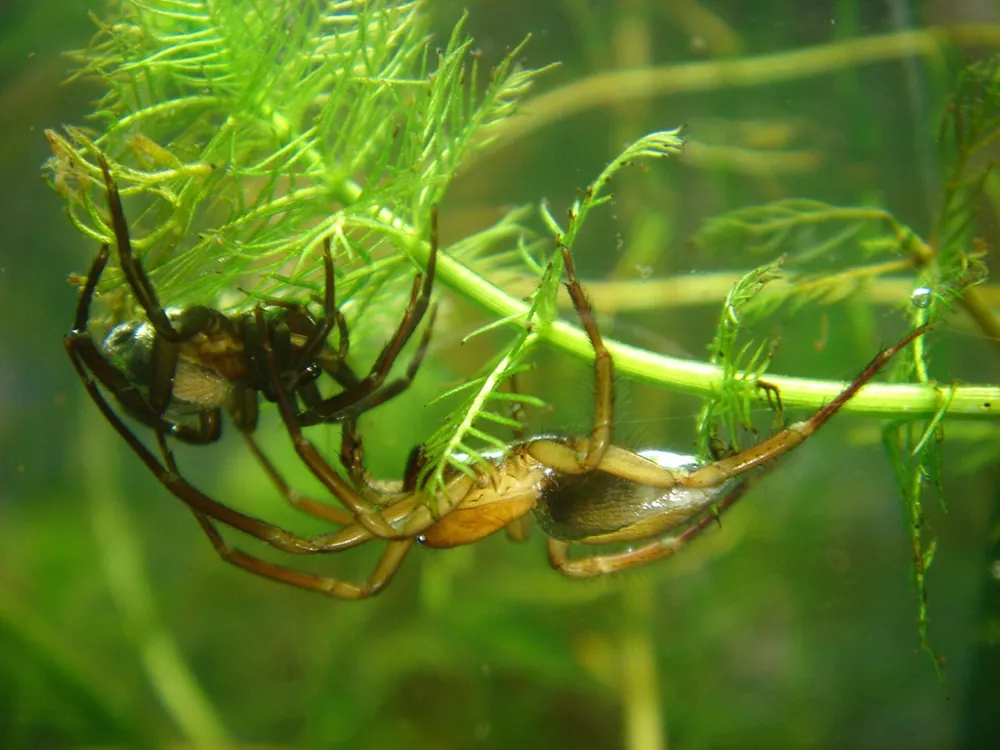
BisseThe diving bell spider is the only spider known to live almost entirely underwater. It makes its home in clean freshwater across Europe and Asia. It is special because it breathes air that it carries down from the surface and keeps in a silk bell under the water.1
 So erkennst du es
- Out of the water, it is mid to dark brown.1
- Hairs on the abdomen give it a dark grey, velvet-like look.1
- Underwater, an air bubble trapped by dense hairs on the abdomen and legs makes it look silvery.1
- Males have a head-and-body length of 10 to 15 mm, and females 8 to 12 mm.1
- It spends most of its time inside a silk diving bell, darting out to catch prey.1
Giftkraft
Das Gift kommt beim Beißen durch die Giftzähne oder Zähne heraus.
Was macht sein Gift, wenn es beißt oder sticht?
Reports describe a bite that is painful, with local swelling, vomiting and a slight fever that lasts 5 to 10 days. These reports are old and unverified, so the effects are not well confirmed.1
Wie gefährlich ist es für Menschen?
Gefahr für Menschen: SchmerzhaftEs kann richtig wehtun, ist aber fast nie gefährlich.The bite is reputedly painful, but there is no solid evidence of serious harm to people. Recent confirmed reports are lacking.1
 Wenn es beißt
- Wasch den Biss und leg gegen die Schmerzen ein Kühlpack darauf. Hol ärztliche Hilfe, wenn die Schmerzen stark sind, sich ausbreiten oder es der Person schlecht geht.
Ruf immer zuerst deine Notrufnummer an (112, 000, 911). Das sind allgemeine Erste-Hilfe-Hinweise, keine ärztliche Beratung. Erste-Hilfe-Grundlagen
 Bleib sicher
- Fass ein wildes Tier niemals an, fang es nicht und ärgere es nicht, auch kein kleines, und auch nicht, wenn es schlafend aussieht oder tot.
- Halte Abstand. Wenn du einem begegnest, bleib ruhig, geh langsam zurück und lass es seiner Wege gehen.
- Wenn dich eines beißt: Bleib ruhig, halt still, ruf deine Notrufnummer an (112, 000, 911) oder fahr schnell in ein Krankenhaus. Merk dir, wie es aussah, ein Foto hilft.
Es hat es nicht auf dich abgesehen. Es benutzt sein Gift, um Futter zu fangen oder sich zu schützen, und versteckt sich viel lieber. Mehr über Sicherheit
Wo auf der Welt?
Wie groß ist es?
Wie lang ist es?
 kürzer als dein kleiner Finger
Wie groß ist Diving bell spider im Vergleich zu DIR?
Nur Rechnen in deinem Browser. Nichts wird gespeichert oder irgendwohin geschickt.
Wie schnell ist es?


Fakten
It is the only known spider that spends almost its whole life underwater, including resting, hunting, mating, laying eggs and overwintering. It surfaces only briefly to refill its air supply.1
Its diving bell is made of waterproof silk and lets gases pass through. Oxygen flows in and carbon dioxide flows out, so the bell works like a kind of gill.1
Nitrogen slowly leaves the bell, so the air bubble shrinks and the spider must keep refilling it.1
Unlike most spiders, the males are larger than the females, and they are more active hunters.1
Mythen-Check
Mythos: Its bite is very painful and causes vomiting and fever.
Wahrheit: These effects are based on old, unverified reports. There is no solid evidence for them, and recent confirmed reports are lacking.1
Für Giftexperten
- Wissenschaftlicher Name
- Argyroneta aquatica
- Gruppe
- Spinnen
- Familie
- Argyronetidae2
- Ordnung
- Araneae
- Kontinente
- Europa, Asien
- Babys
- After mating in the female's bell, she builds an egg sac inside it and lays between 30 and 70 eggs.1
- Lebensdauer
- etwa 2 Jahre1
- Wie es ihm in der Natur geht
- Endangered in South Korea1
- Gefahr für Menschen
- 2 / 5: Schmerzhaft3
Woher die Fakten kommen
- Diving bell spider (Wikipedia (CC BY-SA 4.0))
- Argyroneta aquatica (iNaturalist): Namen und Klassifikation.
- Venom Wiki: die Gefahrenstufe, die typische Größe und die geschätzte Geschwindigkeit sind von uns. So berechnen wir sie: So bewerten wir die Gefahr.
Jeder Fakt auf dieser Seite hat eine Nummer, die auf seine Quelle zeigt. Wenn wir etwas falsch haben: Entschuldigung, wir sind Tierfans, keine Fachzeitschrift. Schreib uns an [email protected] und wir korrigieren es.
 Der Skorpion hat Hunger! Venom Wiki ist ein Ein-Mann-Projekt: kostenlos, ohne Werbung und ohne Tracker. Ein kleines Trinkgeld hilft, es online zu halten.Füttere den Skorpion
Mehr aus derselben Gruppe: Spinnen
 Mediterranean black widow
 European yellow sac spider
 Noble false widow
 Tarantula wolf spider
 Daddy long-legs spider
 European garden spider
Lebt auch in: Europa
 Common European adderVipern & OtternBraucht einen Arzt
 Spanish flyAndere passiv giftige TiereBraucht einen ArztNicht anfassen
 Common waspBienen, Wespen & HornissenTut nur weh
 European hornetBienen, Wespen & HornissenTut nur weh
 Fire salamanderPfeilgiftfrösche, Kröten & MolcheTut nur wehNicht anfassen
 Western honey beeBienen, Wespen & HornissenTut nur weh