
 Afrika
 Asien
Asien Europa
 Südamerika
 Australien & Ozeanien
 Antarktis
 Pazifischer Ozean
 Atlantischer Ozean
 Indischer Ozean
 Nordpolarmeer
 Mittelmeer
 Rotes Meer
 Karibisches Meer
 Korallenmeer
 Südchinesisches Meer
 Philippinensee
 Andamanensee
 Nordsee
 Timorsee & Arafurasee
 Golf von Bengalen
 Golf von Kalifornien
Giant vinegaroon
 Sprüht oder spuckt
The giant vinegaroon is a large, harmless-to-people relative of the scorpion, known for the vinegar smell it gives off when threatened. It lives in the southern United States and Mexico, where it hunts insects and other small creatures at night. It is useful to people because it eats scorpions and other pests.1



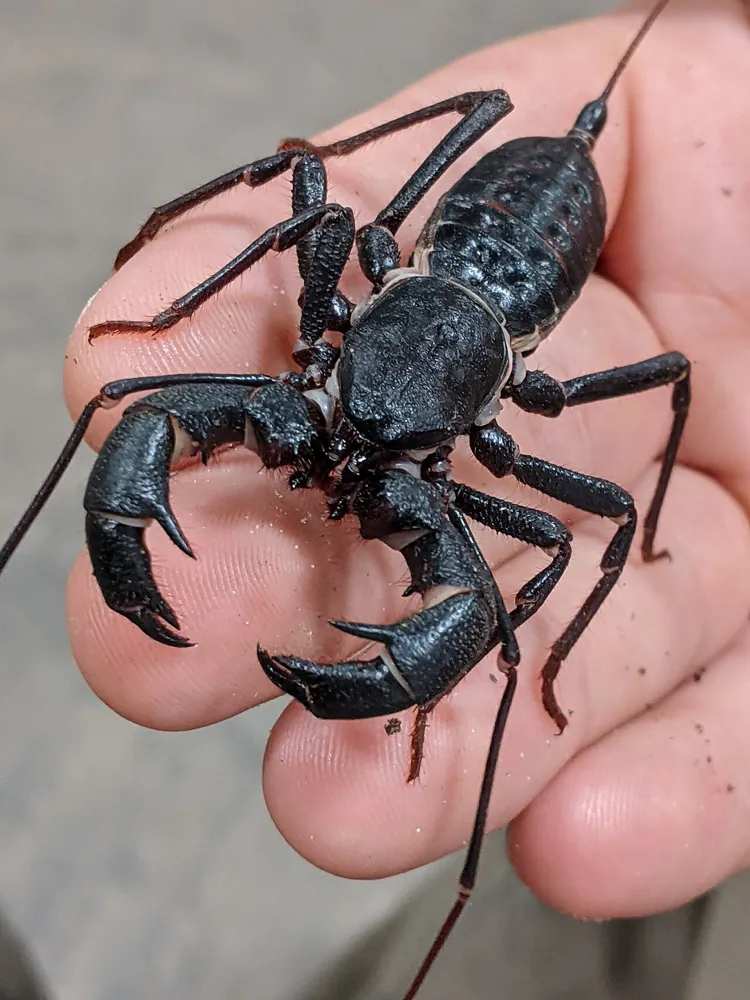
 So erkennst du es
- Body length is 40 to 60 millimetres, not counting the tail.1
- Has a long, thin, whip-like tail at the back.1
- Has two long front legs that it uses to feel around and sense vibrations.1
- Has two large pedipalps (front limbs) modified into claws for crushing prey.1
- When sprayed, it smells strongly of vinegar.1
Giftkraft
Es sprüht oder spuckt Angreifern eine brennende Flüssigkeit entgegen.
Was macht sein Gift, wenn es beißt oder sticht?
It is not venomous. From the base of its tail it sprays a liquid made of 85% acetic acid, the main component of vinegar. If the spray gets into mucous membranes or cuts, it can sting, and it can irritate the eyes.1
Wie gefährlich ist es für Menschen?
Gefahr für Menschen: LeichtWie ein Bienenstich oder weniger. Für Menschen praktisch harmlos.It seldom bites or pinches people. Its main risk is the acid spray, which can sting and cause eye irritation.1
Was macht es, wenn es Angst hat?
When threatened, it sprays acetic acid from the base of its tail.1
 Wenn es dich ansprüht
- Bei Brennhaaren von Raupen: Heb die Haare mit Klebeband ab und wasch dann die Haut. Nicht reiben.
- Bei Bissen: waschen und kühlen. Hol ärztliche Hilfe, wenn es der Person schlecht geht oder sie leicht blutet.
Ruf immer zuerst deine Notrufnummer an (112, 000, 911). Das sind allgemeine Erste-Hilfe-Hinweise, keine ärztliche Beratung. Erste-Hilfe-Grundlagen
 Bleib sicher
- Fass ein wildes Tier niemals an, fang es nicht und ärgere es nicht, auch kein kleines, und auch nicht, wenn es schlafend aussieht oder tot.
- Halte Abstand. Wenn du einem begegnest, bleib ruhig, geh langsam zurück und lass es seiner Wege gehen.
- Wenn dich eines ansprüht: Bleib ruhig, halt still, ruf deine Notrufnummer an (112, 000, 911) oder fahr schnell in ein Krankenhaus. Merk dir, wie es aussah, ein Foto hilft.
Es hat es nicht auf dich abgesehen. Es benutzt sein Gift, um Futter zu fangen oder sich zu schützen, und versteckt sich viel lieber. Mehr über Sicherheit
Wo auf der Welt?
Wie groß ist es?
Wie lang ist es?
 so lang wie 2 Bausteine in einer Reihe
Wie groß ist Giant vinegaroon im Vergleich zu DIR?
Nur Rechnen in deinem Browser. Nichts wird gespeichert oder irgendwohin geschickt.
Wie schnell ist es?


Fakten
Its common name 'vinegaroon' comes from the vinegar smell of the acid it sprays.1
It is an efficient predator of scorpions, and it is sometimes bought for that purpose.1
Males fight each other at night in fierce battles for the chance to mate with a female.1
It has eight eyes, but they are very weak, so it finds its way mostly by feeling with its front legs, tail and pedipalps.1
Raccoons, coatis, armadillos, skunks, bears, roadrunners, lizards and tarantulas may all eat it.1
It is sold in the exotic animal trade as a pet.1
Mythen-Check
Mythos: Giant vinegaroons are dangerous and venomous to people.
Wahrheit: They are non-venomous and seldom bite or pinch people. The main risk is the acid spray, which can irritate the eyes or sting if it reaches cuts or mucous membranes.1
Für Giftexperten
- Wissenschaftlicher Name
- Mastigoproctus giganteus
- Gruppe
- Raupen & Käfer
- Familie
- Thelyphonidae2
- Ordnung
- Uropygi
- Kontinente
- Nordamerika
- Babys
- The female produces about 40 offspring, which she protects and feeds during their early lives. She reproduces only once.1
- Lebensdauer
- etwa 7 Jahre1
- Gefahr für Menschen
- 1 / 5: Leicht3
Woher die Fakten kommen
- Mastigoproctus giganteus (Wikipedia (CC BY-SA 4.0))
- Mastigoproctus giganteus (iNaturalist): Namen und Klassifikation.
- Venom Wiki: die Gefahrenstufe, die typische Größe und die geschätzte Geschwindigkeit sind von uns. So berechnen wir sie: So bewerten wir die Gefahr.
Jeder Fakt auf dieser Seite hat eine Nummer, die auf seine Quelle zeigt. Wenn wir etwas falsch haben: Entschuldigung, wir sind Tierfans, keine Fachzeitschrift. Schreib uns an [email protected] und wir korrigieren es.
 Der Skorpion hat Hunger! Venom Wiki ist ein Ein-Mann-Projekt: kostenlos, ohne Werbung und ohne Tracker. Ein kleines Trinkgeld hilft, es online zu halten.Füttere den Skorpion
Mehr aus derselben Gruppe: Raupen & Käfer
 Giant water bugRaupen & KäferTut nur weh
 Puss caterpillarRaupen & KäferTut nur wehNicht anfassen
 Saddleback caterpillarRaupen & KäferTut nur wehNicht anfassen
 Wheel bugRaupen & KäferTut nur weh
 Rhodnius kissing bugRaupen & KäferBraucht einen Arzt
 Black-waved flannel mothRaupen & KäferTut nur wehNicht anfassen
 Terciopelo-Lanzenotter
 Eastern coral snake
 Eastern diamondback rattlesnake
 Eyelash viper
 Timber rattlesnake
 Western diamondback rattlesnake
_face.jpg)