
 Afrika
 Asien
Asien Europa
 Südamerika
 Australien & Ozeanien
 Antarktis
 Pazifischer Ozean
 Atlantischer Ozean
 Indischer Ozean
 Nordpolarmeer
 Mittelmeer
 Rotes Meer
 Karibisches Meer
 Korallenmeer
 Südchinesisches Meer
 Philippinensee
 Andamanensee
 Nordsee
 Timorsee & Arafurasee
 Golf von Bengalen
 Golf von Kalifornien
Mexican redknee tarantula
 Bisse
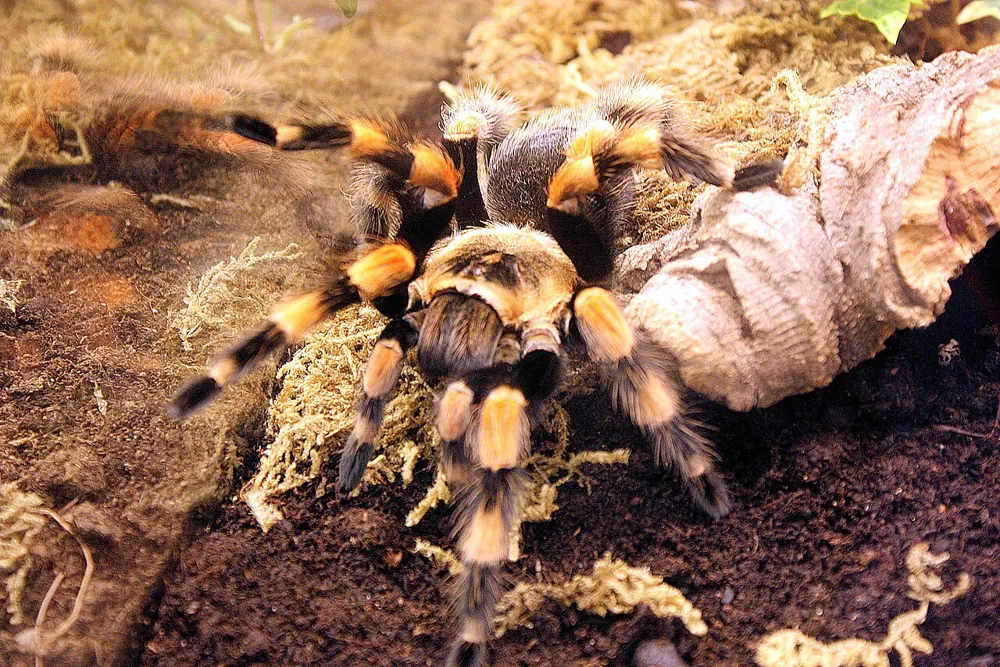
BisseThe Mexican redknee tarantula is a large, hairy spider from the Pacific coast of Mexico. It lives in burrows under rocks and tree roots, and it is a popular pet among tarantula keepers. Its name has caused confusion, because for many years it was mixed up with a very similar species.1



 So erkennst du es
- Males and females are large, with bodies about 4 to 6 cm long, not counting the fangs and spinnerets.1
- Legs and palps (the short leg-like parts near the mouth) are bluish black with reddish orange and pale pink rings.1
- Adult males have a yellowish brown carapace (the hard top of the front body) and a black upper abdomen.1
- Adult females vary more. The carapace may be mostly bluish black with a light brown border, or have a dark starburst pattern.1
Oft verwechselt mit: It is often confused with Brachypelma hamorii, which has very similar colours. The two can be told apart by two brownish pink bands on the chelicerae (the fang-bearing parts), which are present in B. hamorii but absent in B. smithi. Mature males can also be told apart by the shape of the palpal bulb, which is straighter and spoon-shaped in B. smithi.1
Giftkraft
Das Gift kommt beim Beißen durch die Giftzähne oder Zähne heraus.
Wie gefährlich ist es für Menschen?
Gefahr für Menschen: LeichtWie ein Bienenstich oder weniger. Für Menschen praktisch harmlos. Wenn es beißt
- Wasch den Biss und kühl ihn. Hol ärztliche Hilfe, wenn die Schmerzen stark sind oder es der Person schlecht geht.
Ruf immer zuerst deine Notrufnummer an (112, 000, 911). Das sind allgemeine Erste-Hilfe-Hinweise, keine ärztliche Beratung. Erste-Hilfe-Grundlagen
 Bleib sicher
- Fass ein wildes Tier niemals an, fang es nicht und ärgere es nicht, auch kein kleines, und auch nicht, wenn es schlafend aussieht oder tot.
- Halte Abstand. Wenn du einem begegnest, bleib ruhig, geh langsam zurück und lass es seiner Wege gehen.
- Wenn dich eines beißt: Bleib ruhig, halt still, ruf deine Notrufnummer an (112, 000, 911) oder fahr schnell in ein Krankenhaus. Merk dir, wie es aussah, ein Foto hilft.
Es hat es nicht auf dich abgesehen. Es benutzt sein Gift, um Futter zu fangen oder sich zu schützen, und versteckt sich viel lieber. Mehr über Sicherheit
Wo auf der Welt?
Wie groß ist es?
Wie lang ist es?
 kürzer als dein kleiner Finger
 könnte 100 Meter in 200 Sekunden schaffen (der schnellste Mensch braucht 9,6)
Wie groß ist Mexican redknee tarantula im Vergleich zu DIR?
Nur Rechnen in deinem Browser. Nichts wird gespeichert oder irgendwohin geschickt.
Wie schnell ist es?


Fakten
Large numbers of wild-caught Mexican redknee tarantulas are still smuggled out of Mexico. At least 3,000 Mexican tarantulas were sent to the United States or Europe a few years before 2017, most of them this species.1
Its burrow has a single entrance, a tunnel about three times the spider's leg span long, and one or two chambers, one for moulting and one for resting and eating.1
Males have shorter bodies than females but longer legs.1
Mythen-Check
Mythos: The name Mexican redknee tarantula always refers to one single species.
Wahrheit: The name has been used for two very similar species, B. smithi and B. hamorii. Many older sources mixed them up, so earlier records may be about either species.1
Woher die Fakten kommen
- Brachypelma smithi (Wikipedia (CC BY-SA 4.0))
- Brachypelma smithi (iNaturalist): Namen und Klassifikation.
- Venom Wiki: die Gefahrenstufe, die typische Größe und die geschätzte Geschwindigkeit sind von uns. So berechnen wir sie: So bewerten wir die Gefahr.
Jeder Fakt auf dieser Seite hat eine Nummer, die auf seine Quelle zeigt. Wenn wir etwas falsch haben: Entschuldigung, wir sind Tierfans, keine Fachzeitschrift. Schreib uns an [email protected] und wir korrigieren es.
 Der Skorpion hat Hunger! Venom Wiki ist ein Ein-Mann-Projekt: kostenlos, ohne Werbung und ohne Tracker. Ein kleines Trinkgeld hilft, es online zu halten.Füttere den Skorpion
Mehr aus derselben Gruppe: Vogelspinnen & Trichternetzspinnen
 Arizona blond tarantulaVogelspinnen & TrichternetzspinnenHarmlos
 Ravine trapdoor spiderVogelspinnen & TrichternetzspinnenHarmlos
 Trinidad chevron tarantulaVogelspinnen & TrichternetzspinnenTut nur weh
 Antilles pinktoe tarantulaVogelspinnen & TrichternetzspinnenHarmlos
 California trapdoor spiderVogelspinnen & TrichternetzspinnenHarmlos
 Costa Rican zebra tarantulaVogelspinnen & TrichternetzspinnenHarmlos
 Terciopelo-Lanzenotter
 Eastern coral snake
 Eastern diamondback rattlesnake
 Eyelash viper
 Timber rattlesnake
 Western diamondback rattlesnake