
 Afrika
 Asien
Asien Europa
 Südamerika
 Australien & Ozeanien
 Antarktis
 Pazifischer Ozean
 Atlantischer Ozean
 Indischer Ozean
 Nordpolarmeer
 Mittelmeer
 Rotes Meer
 Karibisches Meer
 Korallenmeer
 Südchinesisches Meer
 Philippinensee
 Andamanensee
 Nordsee
 Timorsee & Arafurasee
 Golf von Bengalen
 Golf von Kalifornien
Painted coral snake
 Bisse
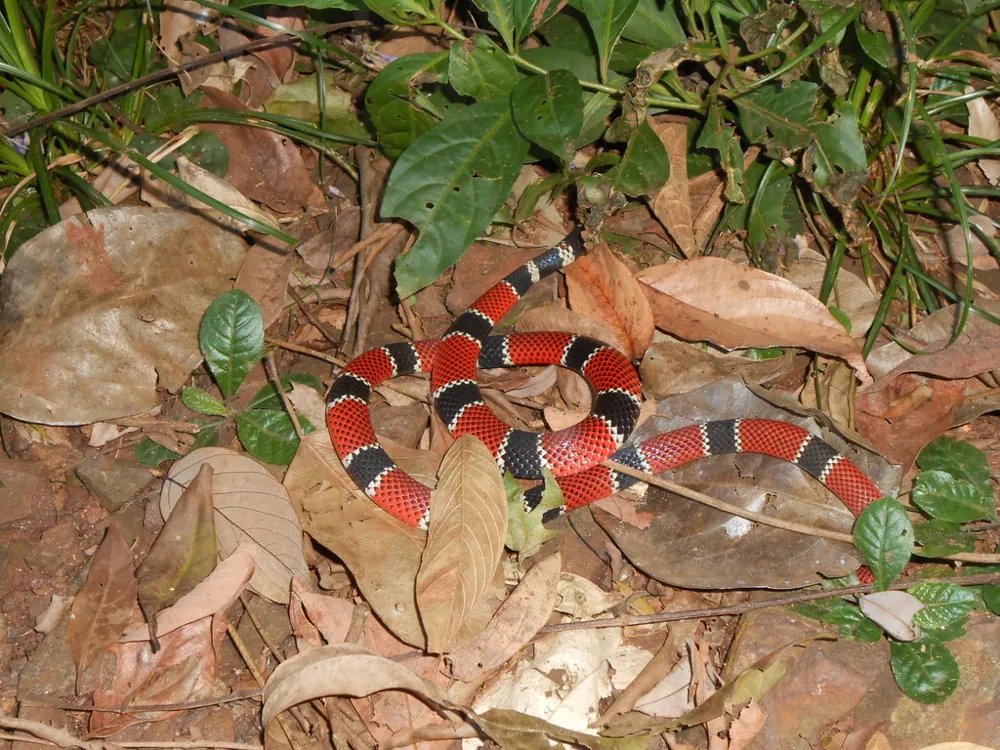
BisseThe painted coral snake is a highly venomous snake with bold bands of red, black and white or yellow. It lives in eastern South America, in Argentina, Brazil and Paraguay. It is active at night and is not aggressive towards people.1


 So erkennst du es
- The head is black with a white or yellow band across the back of the top of the head.1
- Wide red rings alternate with narrower black rings that have white borders along the body.1
- The tail has 3 to 8 black and yellow rings.1
- It has a slim body and a small, round head that is little distinct from the neck.1
Giftkraft
Das Gift kommt beim Beißen durch die Giftzähne oder Zähne heraus.
Was macht sein Gift, wenn es beißt oder sticht?
Its venom is neurotoxic, meaning it attacks the nerves. It causes neuromuscular block, which stops nerves from signalling muscles properly. Paralysis of the breathing muscles can lead to death from respiratory arrest.1
Wie gefährlich ist es für Menschen?
Gefahr für Menschen: Sehr gefährlichEs kann einen Menschen töten, der keine Behandlung bekommt.Coral snakes cause about 1% of accidents in Central and South America. The venom is highly potent. In laboratory milking, the average yield was 10 to 12 mg, about twice the estimated lethal dose of 6 to 8 mg for an adult human.1
 Wenn es beißt
- Halte die Person still und ruhig und bring sie schnell in ein Krankenhaus, auch wenn der Biss klein aussieht: Die Beschwerden können erst Stunden später beginnen.
Ruf immer zuerst deine Notrufnummer an (112, 000, 911). Das sind allgemeine Erste-Hilfe-Hinweise, keine ärztliche Beratung. Erste-Hilfe-Grundlagen
 Bleib sicher
- Fass ein wildes Tier niemals an, fang es nicht und ärgere es nicht, auch kein kleines, und auch nicht, wenn es schlafend aussieht oder tot.
- Halte Abstand. Wenn du einem begegnest, bleib ruhig, geh langsam zurück und lass es seiner Wege gehen.
- Wenn dich eines beißt: Bleib ruhig, halt still, ruf deine Notrufnummer an (112, 000, 911) oder fahr schnell in ein Krankenhaus. Merk dir, wie es aussah, ein Foto hilft.
Es hat es nicht auf dich abgesehen. Es benutzt sein Gift, um Futter zu fangen oder sich zu schützen, und versteckt sich viel lieber. Mehr über Sicherheit
Wo auf der Welt?
Wie groß ist es?
Wie lang ist es?
 so lang wie 2 Hauskatzen von Nase bis Schwanz
 so lang wie 5 Bananen hintereinander
 könnte 100 Meter in 73 Sekunden schaffen (der schnellste Mensch braucht 9,6)
Wie groß ist Painted coral snake im Vergleich zu DIR?
Nur Rechnen in deinem Browser. Nichts wird gespeichert oder irgendwohin geschickt.
Wie schnell ist es?


Fakten
The largest venom yield recorded in the laboratory was 65 mg, enough to kill 5 to 6 people.1
Some of its toxins act before the nerve signal reaches the muscle. They make nerves release too much acetylcholine, a chemical messenger, and then block the signal to the muscle.1
Its venom contains many toxin families, including phospholipase A2 and three-finger toxins.1
Adult females can lay up to 15 eggs.1
Mythen-Check
Mythos: Coral snakes are aggressive and attack people.
Wahrheit: This snake is not aggressive towards humans.1
Woher die Fakten kommen
- Micrurus corallinus (Wikipedia (CC BY-SA 4.0))
- Micrurus corallinus (iNaturalist): Namen und Klassifikation.
- Venom Wiki: die Gefahrenstufe, die typische Größe und die geschätzte Geschwindigkeit sind von uns. So berechnen wir sie: So bewerten wir die Gefahr.
Jeder Fakt auf dieser Seite hat eine Nummer, die auf seine Quelle zeigt. Wenn wir etwas falsch haben: Entschuldigung, wir sind Tierfans, keine Fachzeitschrift. Schreib uns an [email protected] und wir korrigieren es.
 Der Skorpion hat Hunger! Venom Wiki ist ein Ein-Mann-Projekt: kostenlos, ohne Werbung und ohne Tracker. Ein kleines Trinkgeld hilft, es online zu halten.Füttere den Skorpion
 Central American coral snake
 Amazonian coral snake
 Aquatic coral snake
 Argentinian coral snake
 Caatinga coral snake
 Dumeril's coral snake
 Schrecklicher Pfeilgiftfrosch
 Terciopelo-Lanzenotter
 Brazilian wandering spider
 Eyelash viper
 Golden lancehead
 South American bushmaster