
 Afrika
 Asien
Asien Europa
 Südamerika
 Australien & Ozeanien
 Antarktis
 Pazifischer Ozean
 Atlantischer Ozean
 Indischer Ozean
 Nordpolarmeer
 Mittelmeer
 Rotes Meer
 Karibisches Meer
 Korallenmeer
 Südchinesisches Meer
 Philippinensee
 Andamanensee
 Nordsee
 Timorsee & Arafurasee
 Golf von Bengalen
 Golf von Kalifornien
South American bushmaster
 Bisse
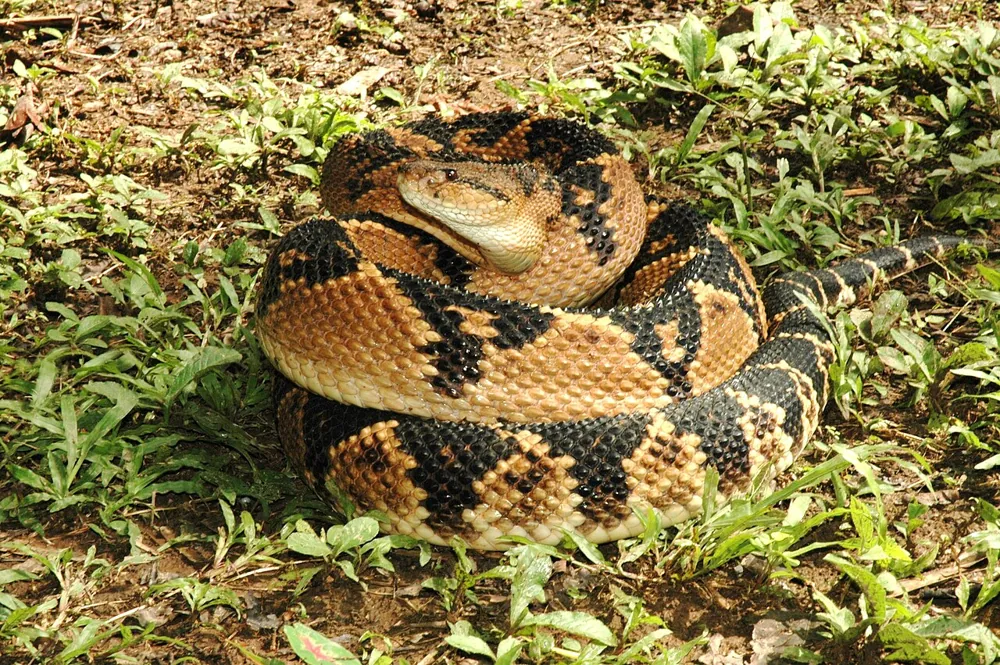
BisseThe South American bushmaster is one of the longest vipers in the world, and it is the longest venomous snake in the Western Hemisphere. It lives in the equatorial forests east of the Andes and on the island of Trinidad. Its bite is dangerous, so it is important to know what it looks like.1



 So erkennst du es
- Its ground colour is yellowish, reddish or grey-brown.1
- Dark brown or black blotches run along the body, forming inverted triangles on the sides.1
- Adults are usually 2 to 2.5 m long, and 3 m is not unusual.1
- The head is broad and clearly separate from the narrow neck.1
- The tail is short and ends in a spine. When alarmed it vibrates the tail, which makes a loud rustling in undergrowth.1
Oft verwechselt mit: It is similar in appearance to rattlesnakes. It has no rattle, so its tail vibration sounds like rustling leaves rather than a rattle.1
Giftkraft
Das Gift kommt beim Beißen durch die Giftzähne oder Zähne heraus.
Was macht sein Gift, wenn es beißt oder sticht?
Its venom breaks down tissue, stops blood from clotting, and can cause bleeding. It also has effects on the nerves. At the bite there is pain, swelling, bruising, blisters and skin death. Whole-body effects include low blood pressure, dizziness, vision problems, a slow heartbeat, vomiting, diarrhoea and kidney failure.1
Wie gefährlich ist es für Menschen?
Gefahr für Menschen: Sehr gefährlichEs kann einen Menschen töten, der keine Behandlung bekommt.Its bites are often fatal. Lab tests show its venom is weak, but the mortality rate of bite victims is high. In reported cases, a 7-year-old boy in Brazil died about 15 minutes after being bitten, and a 5-year-old child in Mato Grosso went into shock about 30 minutes after a bite and died within 90 minutes.1
Was macht es, wenn es Angst hat?
When threatened it vibrates its tail, which makes a loud rustling sound in the undergrowth.1
 Wenn es beißt
- Halte die Person still und ruhig, halte den gebissenen Arm oder das Bein auf Herzhöhe, nimm Ringe und alles Enge ab und bring sie schnell in ein Krankenhaus.
Ruf immer zuerst deine Notrufnummer an (112, 000, 911). Das sind allgemeine Erste-Hilfe-Hinweise, keine ärztliche Beratung. Erste-Hilfe-Grundlagen
 Bleib sicher
- Fass ein wildes Tier niemals an, fang es nicht und ärgere es nicht, auch kein kleines, und auch nicht, wenn es schlafend aussieht oder tot.
- Halte Abstand. Wenn du einem begegnest, bleib ruhig, geh langsam zurück und lass es seiner Wege gehen.
- Wenn dich eines beißt: Bleib ruhig, halt still, ruf deine Notrufnummer an (112, 000, 911) oder fahr schnell in ein Krankenhaus. Merk dir, wie es aussah, ein Foto hilft.
Es hat es nicht auf dich abgesehen. Es benutzt sein Gift, um Futter zu fangen oder sich zu schützen, und versteckt sich viel lieber. Mehr über Sicherheit
Wo auf der Welt?
Wie groß ist es?
Wie lang ist es?
Wie schwer ist es?
 so lang wie 4 Hunde von Nase bis Schwanz
 so lang wie 20 Bananen hintereinander
 etwa so schwer wie eine Hauskatze
 könnte 100 Meter in 71 Sekunden schaffen (der schnellste Mensch braucht 9,6)
Wie groß ist South American bushmaster im Vergleich zu DIR?
Nur Rechnen in deinem Browser. Nichts wird gespeichert oder irgendwohin geschickt.
Wie schnell ist es?


Fakten
It is the longest viper in the world.1
It is the third longest venomous snake in the world, after the king cobra and the black mamba.1
Stress also lowers its venom yield. One specimen's yield fell from 233 mg to 64 mg while it was kept in captivity.1
Its name Lachesis comes from one of the three Fates of Greek mythology, who was said to decide how long a person would live.1
It rarely lives long in captivity, because stress makes it unwell.1
Mythen-Check
Mythos: Its venom is weak, so its bite is not very serious.
Wahrheit: Lab tests show low toxicity, but bite victims die at a high rate, so the bite is very dangerous.1
Woher die Fakten kommen
- Lachesis muta (Wikipedia (CC BY-SA 4.0))
- Lachesis muta (iNaturalist): Namen und Klassifikation.
- Venom Wiki: die Gefahrenstufe, die typische Größe und die geschätzte Geschwindigkeit sind von uns. So berechnen wir sie: So bewerten wir die Gefahr.
Jeder Fakt auf dieser Seite hat eine Nummer, die auf seine Quelle zeigt. Wenn wir etwas falsch haben: Entschuldigung, wir sind Tierfans, keine Fachzeitschrift. Schreib uns an [email protected] und wir korrigieren es.
 Der Skorpion hat Hunger! Venom Wiki ist ein Ein-Mann-Projekt: kostenlos, ohne Werbung und ohne Tracker. Ein kleines Trinkgeld hilft, es online zu halten.Füttere den Skorpion
Mehr aus derselben Gruppe: Grubenottern
 Terciopelo-Lanzenotter
 Eyelash viper
 Golden lancehead
 Common lancehead
 Jararaca
 Jararacussu
Lebt auch in: Südamerika
 Schrecklicher PfeilgiftfroschPfeilgiftfrösche, Kröten & MolcheTödlichNicht anfassen
 Brazilian wandering spiderSpinnenKann töten
 Cane toadPfeilgiftfrösche, Kröten & MolcheBraucht einen ArztNicht anfassen
 Peruvian giant centipedeHundertfüßerBraucht einen Arzt
 Bullet antAmeisenTut nur weh
 Common vampire batGiftige SäugetiereTut nur weh